A very unusual genetic color variation in white-tailed deer — rarer even than albinism — produces all-black offspring in that species which are known as “melanistic” or “melanic” deer.
[T]here’s not exactly a universal cat language when it comes to meows. Rather, as Bradshaw writes in his book, “a secret code of meows … develops between each cat and its owner, unique to that cat alone and meaning little to outsiders.” This was demonstrated in a 2003 study by Cornell researchers, documented in Bradshaw’s book, in which they recorded meows from 12 cats in five everyday scenarios. They then played those recordings to pet owners, and found that only the owners could correctly decipher the scenario in which the meow was recorded. So cat owners can tell with some accuracy what message their cat is trying to get across via its meows, whether it’s feed me or I’m bored or whatever else, but “each meow is an arbitrary, learned, attention-seeking sound rather than some universal cat-human ‘language,’” Bradshaw writes.
YOUR CAT LITERALLY INVENTED A LANGUAGE FROM SCRATCH TO TALK TO YOU
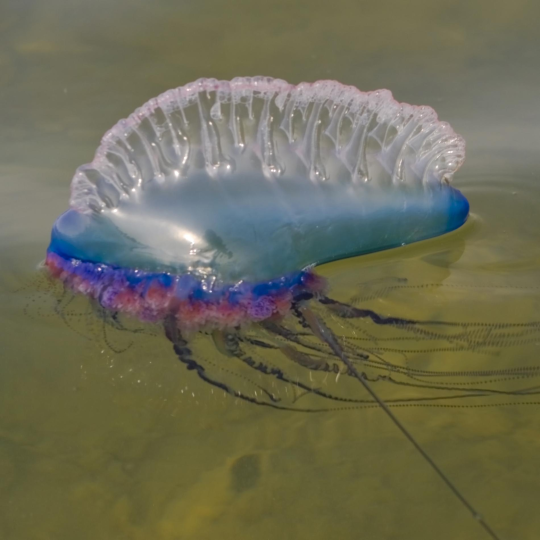
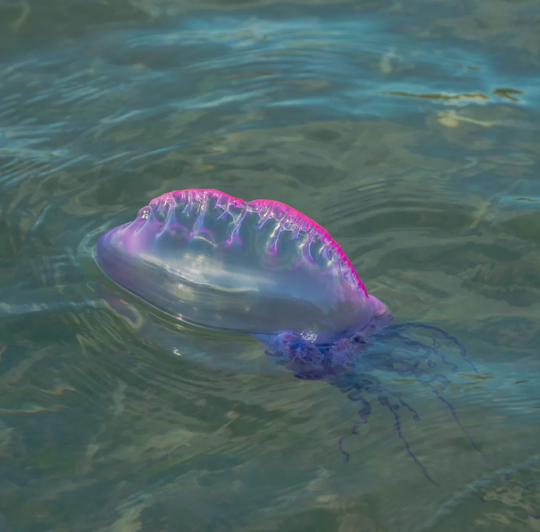
guess what, it’s time for another episode of Weird Biology! today we’re going to learn about a creature that looks like a stained-glass window, but stalks the oceans with toxic might powered only by the wind like a sailing ship of old.
that’s right, it’s the devil’s own shopping bag-
the name is almost longer than the animal.
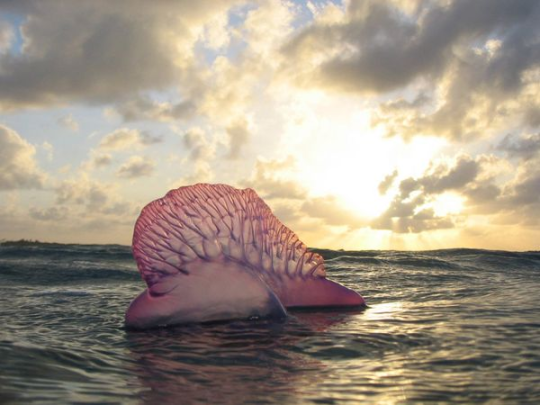
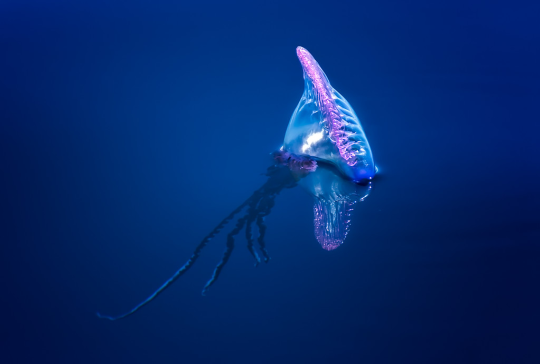
The Portuguese Man o’ War is a floating jellyfish relative called a Hydrozoan. it was named after the 18th century sailing ship, apparently by a blind person. “oh, it looks like a sailing ship under full sail” no it doesn’t, shut up. it looks like a rogue walmart shopping bag that blew into the Atlantic and makes a living by strangling innocent sea turtles.
but like the aforementioned plastic bag, the Man o’ War uses its lovely blue-purple air sac to catch the breeze. it wanders in groups through the warm waters of the Atlantic, driven along by the wind and tides. kind of poetic, really.
as long as you don’t look underwater, anyway.
I’m about to ruin it for everybody, hang on.
like so many other things in life, it’s not what you see on the surface that’s important but what is underneath that counts.
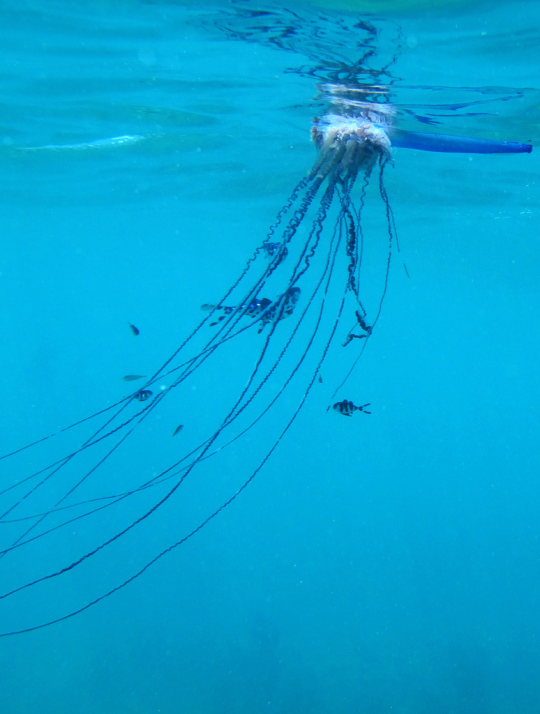
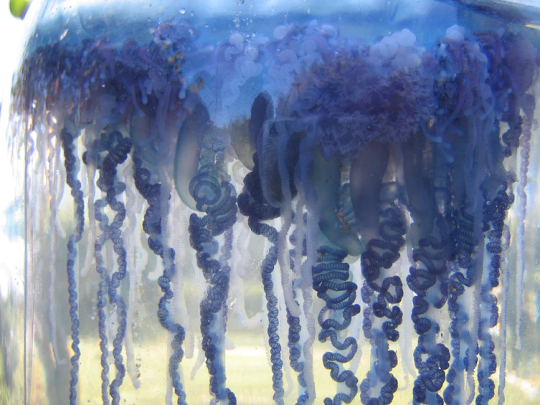
in this case, what’s underneath is up to 165 feet of venomous tentacles. it’s like that thing they say about icebergs, where you only see the top 10% and the rest is an invisible ship-killing nightmare? it’s exactly like that.
except with poison tentacles.
the Man o’ War is basically a biological fishing trawler, trailing these stupidly long tentacles like a fine mesh net through the water. and when an innocent fish who probably has a family at home comes into contact with this “net”, specialized cells called Nematocysts are triggered to fire tiny poison harpoons into the victim, causing instant death or paralysis.
the tentacle then reels itself upward into the body of the Man o’ War like a fishing line, dragging its helpless victim upward to be digested.
so, uh, actually not like a fishing trawler then, not like a fishing trawler at all.
unless the fishing trawler was designed by Junji Ito.
though the Man o’ War may look like a jellyfish, it’s definitely not. in fact, it’s not even a single animal! it’s actually four separate organisms jammed into a venomous trenchcoat like three best friends trying to sneak into an R rated movie.
“how the fuck even”, I hear you say. and that’s a valid question! it’s not everyday that we discover that what we thought was a single animal is actually four smaller animals living communally to form a larger, more dangerous animal. it would be like discovering that opossums are actually comprised of 17 rats each.
no word on if they do a silly dance and tap their fingers together to fuse or what though.
in the Man o’ War’s case, these four individual kinds of “polyps” that comprise the complete final form are the air sac polyp (gets the gang around), the digestive polyp (converts murdered fish into energy for the whole gang), the reproductive polyp (makes small clones of each individual gang member), and the tentacle polyp (murders things indiscriminately for the sheer joy of it).
that’s right, the tentacles are a separate animal! you might be wondering if they sometimes come loose, wander off, and just sting people/animals randomly when they drift into populated areas. what a silly question!
yeah, happens all the time.
SHIT.
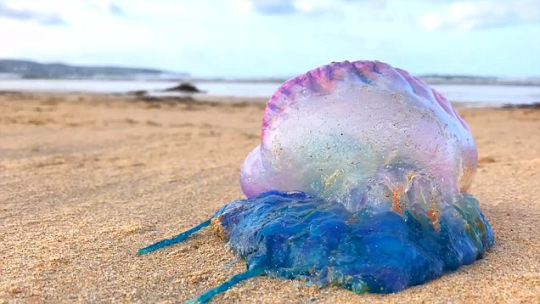
while rarely fatal, Man o’ Wars stings can seriously injure humans. this is a big problem in areas where Man o’ Wars are common, because storms and predators can knock the tentacles right the fuck off. the tentacles drift away, only to wash ashore and sting a hapless beachgoer weeks later. that’s right, rogue tentacles can still sting for days or weeks after separation! even if the Man ‘o War is beached! isn’t that neat! fuck!
the discovery of a beached Man o’ War usually closes the entire fucking beach, for this reason. would YOU want to go fuck around in the sand if it might be full of over a hundred feet of poison spaghetti too fine to notice with the naked eye?
if the answer is yes, I have great news about a bridge I’d like to sell you.
if all this information upset you, I’d like to offer my deepest condolences. but buckle up for one last upsetting fact, and here it is: Man o’ War are spreading.
usually restricted to warm waters, climate change has driven the Man o’ War as far north as Great Britain. that’s awful awful awful news for any country that touches the Atlantic ocean, which is lots of them.
luckily, we have dependable allies in this fight: sea turtles and the Mola Mola! (which I’ve written about before) unfortunately just about all we can do at this point is to cheer these awesome devil-balloon-munchers on from the safety of shore, while trying to invent a Man o’ War-proof barrier net.
for now, watch out for anything that looks like a floating plastic bag.
and for god’s sake, watch where you step.
–
thanks for reading! you can find the rest of the Weird Biology series here.
if you enjoy my work, maybe buy me a coffee or check out my Patreon to see extra content and support Weird Biology.
–
IMAGE SOURCES
img1- National Geographic img2- The Garden of Eadon img3- Sean Nash img4- Enrico Villa img5- livescience.com img6-
Can animals actually dance to music? Is that a thing because every time my friend puts on music her bird goes nuts and starts swaying and chirping along
If there is no music my bird will start clicking to encourage me to make a beat for them to dance to
Mine does that too! She’ll make a knocking/hammering noise and start headbanging because she wants me to put on music or clap for her.
Oh I have some science for y’all, lemme get to my PC!
Okay science time!
Short answer: Some animals appreciate music, some don’t. Some can dance, most do not. It’s dependent on certain types of intelligence.
Long answer…
Birds do like music, they understand rhythm, and they can truly dance! Birds are incredibly intelligent animals, not because of the size of their brains, but the density of neurons means they pack a lot of smarts into a very small braincase. Birds also have some specializations in their intelligence that other animals do not that can make them more likely to dance!
Birds are vocal animals! They learn vocalizations (and in some species even names, called signature contact calls, that they use to identify and find individuals) from their flock, and use sound to navigate their social environment. This means that birds, namely songbirds and parrots, have adapted to have large portions of their brains dedicated to processing sound. They spend a lot of time and energy hearing, paying attention to, processing, mimicking, and thinking about sounds that they hear because their survival depends on it! Now what does that have to do with dancing? A lot, but perhaps not as much as the next thing:
How animals communicate with each other and form social connections. Many birds live in flocks. Their ability to survive, thrive, and reproduce depends on their interactions with other birds. Now sound plays a huge role in socialization, but so does body language! Parrots especially have very complex social lives and subtle nuances to interacting with each other, and they have evolved very elaborate ways to communicate with each other using body language, both behaviorally and physically!
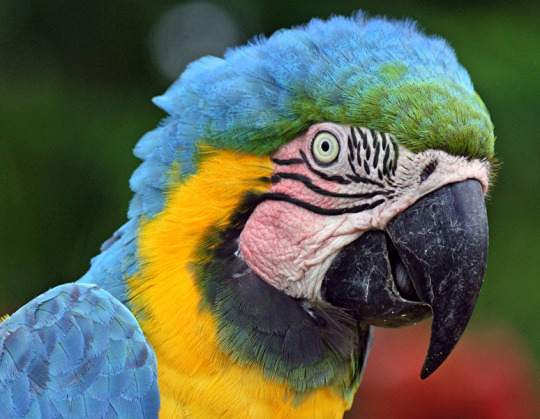
They have brightly colored eyes and control over their pupil size:
Macaws blush;
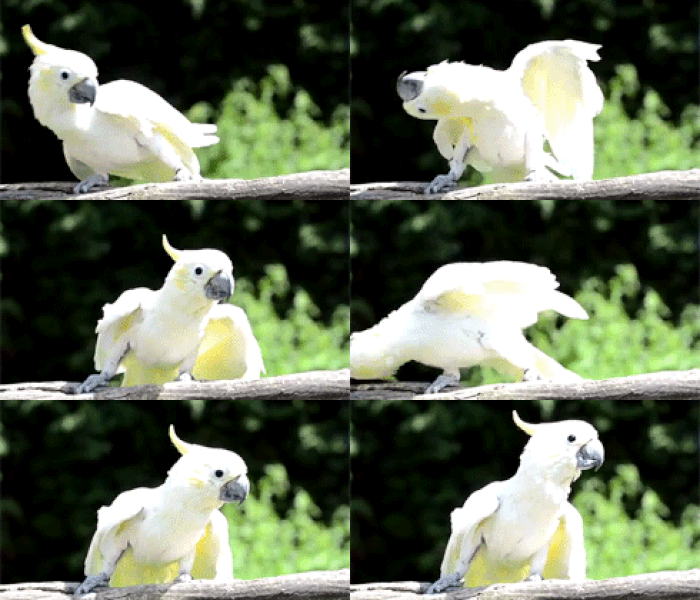
And cockatoos, arguably some of the best dancers in the parrot family, love to raise their crests, spread their wings, and bob and duck and do all sorts of dance-y things naturally to communicate!
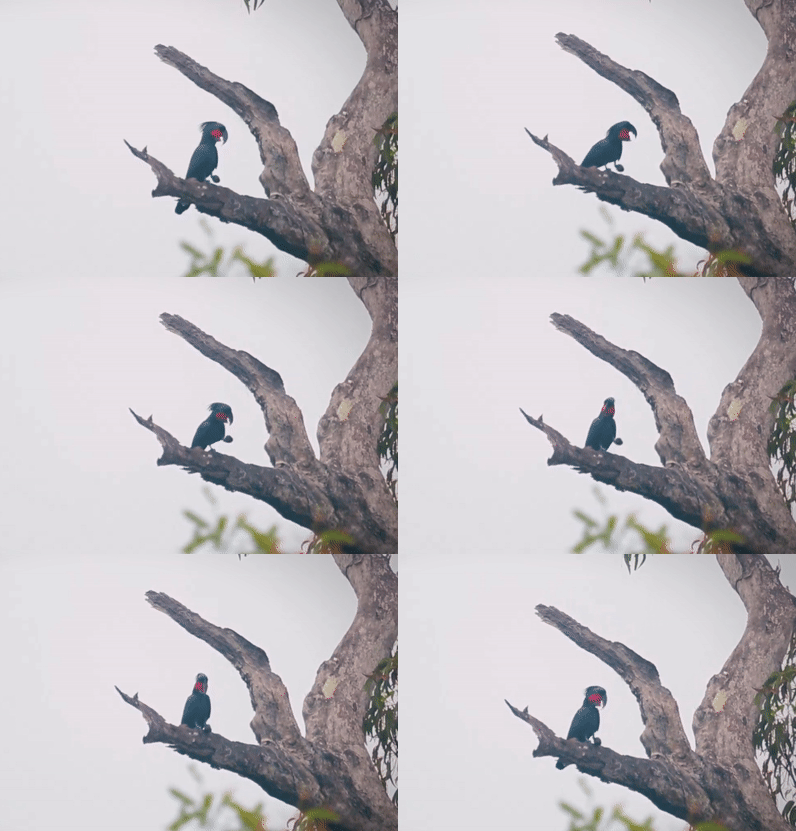
Perhaps most remarkably, black palm cockatoos actually create their own music, using rocks and sticks as drumsticks to bang rhythmically on trees! All with absolutely zero training or human intervention.
Birds don’t perfectly match up with the beat when dancing to music. Actually, their rhythm-keeping skills are about on par with human toddlers. But they do do their best to get into the beat. It just feels good to dance when you’ve got a brain complex enough to process music!
But what about other animals? Dogs dance, right? And horses?
… Not exactly. Almost every single example of other species of animals dancing are either trained behaviors, or coincidence. Except for one other animal. Can you guess what it is?
Well,
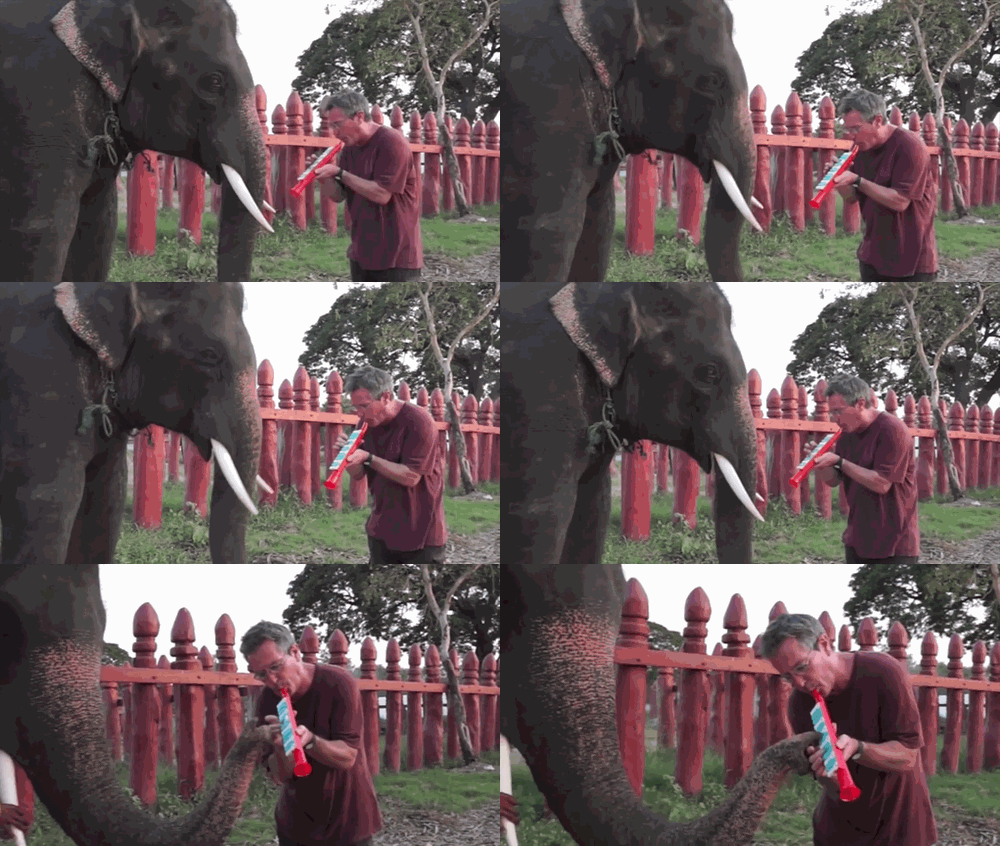
It’s elephants! And they fulfill all the characteristics of dancing animals. Complex brains? Check. Auditory intelligence? Check. Highly social? Check!
This isn’t all to say that other animals don’t enjoy music– many animals enjoy listening to certain kinds of music for all sorts of reasons. But so far, only birds, elephants, and humans are proven dancers.
My science may not be 100% spot on– I encourage you to do your own research and debunk anything I got wrong or add something I missed!
Here is a tiger just going about life until this human gives it the fright of its life. Still cute af. Dream job to be honest. 17/10 would be such an honor to pet
no no no no no look at those ears, tiger totally knows he’s there
tiger thinks the bipeds are terrible, terrible tigers and don’t know how to tiger worth a damn so when one actually pays tiger cub ambush game tiger is so happy
look at that happy tiger
look at it
YES YOU TERRIBLE TIGER YOU ARE FINALLY LEARNING HOORAY 😀









 wupacing