okay, most of what i do re: harry potter is criticism, and hp is flawed in such a number of ways, but sometimes i just sit here and
i mean, you all have a comprehension of just how drastically harry potter changed literature, yeah? like. it revitalized it. it blew the literary scene apart. the new york times had to create a separate bestseller’s list for children’s lit just because harry potter existed. harry potter changed reading.
so many people on tumblr were born in the ‘90s. when the first book came out, most of us couldn’t read. but we grew up in a world where everyone, everyone, everyone was reading harry potter, no matter how old they were; we grew up in a world where the most popular story in the entire world was a fantasy children’s book.
it’s sort of difficult to grasp, sometimes, the extent to which harry potter is not just a book. the extent to which what is basically a series of fun, interesting, and fairly good novels is such an enormous, enormous part of our lives, a cultural touchstone, a truly universal reference point, something so many people have shaped their lives around, a foundation for all of the stories we would read and watch for the rest of our lives– for so many of us, the first books we ever loved
the extent to which so many of us can’t call ourselves “fans” of harry potter, because it would like being a “fan” of, like, having lungs.
it’s not even about liking it or disliking it. it’s just a part of us.
This reminds me an awful lot about Starbucks.
No, seriously. Before Starbucks, America was a coffee wasteland. Coffee was a thing you got at diners and drivethroughs. It was a cheap hot thing you put made palatable with tons of cream and sugar, and most people (but waning!) had a coffee machine at home.
Starbucks told us that we could like coffee. That coffee could be an enjoyable thing, that it could be a status symbol and a ritual. That there could be a place where you go for coffee, and you enjoy it.
As a coffee snob, I think Starbucks’ coffee is awful. But Starbucks is why we have better coffee. Starbucks created the market space for third wave coffee shops and artisanal roasters. They reintroduced “espresso”, “latte” and “cappuccino” to the American lexicon.
We need stuff that’s heinously popular. That’s how culture works.
Every single Native culture is distinct and unique, though many share similarities, and lumping them together is ridiculous. And while some practices are pan-Indian, the vast majority are not.
Stop homogenizing our cultures. Every Native culture is beautiful and unique and deserves to be treated that way.
Don’t fall into the trope of “pan Indian”. Fucking teepees and totem poles never existed together. Totem poles are permanent structures, teepees are fucking tents for nomadic peoples. First Nations and indigenous cultures are all deep and uniquely complex, it would be like confusing England with Russia.
Don’t let people make fun of you for liking japanese culture.
I am living in japan right now and let me tell ya:
There are people here who can’t speak or understand English who play nothing but Missy elliot and ludacris, even in businesses like housing offices and restaurants.
There are people who have cowboy hats and dead cow skulls in their home because they idolize what they assume American homes are like.
There are people who learn English strictly through music videos and American television shows.
There are entire karaoke bars with english songs often sung by people who have no idea what the lyrics mean.
Japan often takes American shows like the powerpuff girls and make japanese versions of them.
They often mistake common Americans for celebrities. I have been mistaken for Micheal jordan, tiger woods, Shaquille o’neal, Tyler perry, and saddest of all: queen latifa.
The act of sprinkling English into your japanese sentences is considered cute and cool and is popular with teenagers. Bonus points if you happen to use it correctly.
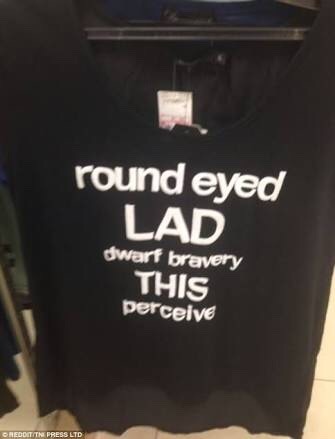
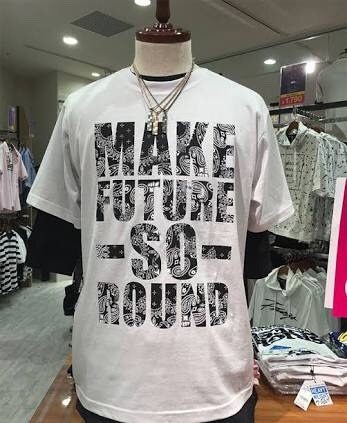
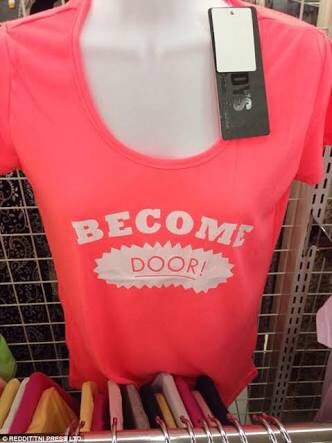
Japanese stores sell shirts with english on them and people buy them not knowing that most of those word combinations are nonsense.
Don’t let someone shame you for singing an anime opening, using japanese in your sentences, wearing clothing with japanese on it, ect. If anything, this is just one more thing that you have in common with them.
The American/Japanese cultural exchange is so pure and wonderful and I love it so much
OK BUT RESONATE WITH THE SHIRT THING THOUGH
My Chinese relatives buy me shirts from China with English letters on them hoping I think it’s cool
I have a shirt that says “Hi Quality Uality”
It’s amazing
It happens alot.
And then what’s really great is Americans getting tattoos of Chinese characters thinking they mean one thing when they really don’t
Also a topic where the reverse happens.
lemme tell you..i have been in a grocery store in Japan and heard the unedited Get Low playin over the intercom..it was literally a Katt Williams moment
Oh, unsensored songs are pretty common.
I should not be hearing an unsensored ‘Magic Stick’ playing at a family restaurant.
And the best thing is when literally no one shows that they understand what is being said.
I was in a Chinese cafe one time and they had obviously put on their “fuck you” playlist. I mean, uncensored versions of Fuck You by Lilly Allen, Fuck You by Cee-lo Green, etc. No one else had any idea.
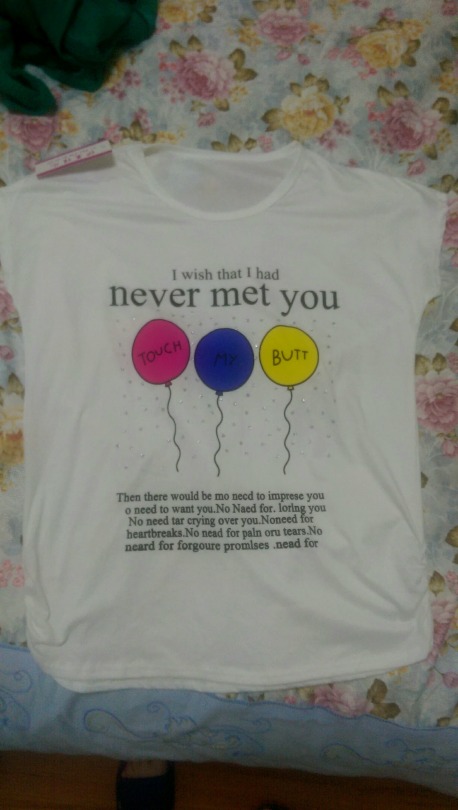
Oh, also, I got my favorite shirt ever in a little tchotchky store in Sichuan:
More
that last one got me holy shit.
i wish i had
never met you
TOUCH MY BUTT
then there would be mo need to imprese you
o need to want you.No naed for. loring you
No need tar crying over you.Noneed for
heartbreaks.No nead for paln oru tears.No
neard for forgoure promises .nead for
For every american teenager that is screaming the lyrics to their favorite anime opening, there’s likely at least 1 or 2 Japanese teens singing English profanities at a karaoke bar.
Oh, also: In Ashkenazi culture, it’s considered bad luck to name a child after a living relative, because there’s a fear that the Malakh Hamavet (Angel of Death) would get confused when coming for an older relative and take the child sharing their name instead. So, as a result, Ashkenazim are generally only named after deceased relatives.
HOWEVER, this leads to an amazing Yiddish phrase for telling somebody to fuck off, which is: “May a baby be named after you.”
The Himba wear little clothing, but the women are famous for covering themselves with otjize, a mixture of butter fat and ochre. The mixture gives their skins a reddish tinge. This symbolizes earth’s rich red color and the blood that symbolizes life, and is consistent with the Himba ideal of beauty.
It also protects their skin from the harsh sun.
It’s also to keep them clean because they live in parts where water is scarce and drinking > bathing. As the otjize flakes off, dirt and dead skin go with it.
The Himba also use it to style their hair, and different headwear is worn during different stages of a female’s life to symbolize her becoming a woman.
I will forever reblog this because I find it so damn beautiful.












 wupacing