i’m so tired of people justifying cultural appropriation by saying things like “Actual Chinese People ™ from mainland china don’t care that this non-chinese person is wearing a cheongsam!” and acting like this is evidence that cultural appropriation is just an issue made up by Oversensitive Special Snowflakes
like… ok… sure, of course mainland chinese people would care less about who wears cheongsam. but you’re kind of missing the whole point. most of the poc i’ve seen who are upset about cultural appropriation aren’t mainlanders. they’re fckn diaspora.
nobody in mainland china is going to judge you if you wear a cheongsam to a formal event. but let’s pretend you’re the asian chick in your mostly-white school in the US, and your mom pushes you to wear a cheongsam to prom. you’re probably going to get the “oh of course the asian girl wears her asian dress to prom” reaction from the people around you. so you fight your mom about the cheongsam, because you want to fit in with Everyone Else. you don’t want to be the Chinky Girl in the Chinky Dress.
your beautiful cheongsam sits in your closet, until one day, a stray clothes hanger snags on the lace overlay and shreds your dress and you throw it out.
and then a few years later, you see some white girl wearing the dress your mom wanted you to wear, but you were too ashamed to wear because you didn’t want to be a stereotype.
and that’s the frickin difference. mainlanders don’t experience the same things as people who are diaspora. they’re not gonna have the same perspective. there are no societal repercussions stopping them from expressing themselves culturally. their experiences ARE NOT THE SAME. stop using the opinions of people living in China to invalidate the experiences of Chinese Americans. thanks
Do you ever think about the fact that the US has created and legitimized a system of institutionalized inequality by funding schools through property taxes? That basically a child’s education is only as good as the value of the property in their neighborhood. Funny how education is so often viewed as an equalizing factor when there is nothing equal about it.
I really don’t care if I’ve already reblogged this
Because this needs to be reblogged….
I remember learning this for the first time as an adult. I had grown up thinking education was the great playing field leveler. So I was so furious to find out how very much it wasn’t anything of the kind.
This is a big part of why you’ll often see rich white people fussing about school district lines, because they hate the idea that their money is going towards the education of poor children.
since tumblr is us-centric, this is probably going to be one of the only posts about it, but here it is.
early this week, naomi musenga, a 22-year-old black woman, called the samu, our equivalent of 911, because she was suffering from extreme stomachache and had a fever. when the operator picked up, naomi was out of breath, as if she had difficulty breathing, and was basically begging for help, saying that she was going to die. you’d expect them to be worried about her and do anything in their power to help, right?
wrong.
the operator who took the call – and another colleague of hers – proceeded to make fun of her, not taking her seriously and saying that “everybody dies eventually”. the operator threathened to hang up on naomi because she wasn’t clear enough, because of the fact that she was in pain? because of her accent?the operator told her to call either sos doctor or her attending physician because “she couldn’t do it for her”. after she did call sos doctors – and taken seriously – she was rushed into the ER before dying of a heart attack, six hours after she called the samu.
naomi musenga was only 22. she has a daughter, who now has to grow up without a mother because of racist – yeah, this is about racism and bigotry and just plain hatred – women who didn’t want to do their jobs.
je sais c’est pas un post en français mais vous pouvez signer la pétition ici :
This is the police trying to make people panic about legalization.
IF YOU LEGALIZE THESE DRUGS WE’LL KILL THIS DOG is totally a normal and cool thing that professionals interested in protecting the people say
holy fuck lol
noah fence, but I’d happily kill all dogs in police service if it means curbing white supremacist oppression and subjugation of black communities
Honestly lmao. Although I can totally see white moderates and right-libertatians going back to supporting criminalization if it saves some fucking dogs lives.
Also there’s rescuse that specialize in rehabilitating police dogs so they can exist in society. There is absolutely 0 reason to euthenize these dogs aside from using it as emotional manipulation.
The response to this shouldn’t be “well then we won’t do this so you won’t kill innocent dogs,” it should be, “I can’t believe you abused these dogs so badly to carry out your agenda that they can’t be regular dogs any more and care so little for them that you would euthenize them just to make a political point.”
26-year-old Jamarion Robinson’s grandmother Beverly Nixon said her grandson was bipolar and schizophrenic. Still got shot 76 (!!!) times. Would a white person get the same treatment?
The witness said he saw more than a dozen patrol cars at the complex where US Marshals killed Robinson on August 5, 2016. Why were there no behavioral specialist? Surely one of them would know how to interact with a bipolar schizophrenic better than the police.
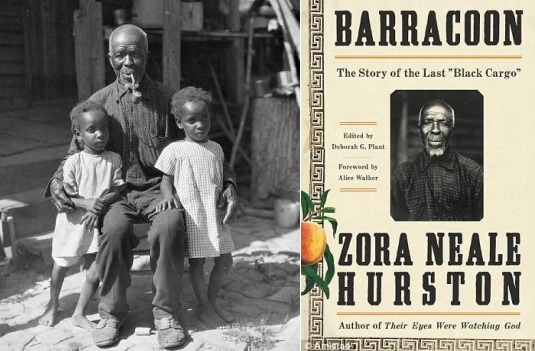
Cudjo Lewis, who was born as Kossola, was nearly 90 years old and living in Plateau, Alabama. He was thought to be the last African man alive who had been kidnapped from his village in West Africa in 1859 and forced into slavery in America aged 19.
Hurston, who was an anthropologist, documented her interviews with Lewis during the late 1920s and wrote a book in his own words about his life titled, ‘Barracoon: The Story of the Last ‘Black Cargo’.
But the manuscript she wrote was turned down by multiple publishers in 1931 who felt as though Lewis’s heavily accented dialect was too difficult to read.
For decades, Hurston’s manuscript of the book was tucked away inside Howard University’s archives until The Zora Neale Hurston Trust found a buyer for the book – more than 50 years after her death in 1960. On Tuesday, May 8, 2018. ‘Barracoon: The Story of the Last ‘Black Cargo’,’ was published by Amistad/HarperCollins.
Of her time spent with Lewis, Hurston wrote in a letter to her friend, fellow Harlem Renaissance author and poet Langston Hughes, that the experience left her deeply moved, according to her biography, ‘Wrapped in Rainbows: The Life of Zora Neale Hurston’ by author Valerie Boyd.
‘Tears welled in his eyes as he described the trip across the ocean in the Clotilda,’ Hurston wrote, as cited in Boyd’s biography.
‘But what moved Hurston most about the old man — whom she always called by his African name, Kossola — was how much he continued to miss his people back in Nigeria. ‘I lonely for my folks,’ he told her.
‘After seventy-five years he still had that tragic sense of loss…That yearning for blood and cultural ties. That sense of mutilation. It gave me something to feel about.’



 wupacing