Let’s not credit just Chris Sanders for this. This happened because they cast actual Hawaiian Actors like Tia Carrere and Jason Scott Lee to play Hawaiian characters, and allowed the actors to have input into writing the characters’ lines.
This sort of authenticity comes from accuracy and authenticity in casting choices. The fact that Chris Sanders as direct/writer facilitated that does not mean he gets credit for the actors’ experience.
This is why diversity and representation in media matters.
Dude as a hawaiian, this is like straight up what my life as a kid was. My mom worked at those fakey luaus full time to pay rent. My mom is someone who is absolutely passionate and proud about being a hawaiian, living and teaching the ways our ancestors lived and taught.
See, we Hawaiians, we live by the way of aloha. And not by the way of “hello” “goodbye”, let me educate you. As Pono Shim, CEO and President of Enterprise Honolulu, the Oahu Economic Development Board, states absolutely perfectly “aloha is to be in the presence of life, to share the essence of one’s being with openness, honesty, and humility. It is a way of being, a way of behaving, a way of life. It is a commitment to accepting others and giving dignity to who they are and what they have to offer.” Aloha is more than hello and goodbye. Think of aloha as an abbreviation.
Akahai: meaning kindness
Lokahi: meaning unity
Olu’Olu’: meaning agreeableness
Ha’aha’a: meaning humility
Ahonui: meaning patience
This is something we all need to live by, seriously, we all should
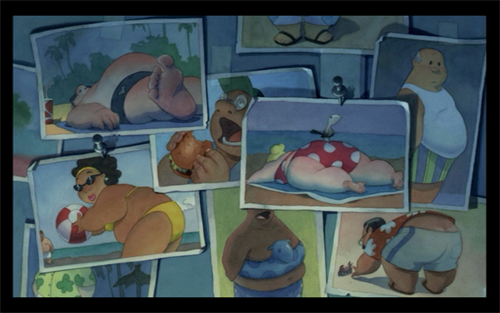
the dropped sub-plot was that lilo hated tourists, which is why she goes around taking pictures of them like they were attractions instead of people; like how they took photos of locals
similarly there was a deleted scene where she scares tourists off of a beach by sounding a false tsunami siren to watch them run screaming
deeper in the lore that kid thats a prick to her, mertyle, is the daughter of the person who runs the megamart and crushed a lot of other local businesses- when they have to do a hula to tell a story mertyle actually uses it to describe the low prices, where lilo does a hula about a traditional creation myth that was important to her mother. you may notice both lilo and nani are on first name basis with both the coffee shop owner and the fruitseller, there is big disparity between the locals and foreign interest businesses relegating them to just be tourist industry
friendly reminder that lilo & stitch is indisputably the best disney film
One, single statistically significant variable predicts whether a voter
supports Trump—and it’s not race, income or education levels: It’s
authoritarianism.
That’s right, Trump’s electoral strength—and his staying power—have
been buoyed, above all, by Americans with authoritarian inclinations.
And because of the prevalence of authoritarians in the American
electorate, among Democrats as well as Republicans, it’s very possible
that Trump’s fan base will continue to grow.
My finding is the result of a national poll I conducted in the last
five days of December under the auspices of the University of
Massachusetts, Amherst, sampling 1,800 registered voters across the
country and the political spectrum. Running a standard statistical
analysis, I found that education, income, gender, age, ideology and
religiosity had no significant bearing on a Republican voter’s preferred
candidate. Only two of the variables I looked at were statistically
significant: authoritarianism, followed by fear of terrorism, though the
former was far more significant than the latter.
Authoritarianism is not a new, untested concept in the American
electorate. Since the rise of Nazi Germany, it has been one of the most
widely studied ideas in social science. While its causes are still
debated, the political behavior of authoritarians is not. Authoritarians
obey. They rally to and follow strong leaders. And they respond
aggressively to outsiders, especially when they feel threatened. From
pledging to “make America great again” by building a wall on the border
to promising to close mosques and ban Muslims from visiting the United
States, Trump is playing directly to authoritarian inclinations.
Not all authoritarians are Republicans by any means; in national
surveys since 1992, many authoritarians have also self-identified as
independents and Democrats. And in the 2008 Democratic primary, the
political scientist Marc Hetherington found that authoritarianism
mattered more than income, ideology, gender, age and education in
predicting whether voters preferred Hillary Clinton over Barack Obama.
But Hetherington has also found, based on 14 years of polling, that
authoritarians have steadily moved from the Democratic to the Republican
Party over time. He hypothesizes that the trend began decades ago, as
Democrats embraced civil rights, gay rights, employment protections and
other political positions valuing freedom and equality. In my poll
results, authoritarianism was not a statistically significant factor in
the Democratic primary race, at least not so far, but it does appear to
be playing an important role on the Republican side. Indeed, 49 percent
of likely Republican primary voters I surveyed score in the top quarter
of the authoritarian scale—more than twice as many as Democratic voters.
Political pollsters have missed this key component of Trump’s support
because they simply don’t include questions about authoritarianism in
their polls. In addition to the typical battery of demographic, horse
race, thermometer-scale and policy questions, my poll asked a set of
four simple survey questions that political scientists have employed
since 1992 to measure inclination toward authoritarianism. These
questions pertain to child-rearing: whether it is more important for the
voter to have a child who is respectful or independent; obedient or
self-reliant; well-behaved or considerate; and well-mannered or curious.
Respondents who pick the first option in each of these questions are
strongly authoritarian.
Based on these questions, Trump was the only candidate—Republican or
Democrat—whose support among authoritarians was statistically
significant.
So what does this mean for the election? It doesn’t just help us
understand what motivates Trump’s backers—it suggests that his support
isn’t capped. In a statistical analysis of the polling results, I found
that Trump has alreadycaptured 43 percent of Republican primary
voters who are strong authoritarians, and 37 percent of Republican
authoritarians overall. A majority of Republican authoritarians in my
poll also strongly supported Trump’s proposals to deport 11 million
illegal immigrants, prohibit Muslims from entering the United States,
shutter mosques and establish a nationwide database that track Muslims.
And in a general election, Trump’s strongman rhetoric will surely
appeal to some of the 39 percent of independents in my poll who identify
as authoritarians and the 17 percent of self-identified Democrats who
are strong authoritarians.
What’s more, the number of Americans worried about the threat of
terrorism is growing. In 2011, Hetherington published research finding
that non-authoritarians respond to the perception of threat by behaving
more like authoritarians. More fear and more threats—of the kind we’ve
seen recently in the San Bernardino and Paris terrorist attacks—mean
more voters are susceptible to Trump’s message about protecting
Americans. In my survey, 52 percent of those voters expressing the most
fear that another terrorist attack will occur in the United States in
the next 12 months were non-authoritarians—ripe targets for Trump’s
message.
Take activated authoritarians from across the partisan spectrum and
the growing cadre of threatened non-authoritarians, then add them to the
base of Republican general election voters, and the potential electoral
path to a Trump presidency becomes clearer.
So, those who say a Trump presidency “can’t happen here” should check
their conventional wisdom at the door. The candidate has confounded
conventional expectations this primary season because those expectations
are based on an oversimplified caricature of the electorate in general
and his supporters in particular. Conditions are ripe for an
authoritarian leader to emerge. Trump is seizing the opportunity. And
the institutions—from the Republican Party to the press—that are
supposed to guard against what James Madison called “the infection of
violent passions” among the people have either been cowed by Trump’s
bluster or are asleep on the job.
It is time for those who would appeal to our better angels to take
his insurgency seriously and stop dismissing his supporters as a small
band of the dispossessed. Trump support is firmly rooted in American
authoritarianism and, once awakened, it is a force to be reckoned with.
That means it’s also time for political pollsters to take
authoritarianism seriously and begin measuring it in their polls.
I feel like racism is more pronounced in America. The disease is still there, it’s the same disease, but it just manifests in a different way. British culture is way more reserved, so it’s more systematic. – Daniel Kaluuya
This is what I always think when people claim that Americans spend too much time on racism, and that racism isn’t as bad as it is in other countires, and that we just make it more than what it is.
Like, it’s just as bad, but you have all inernlized it to the point of thinking it’s disapeared. You think your country is the best regarding racism, partly because you are someoen who doesn’t/can’t experience it.
It’s always white people who are regarding racism as a sort of American thing, not realizing that you all think racism is non-existent because you perpetrate an idea and system that makes it impossible for it to be as pronounced. and when it’s not as pronounced, it never gets fixed.
When I was a kid, I read the autobiographical novel To Sir, With Love by
the African-British writer
E.R. Braithwaite. It was written in 1959, and he made the exact same observations about US vs UK racism. It was something that always stuck with me, how the same racism can look different in different places. 60 years later, what has changed?
I legit served a man at my last job who was fully covered in nazi symbols and shit. He was a proud actual real life nazi getting icecream in a family theme park and when he left I voiced my disgust to my coworkers on how security even let him in the gate wearing all of that. And you know what that bitch said? “Well some people are offended by your rainbow flag and you are allowed to wear it so he can too”. It’s not the fucking same. Don’t fucking compare the two
Nazis’ entire mission is to exterminate anyone who’s not exactly like them. It’s in no way comparable to “some people are offended”.
me: “I’d like to visibly exist without fear”
them: “I want to literally kill these people so that they stop existing”
centrists: “I don’t see the difference”
Oh wow I guess my addition to this post got spread a lot. I just wanted to add in another piece of important information. I live in Orlando. The location of the Pulse night club shooting. I was wearing a rainbow pin on my uniform because 49 people in my community died in a hate crime. I will never forgive anyone who tells me that my rainbow pins are the same as a swastika
Ok guys you need to check this out! You know those spikes under bridges and bars over benches? The expensive shit designed to make it so homeless people can’t sleep there?
Stuart Semple (yes, of the 2nd blackest pigment that Anish Kapoor can’t buy) is spearheading a campaign against these hostile designs – and you can order stickers to slap on the hostile designs in your city! They are only £1 too (orrrr free, if you’re really broke right now).


 wupacing