The thing about this is that sculptures like these in art history were for the male gaze. Photoshop a phone to it and suddenly she’s seen as vain and conceited. That’s why I’m 100% for selfie culture because apparently men can gawk at women but when we realize how beautiful we are we’re suddenly full of ourselves…
“You painted a naked woman because you enjoyed looking at her, put a mirror in her hand and you called the painting “Vanity,” thus morally condemning the woman whose nakedness you had depicted for you own pleasure.” ― John Berger, Ways of Seeing
I know I’ve reblogged this before but it’s so important.
I choose to look at this Photoshop as an epowering thing, rather than the woman being depicted to be looked at by others, she’s looking into her phone like ‘shit I look fine af today’ and that’s #mood forever tbh
i swear to god, men raising their voice is the most terrifying thing in the whole world. they dont understand, like its an immediate panic response, game over
I actually had no idea women found this so scary
my downstairs neighbors fight on a regular basis, and every time he starts yelling i’m a little afraid he’s going to kill her. i have no reason to think this except that he is a man and he is angry
My math teacher has a loud voice and a temper and he scares the living shit out of me almost everyday. He’s made me and other kids cry more than once and he and his teacher buddies make a joke out of terrifying students.
this was women in general? i knew my gf didn’t like it but I was unaware if this affected most women
Yes, it does
As a woman, I had no idea it effected other women like this. I was too afraid to even talk about it. I thought I was weak. Thanks for bringing attention to this.
My dad thinks it’s funny that I used to cry when he raised his voice. I freak out whenever some one does. Once my director did, and I started crying I couldn’t stop. I’m glad to see I’m not alone…
This is so important– seeing how common this is– and I also want you all to know that this is not normal. It isn’t something instinctively ingrained into women, to be afraid of men. There is no natural state of men being a threat that women constantly have to be afraid of. This is cultural. So many women and girls here have a mutual understanding of this feeling, and I think it really shows an unsettling truth about our society, particularly about how men are raised to act and how so many women have this defensive reaction gradually develop. It’s so important that these people have their voices heard, because it teaches us about problems that we just can’t deny the existence of any longer.
I’m glad I’m not the only one
My fellow men, pay attention. I didn’t realize how scary this could be until one of my exes explained it to me, and it’s heartbreaking.
Also, when we move too much during an argument, or lean forward, it’s scary, and I never knew. I was even a little insulted at first, because surely she didn’t think I would hurt her. But see, that doesn’t matter. It wasn’t a sign that she mistrusted me specifically; it’s a conditioned response. (Although if you keep doing it once you realize it scares her, she SHOULDN’T trust you.)
Not every woman has been physically harmed by a man she trusted, but every woman KNOWS a woman who has.
I used to be horrible about this, because I didn’t realize how intimidating it was. I didn’t understand why the woman I was with clammed up or tried to tell me what she thought I wanted to hear, and I only got angrier, and acted even more like an asshole. It was wrong. It was abusive. It didn’t matter if I INTENDED it that way; it was still emotionally abusive. And it was inexcusable.
I get that when passions are high, and when you’re frustrated, it’s a natural tendency to let your voice get louder, to shout and gesture and lean forward. But you can train yourself to do better. You can train yourself to keep more of an even tone, to refrain from large and fast gestures, to not lean into her personal space. I did. I’m not perfect at it yet, but goddamn it, I WILL be.
Don’t tell me it’s too hard, that you just can’t do it, or that you “shouldn’t have to.” I’m 53 years old and just now getting the hang of it, and if this old dog can learn something new, so can you.
Note to guys: It really, REALLY doesn’t matter if you’re thinking, “but I would never…”
History is littered with the bodies of women who believed a man “would never.” This includes women killed by men who honestly, deeply, truly believed they “would never”… right up until she said that one thing or moved in just that way and he just got so mad, just that once, and pushed her or punched her or slashed her or shot her… just once, y’know, to shut her up, or because she was flinching and didn’t she know that HE’S NOT LIKE THAT and I’LL TEACH HER TO BE AFRAID OF ME…
We are trained, from infancy, that Men With Loud Voices are a source of pain from which we cannot escape, and attempts to escape may result in more pain. And as soon as we’re old enough to comprehend a world broader than our immediate circle, a world that extends into the past and will run into the future, we realize that there is no way, no way at all, to tell which men “would never” and which men “would never… except if.”
We live or die on that “if.” And any man who doesn’t like facing that hyper-vigilance can work on fixing OTHER MEN, not women’s fear.
The reaction shouldn’t be “not all men are like that;” it should be “no woman should have to live in fear.”
It’s telling that so many people will hear a story of long-term abuse and say, “why did she stay with him?” and not “why did he treat her like that?”
A while back I heard my friend (male) insult another dude by saying, “You look like the kind of guy who wouldn’t go to Wal-Mart to buy his girlfriend a box of tampons” and I still think about that crowning insult sometimes
My dad once called another guy “someone who thinks loading the dishwasher once in a while makes him less of a man”
I like your dad already
one time my dad’s boss was giving him shit for always leaving work early so he could get home and help my mom with me when i was a newborn and his boss said “i’ve never changed a diaper in my life” really proudly and my dad responded “i’d be ashamed to ever admit i was that worthless of a husband”
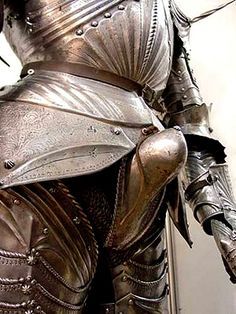
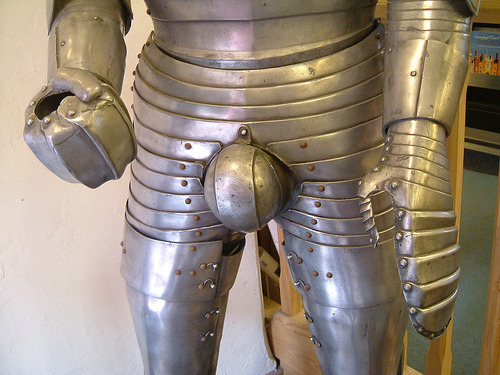
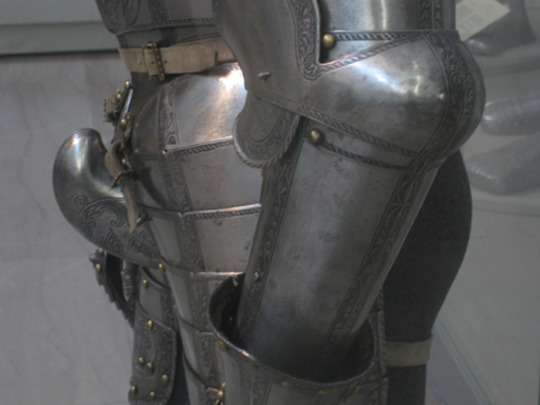
Next time someone brings up “historical accuracy” as an argument for some ridiculous double standards in costume design, don’t forget to bring up this Renaissance fashion curiosity. And how conveniently it is never incorporated into male characters supposedly inspired by the era of codpiece popularity.
Thanks to she5los for tagging us in one of the reblogs to this 🙂
~Ozzie
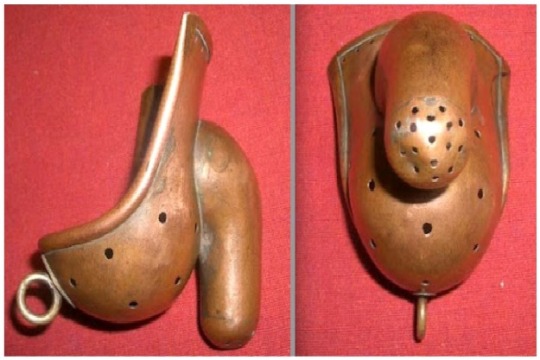
As a small nitpick, that last one isn’t a codpiece – it’s a chastity belt.
Of course, chastity belts are another fun one for the historical accuracy crowd. While the popular image of the chastity belt involves a medieval knight slapping one on his wife to ensure she didn’t get up to any shenanigans while he was off at war, in fact, there’s no credible evidence for their widespread use prior to the 19th Century. Furthermore, they seem to have been employed in main not to safeguard marital fidelity, but to prevent teenagers from masturbating.
(Amusingly, by all accounts, chastity belts were far more commonly forced upon boys than girls – another little detail that “historically accurate” fantasy media understandably never touches on!)
We were hundreds of women, marching on the streets of Karachi, Pakistan.
We shouted slogans. ’“Aurat aiee, aurat aiee, tharki teri shaamath aiee!” (Women are here, harassers must fear!)
We raised our fists in the air, smiling, laughing.
We wore what we wanted to wear: burqas, jeans and designer shades, brightly embroidered skirts, the traditional tunic and baggy trousers called shalwar kameez.
Men gaped, shook their heads, filmed us from passing cars as we walked by, disrupting traffic.
We did not care what the men thought of us.
We were free to stand, walk, dance, with nobody to tell us to sit down, be quiet, be good.
It was the first time in my life that I saw women gathering in public, in strength, in numbers.
This was the Aurat (Urdu for “women”) March, the first of its kind in the conservative Muslim country of Pakistan. There were actually three marches — in Karachi, Lahore and Islamabad – all held on March 8, International Women’s Day.
Word spread through Facebook and Twitter posts among the various networks of women involved in grassroots work — in education, health, microfinance, women’s shelters, workers’ rights.
Objectives were ambitious: a demand for the recognition of women’s rights and gender equality, and an end to the hideous scourge of gender violence, among other aims.
But the overriding intent was to raise the morale of Pakistani women. The constant drip of misogyny can turn life into a misery, where you are considered a lucky woman if you have a husband who doesn’t beat you. The Aurat March wanted to remind women that the bar doesn’t need to be set that low.
Before the march began, activists took to the stage and spoke of their struggles and triumphs. Veeru Kohli, a member of the Dalit community in the Thar Desert (low-caste Hindus known by the epithet of “untouchables”) related how she escaped a life of slave labor to become a political activist. Kainat Soomro, a victim of gang rape at 13 who is trying to take her rapists to court, described her as yet unsuccessful 11-year fight for justice. An activist from the Christian community excoriated the government for ignoring the scourge of forced conversions, where Muslim men kidnap minority women, force them to convert to Islam and marry them against their consent.
The March brought together women across class, ethnic, and religious lines. University students cheered on older feminist icons. Placards in English and Urdu read “Patriarchy is Fitna (sedition)”, “Kebab Rolls not Gender Roles”, “Woman is King” and “Stop Killing Women.” Children waved orange and yellow flags with the Aurat March logo, and 97-year-old folk singer Mai Dhai sang and banged enthusiastically on a dhol, the traditional Pakistani drum played at weddings, stirring women and men to dance together in a spirit of festivity and celebration.
For the first time, I felt as though the invisible ties that held me back, those hundreds of written and unwritten rules about Pakistani women’s behavior in public, had been cut through with a blowtorch.
A small group of trans women watched from the edges, nervous and scared, but they soon joined in, along with the procession of nuns bearing giant crosses and the Dalit women from the desert. We marched behind women in red, members of the working women’s union, bussed in from Hyderabad. We marched, hair bare or covered, to the beat of the drums and the pounding of our hearts.
We were accompanied by women on motorcycles, girls on pink bikes. Tens of men and boys joined us. We walked next to women wearing masks portraying the face of Qandeel Baloch, the social media star who was murdered by her brother two years ago because he could not stand her bold, risqué public persona. They bore a symbolic coffin containing a body shrouded in white, calling it “patriarchy’s funeral.”
It’s been three decades since members of the Women’s Action Forum were beaten on the streets for protesting the Islamization laws of dictator General Zia in the early 1980s. Pakistani women in 2018 still find themselves trampled under decades of discrimination and oppression. But the Aurat March has motivated them to demand equality and justice. The Aurat March has uncovered an undeniable truth: The revolution has arrived in Pakistan — and it is a women’s revolution.
I met the creator of this a month ago and he said he got a lot of hate mail from dudebros who thought that he was a woman complaining about these problems.
I want men to try and imagine going about your day–working, running, hiking, whatever–and not being allowed to wear pants under threats of violence or total social and economic exclusion.
That’s the kind of irrationally violent and controlling behaviour women have been up against.
Also for anyone who thinks it’s easy for women to be gender non conforming because we can wear pants.
The only reason we can is because we fought tooth and nail for the right to! Any rights we take for granted today we’re the result of a prolonged, bitter battle fought by our predecessors for every inch of territory gained. Never forget that.
Title IX (1972) declared that girls could not be required to wear skirts to school.
Women who were United States senators were not allowed to wear trousers on the Senate floor until 1993, after senators Barbara Mikulski and Carol Moseley Braun wore them in protest, which encouraged female staff members to do likewise.
This was never given to us. Women have had to fight just to be able to wear pants. Women who are still alive remember having to wear skirts to school, even in the dead of winter, when it was so cold that just having a layer of tights between them and the elements was downright dangerous. Women who remember not even being allowed to wear pants under their skirts, for no other reason than they were female.
So don’t talk about women wearing pants being gender nonconforming like it’s easy. It’s only less difficult now because your foremothers refused to comply.
My mother spent her entire school career up until high school having to wear skirts, no matter how horrible the New England winters got, because she was forbidden to do otherwise. There were times when the weather was bad where my grandmother kept her home rather than make her walk to and from the bus in a skirt.
They rebroadcast a few old interviews with Mary Tyler Moore, and in them she addressed the pants issue. There was a strict limit on what kind of pants she could wear (hence, always Capri pants, nothing masculine), and to use her words, how much cupping the pants could show. A censor would look at every outfit when she came out on stage, and if the pants cupped her buttocks too much, defining them rather than hiding them, then she had to get another pair.

 wupacing