If Congress does not pass legislation protecting the tribe and the legal challenge fails, the Mashpee would be stripped of their right to exercise sovereign jurisdiction over their land.
Jessie Little Doe Baird, the tribe’s vice-chairwoman, told Al Jazeera that loss of jurisdiction would prevent the tribe from running indigenous language schools, tribal courts, and housing projects, as well as its own police.
“We have our own police force, which is important because they’re tribal citizens and since we’ve had our own police force, none of our men have been beaten or shot, which we’ve had before with non-tribal police,” she said.
Every single Native culture is distinct and unique, though many share similarities, and lumping them together is ridiculous. And while some practices are pan-Indian, the vast majority are not.
Stop homogenizing our cultures. Every Native culture is beautiful and unique and deserves to be treated that way.
Don’t fall into the trope of “pan Indian”. Fucking teepees and totem poles never existed together. Totem poles are permanent structures, teepees are fucking tents for nomadic peoples. First Nations and indigenous cultures are all deep and uniquely complex, it would be like confusing England with Russia.
“I’m laying there, scared enough, not wanting this done, telling her I didn’t want it done. All of a sudden I smell something burning. If I could’ve moved my legs I probably would’ve kicked her.”- Brenda Pelletier on being sterilized against her will
Brenda Pelletier checked in to Royal University Hospital in Saskatoon five years ago to give birth to her baby girl. She left, with her tubes tied. The tubal ligation procedure happened, she says, after she was pressured into it by hospital staff, while she was in a vulnerable state.
And as a Métis woman, Brenda Pelletier’s experience appears not to be an isolated case.
At least three other aboriginal women have come forward to say that they too were pressured to be sterilized at the Saskatoon hospital in recent years.
Ok but this is true!!! I was 19 years old when i went into the hospital to give birth to my first child and while i was laying in bed reading and signing consent forms i came across one that woukd give them.permission to tie my tubes. The nurse kept telling me i didnt have to read them all that they were all about my stay in the hospital and intake forms and when i began to read that particular form the nurse came to me laughed nervously and said well we put that in there just in case you wanted to get your rubes tied. I then asked if they always gave them to woman giving birth she said no, the doctor had asked for thematic be put in there “just in case” I didnt want any future children. The nurse then went on to ask me about my future and if i was really sure i wanted to have more children or not. Until my mom came intimate room to check up on me and the nurse then took all the papers from me and left. For the rest of my delivery the nurses refused to give me medication for the pain or an epidural saying it was too early for that and it might stop my labour. I honestly think they withheld pain medication and the epidural to show me how hard child birth can be. Afterwards when they were releasing me the nurse asked me again if i was sure i didnt want to get ny tubes tied. Which i said no to. She then went on and explained thaf if i did i woukd just have to make an appointment with my doctor and i would be in and out in no time at all. That is my experience with the Canadian healthcare system and being a native woman. It is wrong that anyone would try and force something like that on a 19 year old. Please share. Let it be known what is happening to native woman. We have rights just like any other woman and shouldn’t be pushed into suxh decision at such a young age.
Hey white folks with uteruses who do not want or should not have kids,
you know how you’re outraged about how hard it is to get a Doctor to agree to sterilize you even to save your life?
Guess what else they do? Double your outrage.
This is so common there’s even a book just about Saskatchewan on the topic: An Act of Genocide, by Karen Stote. And this isn’t just a contemporary thing, Canada had a lengthy eugenics legal history, particularly in Western Canada, which targeted Indigenous people, Jews, Ukrainians, and developmentally disabled people. Learn more at http://eugenicsarchive.ca/ including how institutions of eugenic sterilization collaborated with Indian Residential Schools and Indian Hospitals, and how these institutions all sexually and emotionally and physically abused their patients as well as non-consentually sterilizing them.
After winning her Democratic primary, Haaland, a member of the Pueblo of Laguna, a Native American tribe, is running for the U.S. House in a strongly Democratic district in New Mexico. That means she may soon be the first Native American woman in Congress.
“Somebody has to be the first,” she says as she walks through the southeast neighborhood where her office is. “Native women, I mean we’ve been on the frontlines for a long, long time. Think of all the native women who have fought for treaty rights and fishing rights and all of those things.”
Haaland worked on President Obama’s 2008 campaign before chairing the state’s Democratic Party. But after thinking a woman would become president in 2016 and feeling let down, she says she decided to run for federal office. Because she says, she understands what it is to be working class in the United States.
“I identified with so much of what people go through in this district and in the state. Half of our population is Medicaid eligible,” she says. “I know what it’s like to be on food stamps. My daughter and I both are paying off our student loans. So, I just felt like I know what it’s like and we need more people who know what it’s like to struggle.”
Haaland is a single mom, went to 13 different public schools in the district where she’s on the ballot and says she understands Indian country.
“We have a president who doesn’t understand what the trust responsibility is to tribes or our history at all.” She says that’s a major reason why she’s running for Congress. “You want to have influence over people who are making decisions for one of the most vulnerable communities in our country.”
She’s one of a record number of Native American women running for office this year — a record number of women among a record number of Native American candidates. This year, Haaland says, is the year of women of color.
“This year, maybe we just all said separately, ‘It’s time for us to take the next step.’ ”
Then there’s Peggy Flanagan, a state representative in Minnesota now running for lieutenant governor. Her top campaign issues include access to child care, education and inequities affecting “children of color and Indigenous students.”
But also, she says, it’s an opportunity to educate people about Native Americans and to stop legislation that’s done to her community, rather than alongside it.
“Minneapolis is the birthplace of the American Indian movement and we have incredible history as well as infrastructure,” she says. “Oftentimes, it’s just ignorance … That we weren’t given these rights. We always had them. Educating folks on issues of sovereignty.”
There’s also Paulette Jordan, making a Democratic bid for governor in the conservative state of Idaho. She grew up on a reservation in a rural part of the state.
“We need leadership that will help defend the voices of the people and the needs of our community. There is no other option but to lead. That’s why I’m running for governor,” she says. “Balance in the voices of representation in government is wholly unique and very critical.”
A course created one year ago by the University of Alberta was the most popular online course in Canada in 2017, and is already making inroads into how Canadians understand the history of Indigenous people.
With almost 20,000 people enrolled, the free online 12-module course called Indigenous Canada teaches those from an Indigenous perspective.
“A lot of Indigenous experiences in Canada have been silenced by a normative settler vision of Canada and the history of it,” said Paul Gareau, assistant professor with the U of A’s Native Studies program and the academic lead for the course.
“This course focuses on telling an Indigenous experience of Canada.”
“The course is available for free through Coursera here.”
I’ve done this course and it is fantastic. I learnt so much about the various Indigenous cultures across Canada along with history and was given a much better understanding of what Indigenous people face.
It only takes an hour or so per course and you can do them at your own pace.
So I will admit I was feeling funny about going to the Field Museum because of the whole “look at display of objects from colonized groups” thing. Especially because of the Black Panther post with commentary on museums.
But boy, the Field Museum really does seem to be doing a fair amount towards rectifying past attitudes and actions. I took these two pictures and there were at least two others I wish I had remembered to take pictures of. I was thrilled to see such obvious mentions of this kind of thing instead of a lack of change or pretending it didn’t happen.
@kaijutegu I’ve been meaning to post these for the past few days, every time I see the BP museum post go by again!
This is great, but I would be really curious to see what tribe responses to these efforts have been. I know a lot of tribes struggle with NAGPRA recognition and have to be “validated” through historical records written mostly by white explorers. I would hope the Field Museum would take a more proactive approach. I also hope there’s an effort to return these artifacts to their homes and help those populations with preservation on their own terms, rather than maintaining those items in their own care (unless that permission has been specifically granted).
@upperpaleolithic Idk if you already did, but in case you didn’t, I would click to read the Black Panther post I linked! I know @kaijutegu talks a lot about returning artifacts to the groups they came from & such, and co-curation (which is the maintaining of objects at the museum, but with input from the original group).
I don’t think it’s in the link I included, but I also remember another discussion on that same post where people were talking about how there are still issues with paperwork & bureaucracy & difficulties with recognition or jumping through hoops to sort this kind of thing out. I think it was more about the availability of collections to scholars of color & scholars from the groups that those collections are from, but yeah. Still definitely some difficulties, and I’m sure not all museums have the funds or time or people necessary to be doing as much as they should with de-colonizing and all. But there is some progress and hopefully that will continue to spread and improve.
Loads of good stuff to talk about here! ’s gonna get long, but I hope you take the time to read it if you’re interested in this stuff! Also please let me know if you can’t see the links.
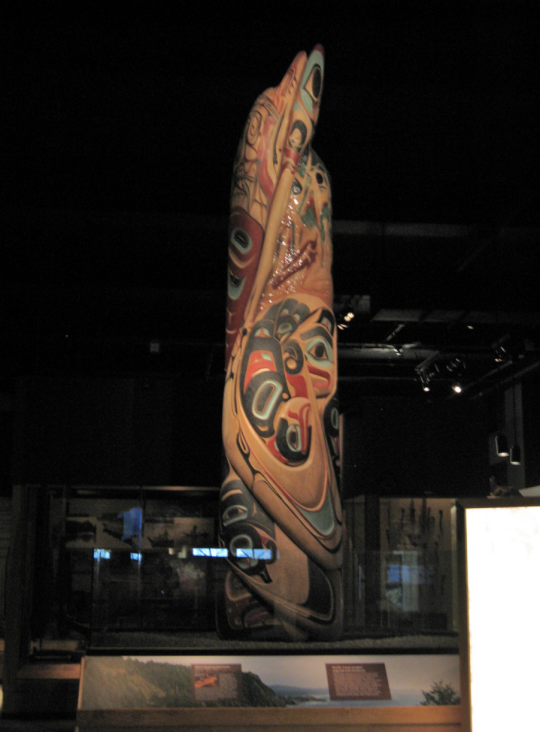
I’ve posted about it before, but the Field has an incredibly good repatriation department that actively does work with indigenous nations to get stuff home. But the goal isn’t “empty the museum,” the goal is “present indigenous history in a way that represents what the native group actually wants.” Case in point: this totem pole.
I told the story of it here, but the gist is there was this really awesome but totally stolen totem pole and the people who made it rather wanted it back, so back it went- but then the museum commissioned a couple of native artisans from that same group to create a new totem pole to take its place. When done well, repatriation’s not just about giving stuff back- it’s about building relationships with the groups. A lot of Native American groups want archaeology and museum exhibitions to happen- they recognize the scientific and social value. But they also generally don’t want to be objectified.
Another really good example of culture of origin reaction to repatriation/co-curation is the Maori response to the Field’s marae, or meeting house. The house was sold in the midst of a family dispute, and another one was constructed at the original site- and when the Field wanted to exhibit the house, their first point of contact was that family. One of the curators had been trying to talk to the descendants for years about the possibility of repatriation, but… ok, so this is another kinda sticky point about repatriation.
Not every object was stolen and/or excavated; some were actually sold- and there can be an enormous deal of shame surrounding past actions, which was the situation with the descent group for this marae. The fact that the museum bought is inconsequential to this shame- the shame here comes from the fact that it had been sold at all. A family elder/chief had sold it, and that was still a major source of family shame- like somebody selling Grandma’s headstone. When the museum tried to reach out to them, for quite some time it was like rubbing salt in this still-present wound. To the Maori, these houses are alive- spirits dwell in them- and they still have incredible spiritual significance to the Maori today, and so what the museum and the Maori ended up doing was… honestly, something really spectacular.
No, really, it’s cool as hell. The original creators’ direct descendants were flown other and stayed in Chicago for a while while they talked with the Field curators about what to do with the marae. It was restored and painted- not the standard methods for archaeological conservation, but that was less important than keeping the house the way the Maori wanted it. Maori groups regularly come in and have events there, and we do what we can to help keep the spirits warm. Sometimes people even sleep in there, because the Maori asked for that. Now, the big repatriation law in the US- NAGPRA (the Native American Graves Protection and Repatriation Act)- doesn’t cover non-Native North American groups, but this is something that the Field finds important for a lot of reasons. It’s not just about ethics- it improves the museum experience for guests as well. It adds context and shows cultural continuity for the creator cultures.
The Field also has co-curation in place pre-NAGPRA; the Pawnee Earth Lodge we have is a modern recreation that was built with the guidance of Pawnee elders back in 1977. It’s been rededicated, and there’s been drum circles and purification rituals held there by representatives of the Pawnee nation to cleanse the space. It would have been ethically tenuous to have a “genuine” earth lodge in the museum, but having one built for us that combines ancestral and modern Pawnee spiritualities and sensibilities is like I mentioned in the other post- it’s a way to show museum guests that Native Americans still exist and that these rich cultures and their traditions aren’t some relic of an ancient past.
But there’s a major design flaw in NAGPRA that makes repatriation extremely difficult sometimes, even when the museum itself wants to give stuff back. This barrier is the five year rule- basically, when NAGPRA was passed in 1990, museums had five years to identify all of the Native American stuff in their collections and list its tribal affiliation. In the bad old days of collecting, a lot of people didn’t bother to take down the names of the folks they took stuff from, and thanks to the way the US laws regarding tribal enrollment work, group affiliation can change, be subsumed into larger groups, or just not be federally recognized. So a lot of material got classified as “culturally unidentified,” and some museums aren’t making efforts to identify it. And legally, they don’t have to, because they were supposed to get that done within that five year period. Five years is a tiny amount of time to get a bulletproof cultural affiliation on artifacts and remains- big natural history museums have millions of objects in their collections sometimes.
Now, I can say with absolute certainty that the Field is not doing that, because I’ve actually worked on some of this material. A few years back, I was working on a project to identify several hundred boxes of that “culturally unidentified” stuff. These boxes were considered lowest priority because they only contained soil samples, rocks, animal bone, some lithic debitage, and ceramic potsherds, but the work still was important. When my chunk of the project was complete, our repatriation department sent notice to several of their native contacts. None of them wanted two hundred boxes of broken pottery back. Case closed- unless later on they decide they do want it, in which case now it’s been identified and so they’ll get it pretty quickly. That’s an example of a best-case scenario. When remains are involved, it gets a lot trickier. Sometimes two or more nations claim the same set of remains, or the museum drags its feet. Harvard’s Peabody Museum runs into this problem a lot- here’s an article from a few years back, if you want some scope on this kind of problem. If the Wampanoag and the Narragansett clam the same remains, and their historical territorial affiliations overlap, and DNA testing isn’t going to give a good outcome (some groups do not want DNA testing, and others are so closely related that haplogroup testing wouldn’t really be helpful at all, plus admixture over the years can make DNA testing even more complex), who’s in the right? Who gets the remains? Sometimes it works out- Kennewick Man, for instance, ended up buried in a location agreed upon by the groups that had claim to him, and most, if not all, of them participated in the interment ceremony. But other times, it doesn’t- and the legal battles wage on, which can get real expensive real quick for the native groups and museums, especially smaller museums that don’t have a big endowment. Fortunately, there are federal grants available to help. But this leads to another massive problem with NAGPRA…
NAGPRA has some serious budget issues.
Do you know who’s in charge of NAGPRA? It’s the National Park Service! You know, the one that our current president is decimating? This means that NAGPRA grants (aka money to be given to people trying to get their stuff back or money given to museums to help ID stuff) have been substantially reduced as well. In fact, they’ve been 100% reduced! That’s right, our wizened yam of a president requested a whopping ZERO DOLLARS for repatriation grants! It does seem like they did get some funding, as they haven’t closed down grant application- but I hope this stands as an illustration of the potential seriouness of this problem. In addition, part of the legal requirement for repatriation is publishing inventory completions and intents to repatriate in the Federal Register, and there’s a massive backlog of those.
Finally, the actual repatriation process does take some time. The NMAI has a really cool guide to safe repatriation online here; you really can’t just hand over the stuff and say “see ya! you’re on your own!” A lot of it’s actually poisonous, thanks to the old-timey pest treatment called “covering it in arsenic until the bugs are dead.”



 wupacing