Leveraged an inventory of established fictional character and setting elements to generate a disruptive custom-curated narrative entertainment asset.
I worked in HR, handling applications and interviews, and if someone turned in that string of techno babble nonsense, I would have rejected them out of hand.
A resume doesn’t need to sound fancy or overly technical, it needs to tell us why we should hire you.
“Independent novelist/writer” is more than sufficient here. If you want to express the skills that fan fiction taught you, something like, “creative writing, editing, and publication,” will get you a lot further than… Whatever that just was.
A resume should be tailored to the position, if you can afford the time and energy for that. But if not, then just think about what writing got fandom taught you. How to respond to criticism, how to present a professional pubic face, how to correct punished mistakes, creative thinking, project planning, persuasion via emotional leverage, html formatting, office suite fluency.
There are a lot of actual, marketable skills that go into fan fiction.
How to put “I was in a zine” on your resume
Writer:
Published short fiction stories for anthology collection
Able to write short fiction within a designated word count for layout purposes (900-1500 words, 1500-2000, 3000-5000)
Wrote short articles for independent publication
Assisted with editing short stories for publication
Able to reduce or expand written content based on layout needs
Able to check for basic spelling, grammar and syntax
Familiar with Microsoft Office and Google docs
Artist:
Produced full-colour digital illustration for independent magazine
Able to produce digital illustrations optimized for both online and print display
Produced full-colour 2-page spread for art anthology
Published 4-page short comic in anthology collection for charity
Able to transfer traditional art to digital illustration
Illustrated the cover (always brag if you’re on the cover) of an independent art publication
Familiar with professional illustration tools such as Adobe Photoshop, Illustrator, Clip Studio Paint and stylus tablet
Merch artist / graphic designer:
Designed 2″ clear decorative double-sided keychain charm as bonus sale item
Designed 5″ x 6″ sheet of graphic stickers included in art anthology
Able to design bold graphics that are measured for laser cutting production
Designed layouts for 65-page art and writing magazine, focusing on (art placement, text layout, etc)
Able to keep layout design simple and in accordance with the project director’s chosen theme
Created promotional art, icons and banners tailored for social media sites like Twitter, Tumblr, Facebook, etc
Familiar with professional layout and design software such as Adobe Illustrator and InDesign
Running a zine
Produced an independent art and writing collection for sale / for charity
Managed (10, 20, 30) independent artists and writers out of over 500 applicants to create a short-run independent magazine
Worked in online sales and social media promotion selling an independent comics anthology
If it’s really spectacular you can brag about specific numbers
Our book raised over $4,000 for charity in under six months of production
We sold over 750 copies in two weeks of online sales
Produced a digital PDF and printed version of anthology, mailing to recipients all over the world
Communicated with printers and manufacturers of plastic accessories and paper goods, assembling professional packages of our merchandise for mailing.
Built a custom digital storefront and navigated professional market and payment systems including Paypal and Tictail / Bigcartel / Wix etc
Created promotional events to boost sales, including raffles and giveaways over social media
Organized participants through mass emails and use of social media posts on tumblr and twitter
Familiar with organizational software such as Microsoft Excel, Google spreadsheets and Trello
this is my favorite art program. it’s *much* more intuitive than photoshop/gimp or corel paintshop, but it still has the full functionality of a digital art program (layers, brush stabilizer, etc.). it’s not overwhelming to start on like practically every other decent art program I’ve tried, you can just pick a brush and start drawing as if it were paper if you want. plus you can download extra brushes for free! and they publish free art tutorials pretty regularly
ANYONE looking for a free art program: worth looking into.
YALL I LOVE THIS PROGRAM, especially the ipad version!! and i’m psyched that i don’t have to pay $30 a year for it anymore!!!
What’s the most ridiculous false rumor that has been spread about you?
I joined my wife’s workplace about 12 months after she joined. When we worked together (same department, same roles), we’d keep mostly away from each other so not to crowd each other. When we’d take breaks, we’d be hanging out together. You know, normal stuff.
Thing is, no one picked up on the fact that we were husband and wife. They knew she was married, and that I was married – but not to each other.
Someone saw us holding hands on the walk back to our car after work, someone else saw us kiss when I dropped her in to work when I had the day off, and rumours started flying around that we were cheating on our significant others.
People took it upon themselves to ‘intervene’ and approached me to tell me she was married and that I should be ashamed of myself. Someone else made a comment to her that she should be more discreet if she was going to continue on her relationship with me.
Truth be told, we both found it pretty fucking funny. Didn’t get a chance to run with it, because we were so taken aback by it when it was brought up to us individually, that we just blurted out the truth on the spot.
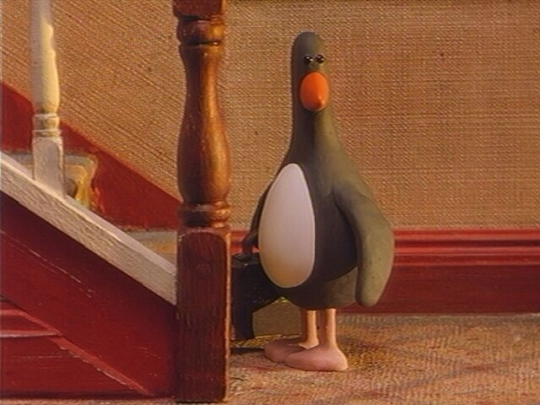
how the FUCK did they make that penguin from wallace and gromit look so evil like it’s literally just a plasticine penguin but it somehow radiates Pure Malice look at it
truly character design at its finest
Part of the reason that Wallace and Gromit is so successful is that every single character is just so expressive. The people’s lips move like half a foot every frame. Gromit has basically only his eyebrows, and he has more personality than two average real people. The Moon Machine was up there with the rest of them, and it didn’t even have a face.
The penguin, on the other hand, never expressed anything at all. It’s designed almost explicitly with purpose of not expressing anything. It’s practically featureless, with only the bare minimum of detail necessary to tell you it’s a penguin.
It has a face, but it never uses it. It has no sclera, meaning it stares straight ahead at all times.
It actively repels most attempts to ascribe any emotion to it – at best, you can feel that it is coldly satisfied, perhaps detachedly frustrated. I’d say it’s like a robot wearing the skin of an animal, but that’s literally the villain of A Close Shave, and he was pretty expressive.
It’s like Aardman found a tiny crack in the likability curve, far away from the uncanny valley but a hell of a lot deeper, and decided to build a penguin there.
As you have hopefully noticed, hanzi don’t all seem to work the same way, and during the Han Dynasty six categories were designated for describing the “logic” of a character. It’s not something that comes up a whole lot, but it’s interesting and handy for explaining to folks that it’s not all “lil pictures” ఠ ͟ಠ
象形 xiàngxíng: pictograms, one’s like 火 or 馬. These arose from people using drawings to help remember oral stories, and then those drawings turning into more simplified and consistent symbols.
指事 zhǐ shì: ideograms, things that “demonstrate” a concept. so like 上 and 下
形声 xíngshēng: an ideogram + a phonetic component. so you may not have encountered 氿 before, but hm it’s got water (三点水) and 九—it’s pronounced jiǔ & means “bubble up” as in spring water
会意 huìyì: joint ideogram, so two “meaningful” components that help make a new meaning. A 人 man with a 戈 spear, 伐 attack! (tho more literary now)
related thought: this is also the pattern of development for hieroglyphics and Sumerian writing, though as these got used for other languages eg Akkadian things would get used for their semantic meaning and get new phonetic readings that could then be remixed again, or used purely phonetically, resulting in a mixed system kind of like Japanese but if the kana looked more like kanji. (if yr into it I cannot recommend this book enough) So also no, emoji are not like hieroglyphics.
转注 zhuǎnzhù: transfer characters, these are weird and I don’t totally get them. it seems to be characters that sound different but contain a similar part and mean the same thing, so 爸 and 父. The classical ones given are 考 老 but?? sorry maybe you need to be deeper in the philology ¯_(ツ)_/¯
假借 jiǎjiè: loan characters. This includes old stuff like 来 which meant wheat but was pronounced lái anyway, and now if you want to talk about wheat you have to add the grass radical 莱, heh. This is also how names and foreign things are transliterated
So that’s how hanzi work! I think in ways there are overlap but these are the technical distinctions. For example “beer” used to be transliterated as 皮酒, aka skin alcohol and that’s gross, so it was changed it to 啤酒, with the “pi” that’s also in 埤 and 脾 but the 口 mouth radical since it’s phonetic, like 啊, 哎, and 哦. Otherwise new characters are exceedingly rare and mostly only for elements, like oxygen is 氧, and has the 气 radical like other gases but the 羊 for pronunciation. I feel like you could also make a contemporary pseudocategory for internet punning or something, like 囧 being used as a face and all the censorship work-arounds.
There’s soOoO much to talk about always but you can google around, here’s a Baidu article that has the old school classification poem, here’s an english rundown with more examples and a powerpoint. (o˘◡˘o) 谢谢你们来我的TED talk
– Rapunzel is the witch’s illegitimate daughter, and she is being kept safe from a king who would have her killed on sight.
– The Little Match Girl is a now phantom luring people to their deaths.
– Little Red Riding Hood is a werewolf.
– “So… You’re the Pied Piper, eh? I thought you’d be taller.”
– Princess Snow White and the evil Snow Queen? One and the same.
– “If you value your life, my life, the lives of everyone in this city… you won’t wake the sleeping princess.”
– The land of the Twelve Dancing Princesses is falling apart at the seams, and the rest of reality with it.
– A witch who made some bad decisions in her youth is forced to adopt and raise a child.
– After Jack the Giant Killer ruthlessly murdered their king and threw their world into turmoil and war, the inhabitants of the Sky Kingdom must rebuild their lives.
– “What… what is it?” “A firebird – the last of her kind.”
@leavesdancing You need to draw on your history degree to write the first prompt with Cinderella as a rebel assassin taking down the monarchy for the people.
So I had a good think about this, based off of what I have written lately. As I go further into my novel, do even more research into different types of sign, and start on the arc that is written solely from the POV of my deaf character, I’ve begun to realize some other differences between signed and spoken dialogue.
For one thing, punctuation doesn’t apply in the same way. There is punctuation in sign language, but as I’ve talked about before, it is mostly facial; therefore, you describe it as a part of the dialogue tags. So then, what do about the commas, colons and semi-colons? In this case, the n-dash is your friend! The aforementioned punctuation marks indicate changes in tone, alterations of pace and pauses. Therefore, they can be replaced with an n-dash, like so
“You and I – I don’t think we can continue.”
And fingerspelled words would be written as single letters, hyphenated into a word:
”You and I – going to L-O-N-D-O-N.”
For another, the syntax of your translated signed dialogue is subtly different. One sign can ususally mean several different words and filler words are absent. If someone were to say “really big.” in sign, they might just make the sign for “big” and super over-exaggerate.
So, verbal dialogue version:
“It was really, really big!” Lottie jumped and down in excitement, her eyes shining.
And the signed dialogue version:
“The dog was huge!” Lottie flung out her hands into the word, making it larger than it needed to be, bouncing on her heels.
Keeping in mind that large, big, huge, bountiful (and other connected synonyms) are all the same sign.
I don’t like to write signed language in the syntax that it would be signed in (Name, yours, what instead of “what is your name”). Not only is this confusing for non-signing readers, but it also reads as childish or overly-simplistic for readers who don’t understand sign, which reinforces the harmful stereotype of deaf people being stupid/infantilisation of deaf people. It is impossible to truly do signed language justice in writing, because it’s a language made for hands, bodies and faces.
This all comes together to mean that the sentence structure of dialogue in sign will be different. You would use less contractions (isn’t, you’re, might’ve etc), fewer modifiers and shorter chunks of dialogue with the description of the sign in between.
If it reads differently or feels strange, that’s okay: signed language is different to verbal language and so they won’t sound the same as one another in writing. They’re more like cousins or step-siblings than part of the same direct family group. You’re utilizing different descriptors and tools.
Hopefully, this also answers the repeated issue of differentiation, which has come up time and time again from various people. Best of luck to you all with your writing x


 wupacing