Make a Vampire character who’s lived through several waves of the common language’s development and can’t let go if certain gramatical habbits from different time eras.
So like, thou ist a horrid creature, an absolute cur, but go off i guess
… can i use that phrase irl?
Absolutely you can and I encourage more uses of similar phrases that just completely fuck up the chronology of the english langauge. I wanna hear 15th century english mixed with surfer speak mixed with current age internet lingo like all the time.
Like this? Well my dude, seems like a weasel hath not such a deal of splean as you’re toss’d with. Chill already, you’re not valid.
You are an unrighteous, bastardly gullion. Heaven truly
knows that thou art false as hell. When you die, I will face God and walk
backwards into hell just so that I can beat your ass in the afterlife too.
A tip for blending when painting digitally: use a transition color! I quickly made this when my brother asked for art advice while I was working on a painting for my best friend. (I was watching a lot of makeup videos to pick out her gifts).
Can I talk for a moment about visual storytelling, cause, I feel like it’s something that a lot of adaptations forget about in lieu of trying to replicate their source material.
It’s a problem you see most often in anime derived from manga or light novels, but it’s also present in movies based on YA novels, and you gotta know what I’m talking about, start on black, opening narration, fade in as the main character explains the world and environment. This works in a book since the reader can’t see anything, they need the specifics of the world explained, but it feels like the movies are just like “well it worked for the book, it’ll work for us right?
I’d say it’s worse in anime, where characters will go on long internal soliloquies trying to explain their thought processes and complex emotions, which again, works for the manga, in a manga movement is very expensive, every single motion requires it’s own panel, which takes up the artist’s time, printed space, and a moment in the narrative, so it’s important to only show what absolutely needs to be shown. But animation is different, it’s all movement and the details are what sells it more than the dialogue.
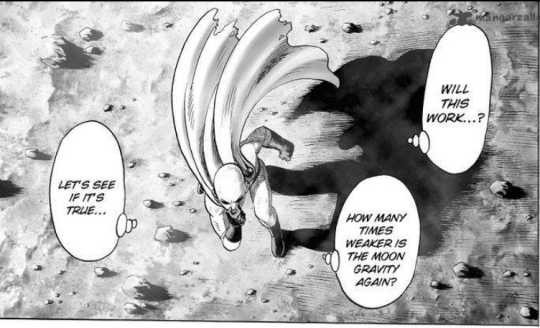
The reason I wanted to make this post is because of one scene in One Punch Man that perfectly exemplifies how to translate a written thought process into visual storytelling. After getting punched to the moon (err, spoilers), Saitama has this thought process
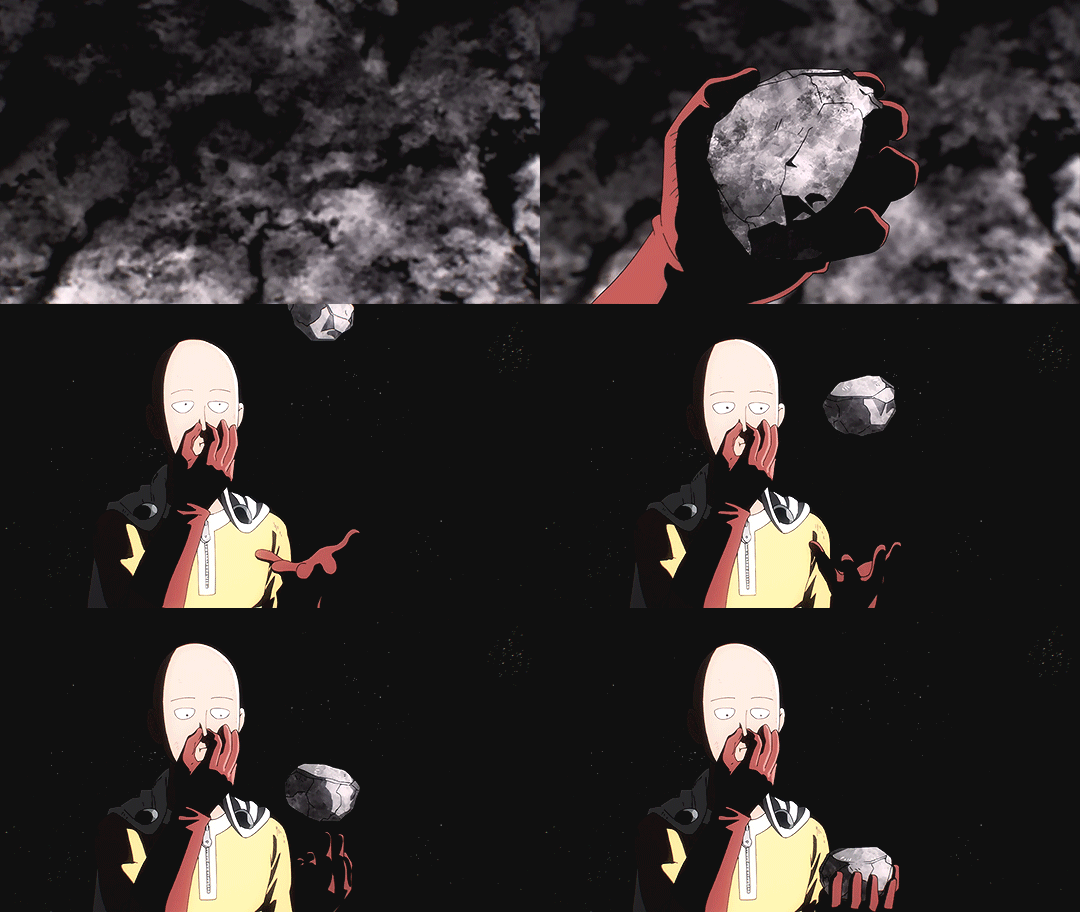
and it’d be easy to translate that entirely literally in the anime, Saitama crouches, has an internal monologue as he tries to figure out how much force he needs to put into his jump, and then he launches. Instead though, the scene is done completely silently, to sell the fact that he’s in space, but the thought process isn’t removed, it’s just show visually.
He throws a bit of moon rock to gauge the moon’s gravity, then launches, it’s a much more thoughtful approach to the scene and the audience’s ability to interpret visual information.
I just, really wish more adaptations realized the inherent strength of the visual medium instead of relying entirely on the source material’s structure and reliance on its own medium.
Most commonly, this is exemplified with the Sassy Gay Best Friend. The Sassy Gay Best Friend has no queer friends, inexplicably content to surround himself exclusively with heterosexual, cisgender women and listen to them vent about what pugnacious assholes their boyfriends are.
The Sassy Gay Best Friend exhausts me just by thinking about him. The closest friends of every other queer person I know are composed predominantly of other queer people, myself included, and it’s with other queer people that we tend to best connect.
Dealing with large groups of straight people tends to exhaust and upset me, and I cannot imagine voluntarily opting into half the amount of heterosexual melodrama as the Sassy Gay Best Friend.
Especially to forward the development of straight people, which it usually is.
The Bury Your Gays trope is thought to have originated with the strict censorship laws of the twentieth century, which dictated that queer characters and relationships could only be portrayed if they atoned for their sins and “turned straight” by the end of the story, or – drumroll please – died.
In other words, the only thing burying your gays accomplishes is contributing to an ugly cycle. So if you have the option not to kill off queer characters, don’t.
This phenomenon, commonly known as queerbaiting, originated with clever creators finding loopholes in the aforementioned censorship laws of the nineteenth and twentieth century, by weaving romantic and/or erotic relationships between same gender-characters in between the lines.
One of my favorite examples of this phenomenon is 1950s film Some Like It Hot, a surprisingly tender and thoughtful examination of gender identity, femininity, and sexual orientation. Concisely put, the two male leads are circumstantially compelled to disguise themselves as women and travel with an all-female band, during which one of the men captures the affection of a (male) millionaire, who asks for his hand in marriage. He says yes, and the film ends with this exchange:
Okay, this isn’t exactly subtext, which is why the film was produced without the approval of the Motion Picture Production Code. But you get the idea: this is as blatant as queer identities could be in 1950s America.
The key difference? It is no longer the 1950s, and what was revolutionary for the time period is not revolutionary now. Don’t repeat JK Rowling’s fallacy and expect to squeak by with subtextual or offscreen representation.
Far too often, queer rep in the media showcases dysfunctional relationships, usually short-term, sex-based, and/or with a reasonably severe power imbalance (looking at you, Call Me By Your Name.) This is worrisome, because it conveys an unhealthy message to queer youth about what normality looks like, and perpetrates a pervasive stereotype that queer people are more likely to be deviant and unhealthy than their straight peers.
So allow your work to reflect this! Portray loving, supportive, and affectionate queer couples who encourage one another’s success and quality of life. Think Nomi and Amanita from Sense8, or Holt and Kevin from Brooklyn 99.
To countermand this, try to portray queer love as sweet, pure, and wholesome whenever possible. Depict puppy love and crushes and adorable dates between same gender couples. Expunge the idea that queer sexuality is inherently profane.
This doesn’t mean the couples can’t be interesting or complex, mind you – books such as Aristotle and Dante Discover the Secrets of the Universe are excellent examples of tenderly portrayed first love, while painting intriguing portraits of complex feelings and characters.
If you’re a straight person who hasn’t interacted much with the queer community, I’m going to personally recommend that you stay away from stereotypes. Promiscuous bisexuals, flamboyant gay men, butch lesbians, et cetera.
These people exist and deserve to be depicted – I’ve even depicted two out of the aforementioned three examples in me my most recent novel – but I’m inclined that it takes a member of the queer community to portray them with authenticity and respect.
So where do you start? Casual representation, that’s where.
Give me trans men relaxing in their binders at the end of the day, casual mention of same-gender crushes or past partners, a same-gender partner that the hero is fighting to get home to. Sometimes the best form of representation is to depict queer people as simply existing and living their lives.
Disclaimer:
These are all based off of my personal pet peeves and opinions as a queer woman, and you don’t have to follow any of them. Though I firmly believe we need better representation from up-and-coming authors, I’m profusely anti-censorship, and I believe everyone deserves to write their story the way they want to.
I hope this helps, and happy writing! ❤
Or just write how you want and ignore virtue signaling bs. Characters are characters. Sexuality is an afterthought
A) Read the end of this post, where I clearly said I support everyone’s prerogative to write how they want.
B) It’s hypocritical to accuse me of virtue signaling when this response is clearly a contrived attempt to appear edgy without actually improving your writing.
C) Sexuality isn’t an afterthought in the seventy-four countries where homosexuality is still illegal, the ten countries where it’s punishable by death, or the forty-one states where forced conversion therapy is still permitted, but you do you, buddy.
OH MY GOD whyyyy did no one tell me you’re supposed to send thank-yous after interviews?? Why would I do that???
“Thank you for this incredibly stressful 30 minutes that I have had to re-structure my entire day around and which will give me anxiety poos for the next 24 hours.”
I HATE ETIQUETTE IT’S THE MOST IMPOSSIBLE THING FOR ME TO LEARN WITHOUT SOMEONE DIRECTLY TELLING ME THIS SHIT
NO ONE TOLD YOU???? WTF! I HAVE FAILED YOU.
Also:
Dear ______:
Thank you so much for the opportunity to sit down with you (&________) to discuss the [insert job position]. I am grateful to be considered for the position. I think I will be a great fit at [company name], especially given my experience in __________. [insert possible reference to something you talked about, something that excited you.] I look forward to hearing from you [and if you are feeling super confident: and working together in the future].
My brother got a really great paid internship one summer. The guy who hired him said the deciding factor was the professional thank you letter my brother sent after the interview.
should it be an email? or like a physical letter?
email, you want to send it within a few hours at max after the interview if you can so it’s fresh in their mind who you are.
Confirmed! I interviewed for a job right after arriving in NY. The interview went incredibly well, and I went home and immediately wrote a thank you letter and put it in the mail. I had a super good feeling about this interview.
I didn’t get the job.
However, a few weeks later, I was called in to interview with another editor in the same company, and I did get that job. I found out later from the initial editor (the one who didn’t hire me) that he had planned to offer me the job, but since I didn’t follow up with a thank you letter, he assumed I didn’t really want it. He offered the job to another contender–but when he got my letter in the mail shortly after the offer had already been made, he went to HR and gave me a glowing recommendation. It was based on that recommendation that I got called in for the second interview.
So: send an email thank you immediately (same day!) after the interview. If you’re feeling extra, go ahead and send a written one too. OR go immediately to a coffee shop, write the letter, and return to the office and give it to the secretary.
Either way, those letters are important.
Pro tip: If you really want HR to develop a personal interest in your application, publicly thank them on linkedin. Just make a short post telling your network about how X recruiter really went above and beyond to make you feel welcome, or about how be accommodating and professional they were, or whatever. Make sure to use the mention feature so they’ll get a notification and see it.
Flattery will get you everywhere… and public flattery that might make its way back to their manager, doubly so.
Obligatory plug for one of FreePrintable.net’s sites: ThankYouLetter.ws. They have a whole section with interview thank you letter templates, and a page with specific tips for interview thank you letters. (There are also tons of other letter templates if you browse around a bit.)
YES. This whole thread is the best thing and betterbemeta’s tags (above) are on point. I would love actual ‘realistic ancient battles’ where like ten actual fighters and whatever serfs they can persuade to accompany them posture and try to intimidate each other, or have an Official Scrum on a mutually beneficial day. That and just…cattle raiding.
I guess in post-collapse terms it’s theoretically different because your whole raider gang exists to nick other people’s shit so doesn’t need to cultivate or craft much except perhaps to make them more self-sufficient in weaponry, armaments, and other logistical things that’ll enable them to raid harder and more often. That’s exactly why, on the other side of things, as many citizen’s as possible in your vulnerable good-guy farming commune might need to be militia members to protect themselves from people who can dedicate their full-time everyday energy to Being Raiders.
I say in theory because, even if you’re nicking other people’s shit, why not treat that as a bonus? Why not look to history’s peoples who placed a particular import on raiding as a way of life, and notice that none of them were just straight-up predators. They had enough agricultural or pastoral or pescatoral (is that a word?) infrastructure to subsist, and then the luxury, the surplus, came from attacking other people part-time, very occasionally. Look at norse folks going viking; look at the invasive pastoralists of the Eurasian steppe. Just in terms of the caloric requirements and risks inherent in combat, you’re not gonna want to do that full-time. Training to do it well will take more calories and they need to come from somewhere. You pick your battles. You take without fighting at all where you can – so intimidation and making enemies surrender without having to fight is important here; c.f. pirates of the Golden Age – and you fight rarely and only when you know you can a) win, b) benefit hugely from it.
THANK YOU
i think this post has changed my world. literally.






 wupacing