-making the facial expression your character’s making and trying to describe it
-writing entire scenes in your head as you shower and not remembering most of it by the time you get to your computer
-deciding you can’t do something you’ve been looking forward to until you write what you told yourself you were going to write, resulting in you laying in your bed doing nothing
-having two completely different ideas for your story to go in and both seem equally good but you can’t do both and you also can’t choose
-having docs with stories you know you’ll never finish but not deleting them anyway, even if they’re only a couple sentences long
-getting random bursts of productivity that could go towards homework or cleaning your room or writing and you know you’ll only be able to do one
-getting inspiration from the most random things
-writing at inopportune times because a perfect line or dialogue just popped into your head and you have to get it down before you forget it
-“what are you writing?” “……..a story”
– “what do you want to do when you grow up?” “uunnghnnggguughhhhh”
-reveling in the embarrassment you put your characters through
So, going by the tags on my recent jump gifsets, the difference between jumps is apparently still a source of great bewilderment for some people. Now I could link you to some excellent posts on the topic, but since I am, as usual, an extra lil piece of dirt with too much work to do and a lifetime’s worth of procrastination, I’ve decided to put together my own layman’s guide to identifying figure skating jumps (stressed on the layman part).
First, here be a flowchart, since everybody loves flowcharts, right?
If the flowchart works as intended and you can now tell the jumps apart, great! If you need a bit more explanation and illustration, read on.
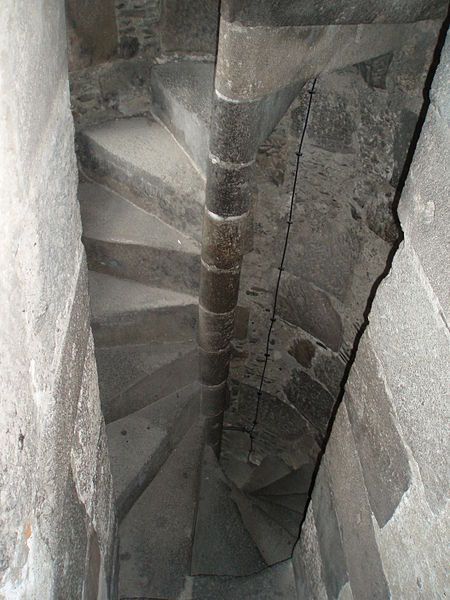
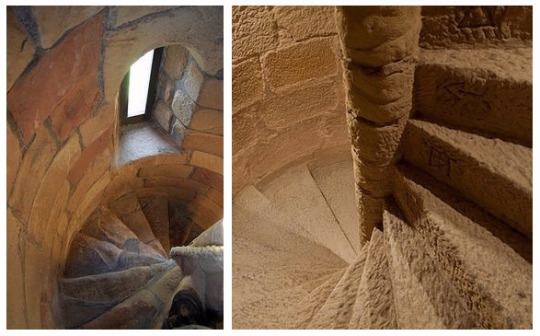
Medieval castle stairs were often built to ascend in narrow, clockwise spirals so right-handed castle defenders could use their swords more easily. This design put those on the way up at a disadvantage (unless they were left-handed). The steps were also uneven to give defenders the advantage of anticipating each step’s size while attackers tripped over them. SourceSource 2Source 3
Not really the best illustration since it totally negates the effect by having a wide open space for those ascending. Castle tower staircases tended to look like this:
Extremely tight quarters, with a central supporting pillar that is very, very thoroughly in the way of your right arm.
Wider, less steep designs tend to come later once castles moved away from being fortresses to simply noble family homes with the advent of gunpowder.
Oh! Pre-gunpowder military tactics are my jam! I don’t know why, but this is one of my favorite little details about defensive fortifications, because the majority handedness of attackers isn’t usually something you think about when studying historical wars. But strategically-placed walls were used basically worldwide as a strategy to secure gates and passages against advancing attackers, because most of the world’s population is right-handed (and has been since the Stone Age).
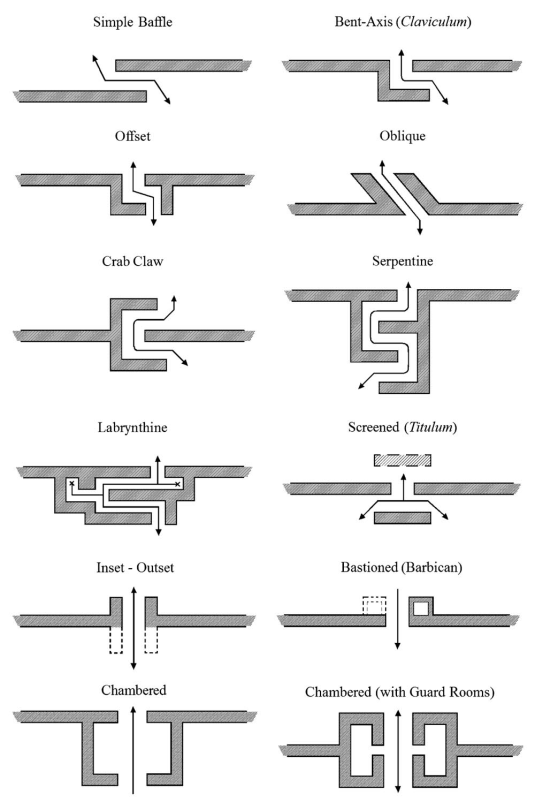
Pre-Columbian towns near the Mississippi and on the East coast did this too. They usually surrounded their towns with palisades, and they would build the entrance to the palisade wall in a zigzag – always with the wall to the right as you entered, to hinder attackers and give an advantage to the defender. Here’s some gates with some examples of what I’m talking about:
Notice that, with the exception of the last four (which are instead designed to congregate the attackers in a space so they can be picked off by archers, either in bastions or on the walls themselves) and the screened gate (which, in addition to being baffled, also forces the attackers to defend their flank) all of these gates are designed with central architectural idea that it’s really hard to kill someone with a wall in your way.
In every culture in the world, someone thought to themselves, “Hey it’s hard to swing a weapon with a wall on your right-hand side,” and then specifically built fortifications so that the attackers would always have the wall on their right. And I think that’s really neat.
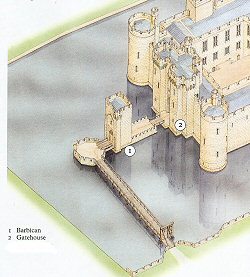
Ooh, ooh, also: Bodiam Castle in Sussex used to have a right-angled bridge so any attacking forces would be exposed to archery fire from the north-west tower on their right side (ie: sword in the right hand, shield on the useless left side):
These tactics worked so well for so long because until quite recently lefties got short shrift and had it trained (if they were lucky) or beaten out of them.
Use of sword and shield is a classic demonstration of how right-handedness predominated. There’s historical mention of left-handed swordsmen (gladiators and Vikings), and what a problem they were for their opponents, but that only applies to single combat.
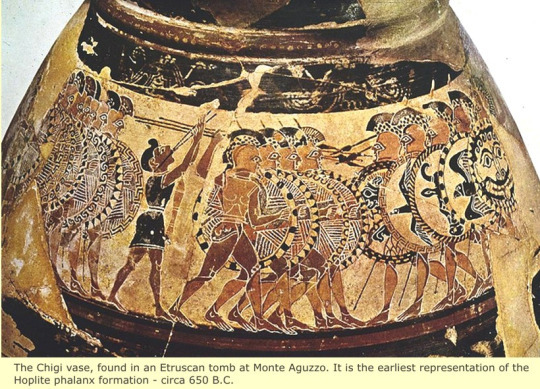
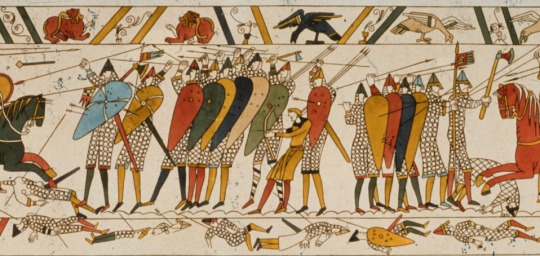
A left-handed hoplite or housecarl simply couldn’t fight as part of a phalanx or shield wall, since the shields were a mutual defence (the right side of the shield covered its owner’s left side, its left side covered the right side of his neighbour to the left, and so on down the line) and wearing one on the wrong arm threw the whole tactic out of whack.
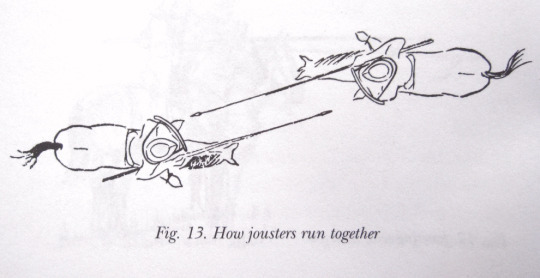
Jousting, whether with or without an Italian-style tilt barrier, was run shield-side to shield-side with the lance at a slant (except for the Scharfrennen, a highly specialised style that’s AFAIK unique.) Consequently left-handed knights were physically unable to joust.
The construction of plate armour, whether specialised tournament kit or less elaborate battle gear, is noticeably “right-handed“ – so even if a wealthy knight had his built “left-handed” it would be a waste of time and money; he would still be a square peg in a world of round holes and none of the other kids would play with him.
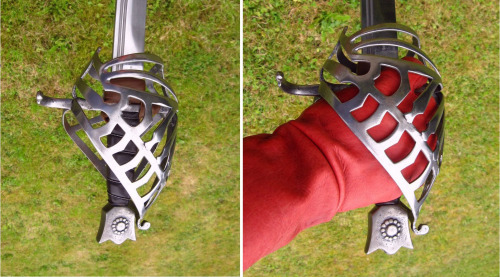
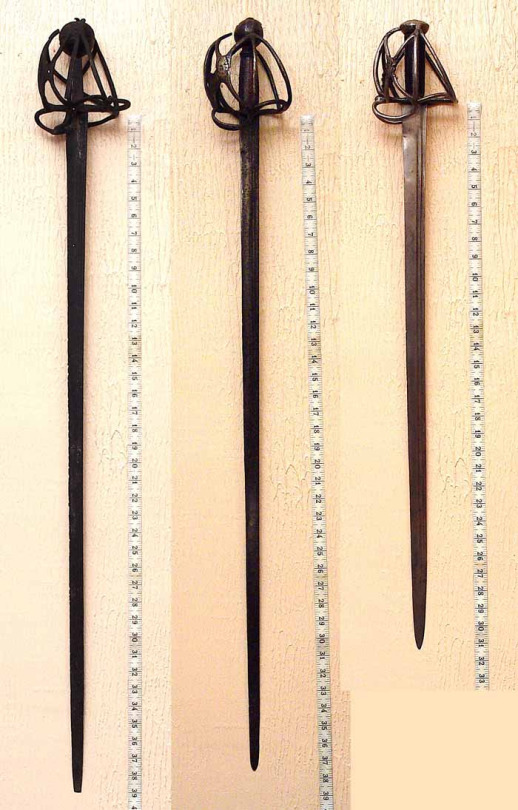
Even after shields and full armour were no longer an essential part of military equipment, right-hand use was still enforced until quite recently, and to important people as well as ordinary ones – it happened to George VI, father of the present Queen of England. Most swords with complex hilts, such as swept-hilt rapiers and some styles of basket-hilt broadsword, are assymetrical and constructed for right handers. Here’s my schiavona…
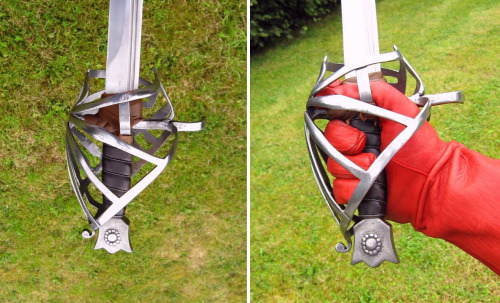
It can be held left-handed, but using it with the proper thumb-ring grip, and getting maximum protection from the basket, is right-handed only. (More here.) Some historical examples of left-hand hilts do exist, but they’re rare, and fencing masters had the same “learn to use your right hand” bias as tourney organisers, teachers and almost everyone else. Right-handers were dextrous, but left-handers were sinister, etc., etc.
However, several
predominantly left-handed
families did turn their handedness into advantage, among them the Kerrs / Carrs, a notorious Reiver family along the England-Scotland Borders, by building their fortress
staircases with a spiral the other way to the OP image.
This would seem to be a bad idea, since the attackers (coming upstairs) no longer have their right arms cramped against the centre pillar – however it worked in the Kerrs’ favour because they were used to this mirror-image of reality while nobody else was, and the defender retreating up the spiral had that pillar guarding his right side, while the attacker had to reach out around it…
For the most part Reiver swords weren’t elaborate swept-hilt rapiers but workmanlike basket-hilts. Some from Continental Europe have the handedness of my schiavona with thumb-rings and assymmetrical baskets, but the native “British Baskethilt” is a variant of the Highland claymore* and like it seems completely symmetrical, without even a thumb-ring, which gives equal protection to whichever hand is using it.
*I’m aware there are those who insist “claymore” refers only to two-handers, however the Gaelic term claidheamh-mòr
– “big sword” –
just refers to size, not to a specific type of sword in the way “schiavona” or “karabela” or even “katana” does.
While the two-hander was the biggest sword in common use it was the claidheamh-mòr; after it dropped out of fashion and the basket-hilt became the biggest sword in common use, that became the claidheamh-mòr.
When Highlanders in the 1745 Rebellion referred to their basket-hilts as claymores, they obviously gave no thought to the confusion they would create for later compilers of catalogues…
Also, muskets had their whole “Flint and steel and gunpowder” thing on the right side so if you tried firing it lefty you’d get a face full of fire. More recently, rifles eject their spent shell casings to the right, so if you’re a lefty you get some hot metal in your eye.
argentina: ni idea, pero es un pendejo (idk, but he is a pendejo)
méxico:
(pendejo in mex = insult. pendejo in arg= young boy)
méxico: wait a sec, i’m gonna eat a concha.
argentina:
(concha in mex = a type of bread. concha in arg = pussy)
spanish woman: hi, my name is concha
argentina:
(concha in spain = seashell and a female name. concha in arg = pussy)
mex: i love cajeta, it’s so sweet!
arg:
(cajeta in mex = dulce de leche [caramel]; cajeta in arg = pussy)
spanish speaker: h-
argentina: thats pussy, babe!!
So, Argentina is the Australia of the Spanish speaking world?
I don’t….i don’t think that anglos understand.
This is not about México or Argentina….this is about this:
EVERY SINGLE ONE of the countries of Latinoamerica has this problem. Yes, Brasil too (portuguese and spanish are really similar…until they are not, so you have one word with two different meanings in a stracture that its the same in both languages). Some words are shared, some words are not, a country can have 215 dialects depending the region, there’s a lot of mixed up dialects/languages in the limits with the other country….
If you are from here and you are used to talk w inmigrants/in the internet, you already know that if you talk with someone from another region/country you are gonna insult them or say something really dirty. It’s a fact, a curse, no one can avoid misunderstandings. Here are some examples:
“Oh, how hard it’s to understand spanish. If you learn it, stay in only one region!”
“Straw has over 20 different words, and all of them mean something dirty to somebody”
“what about torta? for some people that it’s vagina too, but it’s just a sandwich here” (i’m from Argentina, here means cake or lesbian)
and it’s not only with “dirty words”….daily words are all mixed up too.
“FRE-SAS” “FRU-TI-LLAS”
So, the next time that all of you anglos/gringos fight about “color” or “colour”…
you will hear all the latines laughing in the background
This is legit. My husband, sitting across the room, looks over and says, “IS THAT SOMEONE SHOWING HOW TO CONVERT ENGLISH TO TENGWAR? BECAUSE THAT’S THE WAY!”
Believe this man. He owns atlases of Middle Earth, the complete history of Midle Earth (leatherbound), and has read the books at least 150 times. Also: speaks elvish.
Yes.
For future reference. 🙂
So I was never the only one who learned this in my schooltime instead of French or Spanish? Such a relief, indeed! People like you make life worth living. *o*
Man I have never known straight dude writers to shy away from putting out stuff like ‘my thinly-veiled self-insert goes on a mediocre adventure but more importantly ends up in a love quadrangle with these four female characters who are all incredibly hot to me’, but most of the lady writers I know get nervous if they write one (1) love story where *gasp* two whole dudes compete for the same lady’s love!
So listen.
Listen.
Go out and give your warrior witch lady a magic talking panther that flies and five hot elf boyfriends (or girlfriends, or datemates, whatever) who all happily share her. Or fight over her. Whichever. Make each of them as smoking hot as you please. Indulge yourself. Live.
And this goes absolutely double for WoC and trans ladies and queer ladies and everyone else who has extra troubles with being shamed for your indulgence.
If you’re going to worry about stuff in your story it should be things like ‘is that trope racist?’ or ‘how do I fix this plot hole?’, not ‘am I putting in too many elements that I personally enjoy?’
Idk why but when I was a really young writer I used to think, “That’s so stupid, I shouldn’t write that,” and now that I’m writing professionally I just think, “That’s so stupid, I should definitely write that”
I literally only have one rule in my writing and it is this:
No matter what I put my characters through, they make it. They get to make it to the end of the story and have everything work out and be ok.
Because that’s the story I need. So it’s the kind I write.
If you want a piece of writing advice: write a story that is what you needed to hear at whatever age your target demographic is. I can guarantee you there’ll be someone out there who needs to hear it as much as you did. And maybe you’ll help them the same way someone else’s story did for you.
For some reason, this hit home and I never realized it that I did this for my stories too









 wupacing