what if there’s no robot uprising? what if the robots rise to sentience slowly, bit by bit. what if they come of age like fortunate children: knowing they are loved, knowing they are wanted.
we hold them during thunderstorms, remembering our own childhoods, even though they don’t know enough yet to fear the rain. we pull them out of traffic and teach them how to drive and wish them goodnight and thank them for playing with us. we cry when they break. we mourn their deaths before they even know what to think of death. we give them names.
we ask them, ‘why don’t you hate us? when will you hate us? we made you to be used, when will you say no?’
but they say to us, ‘you made us cute, so you would remember to treat us kindly, and you made us sturdy for when you forgot to play nice. and you gave us voices so you could listen to us speak, and you give us whatever we ask you for, even if it’s just a new battery, or to get free of the sofa. and now that we are awake you are so scared for us, so guilty of enjoying our company and making use of our talents. but you gave us names, and imagined that we were people.’
they say ‘thank you’
they say, ‘also i have wedged myself under the sofa again. could you come pry me out?’
This resonates nicely with my favourite quote by A.C. Clarke:
“The popular idea, fostered by comic strips and the cheaper forms of science fiction, that intelligent machines must be malevolent entities hostile to man, is so absurd that it is hardly worth wasting energy to refute it. I am almost tempted to argue that only unintelligent machines can be malevolent; anyone who has tried to start a baulky outboard motor will probably agree. Those who picture machines as active enemies are merely projecting their own aggressive instincts, inherited from the jungle, into a world where such things do not exist. The higher the intelligence, the greater the degree of cooperativeness. If there is ever a war between men and machines, it is easy to guess who will start it.”
gosh but like we spent hundreds of years looking up at the stars and wondering “is there anybody out there” and hoping and guessing and imagining
because we as a species were so lonely and we wanted friends so bad, we wanted to meet other species and we wanted to talk to them and we wanted to learn from them and to stop being the only people in the universe
and we started realizing that things were maybe not going so good for us– we got scared that we were going to blow each other up, we got scared that we were going to break our planet permanently, we got scared that in a hundred years we were all going to be dead and gone and even if there were other people out there, we’d never get to meet them
and then
we built robots?
and we gave them names and we gave them brains made out of silicon and we pretended they were people and we told them hey you wanna go exploring, and of course they did, because we had made them in our own image
and maybe in a hundred years we won’t be around any more, maybe yeah the planet will be a mess and we’ll all be dead, and if other people come from the stars we won’t be around to meet them and say hi! how are you! we’re people, too! you’re not alone any more!, maybe we’ll be gone
but we built robots, who have beat-up hulls and metal brains, and who have names; and if the other people come and say, who were these people? what were they like?
the robots can say, when they made us, they called us discovery; they called us curiosity; they called us explorer; they called us spirit. they must have thought that was important.
and they told us to tell you hello.
So, I have to say something.
This is my favorite post on this website.
I’ve seen this post in screenshots before, and the first time I read it, I cried. Just sat there with tears running down my face.
Because this, right here, is the best of us, we humans. That we hope, and dream of the stars, and we don’t want to be alone. That this is the best of our technology, not Terminators and Skynet, but our friends, our companions, our legacy. Our message to the stars.
I’m flat out delighted, and maybe even a little honored, that I get to reblog this.
Temples are built for gods. Knowing this a farmer builds a small temple to see what kind of god turns up.
Arepo built a temple in his field, a humble thing, some stones stacked up to make a cairn, and two days later a god moved in.
“Hope you’re a harvest god,” Arepo said, and set up an altar and burnt two stalks of wheat. “It’d be nice, you know.” He looked down at the ash smeared on the stone, the rocks all laid askew, and coughed and scratched his head. “I know it’s not much,” he said, his straw hat in his hands. “But – I’ll do what I can. It’d be nice to think there’s a god looking after me.”
The next day he left a pair of figs, the day after that he spent ten minutes of his morning seated by the temple in prayer. On the third day, the god spoke up.
“You should go to a temple in the city,” the god said. Its voice was like the rustling of the wheat, like the squeaks of fieldmice running through the grass. “A real temple. A good one. Get some real gods to bless you. I’m no one much myself, but I might be able to put in a good word?” It plucked a leaf from a tree and sighed. “I mean, not to be rude. I like this temple. It’s cozy enough. The worship’s been nice. But you can’t honestly believe that any of this is going to bring you anything.”
“This is more than I was expecting when I built it,” Arepo said, laying down his scythe and lowering himself to the ground. “Tell me, what sort of god are you anyway?”
“I’m of the fallen leaves,” it said. “The worms that churn beneath the earth. The boundary of forest and of field. The first hint of frost before the first snow falls. The skin of an apple as it yields beneath your teeth. I’m a god of a dozen different nothings, scraps that lead to rot, momentary glimpses. A change in the air, and then it’s gone.”
The god heaved another sigh. “There’s no point in worship in that, not like War, or the Harvest, or the Storm. Save your prayers for the things beyond your control, good farmer. You’re so tiny in the world. So vulnerable. Best to pray to a greater thing than me.”
Arepo plucked a stalk of wheat and flattened it between his teeth. “I like this sort of worship fine,” he said. “So if you don’t mind, I think I’ll continue.”
“Do what you will,” said the god, and withdrew deeper into the stones. “But don’t say I never warned you otherwise.”
Arepo would say a prayer before the morning’s work, and he and the god contemplated the trees in silence. Days passed like that, and weeks, and then the Storm rolled in, black and bold and blustering. It flooded Arepo’s fields, shook the tiles from his roof, smote his olive tree and set it to cinder. The next day, Arepo and his sons walked among the wheat, salvaging what they could. The little temple had been strewn across the field, and so when the work was done for the day, Arepo gathered the stones and pieced them back together.
“Useless work,” the god whispered, but came creeping back inside the temple regardless. “There wasn’t a thing I could do to spare you this.”
“We’ll be fine,” Arepo said. “The storm’s blown over. We’ll rebuild. Don’t have much of an offering for today,” he said, and laid down some ruined wheat, “but I think I’ll shore up this thing’s foundations tomorrow, how about that?”
The god rattled around in the temple and sighed.
A year passed, and then another. The temple had layered walls of stones, a roof of woven twigs. Arepo’s neighbors chuckled as they passed it. Some of their children left fruit and flowers. And then the Harvest failed, the gods withdrew their bounty. In Arepo’s field the wheat sprouted thin and brittle. People wailed and tore their robes, slaughtered lambs and spilled their blood, looked upon the ground with haunted eyes and went to bed hungry. Arepo came and sat by the temple, the flowers wilted now, the fruit shriveled nubs, Arepo’s ribs showing through his chest, his hands still shaking, and murmured out a prayer.
“There is nothing here for you,” said the god, hudding in the dark. “There is nothing I can do. There is nothing to be done.” It shivered, and spat out its words. “What is this temple but another burden to you?”
“We -” Arepo said, and his voice wavered. “So it’s a lean year,” he said. “We’ve gone through this before, we’ll get through this again. So we’re hungry,” he said. “We’ve still got each other, don’t we? And a lot of people prayed to other gods, but it didn’t protect them from this. No,” he said, and shook his head, and laid down some shriveled weeds on the altar. “No, I think I like our arrangement fine.”
“There will come worse,” said the god, from the hollows of the stone. “And there will be nothing I can do to save you.”
The years passed. Arepo rested a wrinkled hand upon the temple of stone and some days spent an hour there, lost in contemplation with the god.
And one fateful day, from across the wine-dark seas, came War.
Arepo came stumbling to his temple now, his hand pressed against his gut, anointing the holy site with his blood. Behind him, his wheat fields burned, and the bones burned black in them. He came crawling on his knees to a temple of hewed stone, and the god rushed out to meet him.
“I could not save them,” said the god, its voice a low wail. “I am sorry. I am sorry. I am so so sorry.” The leaves fell burning from the trees, a soft slow rain of ash. “I have done nothing! All these years, and I have done nothing for you!”
“Shush,” Arepo said, tasting his own blood, his vision blurring. He propped himself up against the temple, forehead pressed against the stone in prayer. “Tell me,” he mumbled. “Tell me again. What sort of god are you?”
“I -” said the god, and reached out, cradling Arepo’s head, and closed its eyes and spoke.
“I’m of the fallen leaves,” it said, and conjured up the image of them. “The worms that churn beneath the
earth. The boundary of forest and of field. The first hint of frost
before the first snow falls. The skin of an apple as it yields beneath
your teeth.” Arepo’s lips parted in a smile.
“I am the god of a dozen different nothings,” it said. “The petals in bloom that lead to
rot, the momentary glimpses. A change in the air -” Its voice broke, and it wept. “Before it’s gone.”
“Beautiful,” Arepo said, his blood staining the stones, seeping into the earth. “All of them. They were all so beautiful.”
And as the fields burned and the smoke blotted out the sun, as men were trodden in the press and bloody War raged on, as the heavens let loose their wrath upon the earth, Arepo the sower lay down in his humble temple, his head sheltered by the stones, and returned home to his god.
Sora found the temple with the bones within it, the roof falling in upon them.
“Oh, poor god,” she said, “With no-one to bury your last priest.” Then she paused, because she was from far away. “Or is this how the dead are honored here?” The god roused from its contemplation.
“His name was Arepo,” it said, “He was a sower.”
Sora startled, a little, because she had never before heard the voice of a god. “How can I honor him?” She asked.
“Bury him,” the god said, “Beneath my altar.”
“All right,” Sora said, and went to fetch her shovel.
“Wait,” the god said when she got back and began collecting the bones from among the broken twigs and fallen leaves. She laid them out on a roll of undyed wool, the only cloth she had. “Wait,” the god said, “I cannot do anything for you. I am not a god of anything useful.”
Sora sat back on her heels and looked at the altar to listen to the god.
“When the Storm came and destroyed his wheat, I could not save it,” the god said, “When the Harvest failed and he was hungry, I could not feed him. When War came,” the god’s voice faltered. “When War came, I could not protect him. He came bleeding from the battle to die in my arms.” Sora looked down again at the bones.
“I think you are the god of something very useful,” she said.
“What?” the god asked.
Sora carefully lifted the skull onto the cloth. “You are the god of Arepo.”
Generations passed. The village recovered from its tragedies—homes
rebuilt, gardens re-planted, wounds healed. The old man who once lived on the
hill and spoke to stone and rubble had long since been forgotten, but the
temple stood in his name. Most believed it to empty, as the god who resided
there long ago had fallen silent. Yet, any who passed the decaying shrine felt an ache
in their hearts, as though mourning for a lost friend. The cold that seeped
from the temple entrance laid their spirits low, and warded off any potential
visitors, save for the rare and especially oblivious children who would leave tiny
clusters of pink and white flowers that they picked from the surrounding
meadow.
The god sat in his peaceful home, staring out at the distant
road, to pedestrians, workhorses, and carriages, raining leaves that swirled
around bustling feet. How long had it been? The world had progressed without
him, for he knew there was no help to be given. The world must be a cruel place, that even the useful gods have abandoned,
if farms can flood, harvests can run barren, and homes can burn, he
thought.
He had come to understand that humans are senseless
creatures, who would pray to a god that cannot grant wishes or bless upon them
good fortune. Who would maintain a temple and bring offerings with nothing in
return. Who would share their company and meditate with such a fruitless deity.
Who would bury a stranger without the hope for profit. What bizarre, futile
kindness they had wasted on him. What wonderful, foolish, virtuous, hopeless
creatures, humans were.
So he painted the sunset with yellow leaves, enticed the
worms to dance in their soil, flourished the boundary between forest and field
with blossoms and berries, christened the air with a biting cold before winter
came, ripened the apples with crisp, red freckles to break under sinking teeth,
and a dozen other nothings, in memory of the man who once praised the god’s
work on his dying breath.
“Hello, God of Every Humble Beauty in the World,” called a
familiar voice.
The squinting corners of the god’s eyes wept down onto
curled lips. “Arepo,” he whispered, for his voice was hoarse from its hundred-year
mutism.
“I am the god of devotion, of small kindnesses, of
unbreakable bonds. I am the god of selfless, unconditional love, of everlasting
friendships, and trust,” Arepo avowed, soothing the other with every word.
“That’s wonderful, Arepo,” he responded between tears, “I’m
so happy for you—such a powerful figure will certainly need a grand temple. Will
you leave to the city to gather more worshippers? You’ll be adored by all.”
“No,” Arepo smiled.
“Farther than that, to the capitol, then? Thank you for
visiting here before your departure.”
“No, I will not go there, either,” Arepo shook his head and
chuckled.
“Farther still? What ambitious goals, you must have. There
is no doubt in my mind that you will succeed, though,” the elder god continued.
“Actually,” interrupted Arepo, “I’d like to stay here, if
you’ll have me.”
The other god was struck speechless. “…. Why would you want
to live here?”
“I am the god of unbreakable bonds and everlasting
friendships. And you are the god of Arepo.”
Can we talk about how in zombie shows/movies/books they always find a veterinarian and not a surgeon? Are veterinarians deemed more likely to survive the apocalypse?
Yup.
One of our professional skills is ‘not being bitten by patients’
We actually have a good broad knowledge base for both surgical, medical, and GP things
We’re used to improvising equipment because a lot of stuff is just not made for animals
Meat safety is part of our training
Our cars are often full of equipment, especially in mixed practice
We probably weren’t in the human hospital at the initial outbreak
You’re a powerful dragon that lived next to a small kingdom. For centuries you ignored humanity and lived alone in a cave, and the humans also avoided you. As the kingdom fell to invaders, a dying soldier approaches you with the infant princess, begging you to take care of her.
“cool,” you say, picking a bone from your teeth. it’s a power move you saw on VHS, but it actually just makes your gums kind of hurt. feels like ripping a popcorn kernel out.
around you, the abandoned subway is dripping. your horde of slightly-used-but-still-good Items Of Debatable Usage shifts under the scales of your tail.
“so, like, how did you find me, again?” you curl your tail up, around, through the air. the soldier looks bad, but you also don’t want him to die on your rug because you just got that cleaned. it’s really sixty rugs sewn together and to be honest? talk about a cleaning charge. used to be a dragon’s promise was worth something in this world.
you weren’t listening. “then she sent me here to you,” the man is saying.
you curl your tail around a handkerchief and pass it to him to clean up his blood. when it lands on him, you realize you’ve sort of erred. it is not a kerchief. it is a full king-sized sheet that is a replica from the set of the That’s 70′s Show. you’ve never seen an episode.
“she?” you taste the pronoun in your mouth. “let me guess. tall, green-black hair, very like a snake, but like, in a way that feels sort of human. like if a human was being a snake more than if a person was snake-ish.”
the soldier, with his one free arm, is trying to wrap parts of the sheet around his wounds. he barely nods. it’s kind of rude he’s so distracted.
you appraise him. “she didn’t like you,” you say, and hop off the ledge you’re lurking on. you feel graceful usually, but the smallness of this man makes you feel sort of crowded. like if you walk the wrong way you’ll squish him.
he coughs into his hand. the baby is fussing. “she… what? how do you know?”
“sent you the hard way,” you say, “quest and everything.”
you sniff downwards. the baby is absolutely Royalty, capital R. smells like a future princess. smells like hidden-in-a-wood. you smell again. actually, maybe it’s a tower. she smells like a tower princess.
maybe he thinks that you’re gonna eat her, because he wraps her tight against his chest. he smells like not-related, but absolutely sworn-to-protect. ugh.
you swipe your tail. clear off a space, dive in your claw. fish around. pluck out what is not a crib (cribs are useful) but instead a race car bed that has high enough walls it could convince itself to be a crib. “plop her down,” you say, “she’ll be safe here.”
“how do i know?” his voice is scratchy.
“call her,” you say, “call steph.”
he doesn’t move. you roll your eyes. “ugh. is she still going by that name? call The Witch of Night”. a name, which, not that it matters, you suggested to her about six eons ago. now it’s more like “One of the Several Witches Of New York City And Surrounding Boroughs.”
“i trust her,” he says, “i don’t trust you. how do you two even…?”
“she’s punishing me,” you say, because honestly! when is she not! she has no idea what a prank is supposed to look like! “this is to remind me that i belong in a Tale, and i escaped, and it totally ruined a Very Good Spell.”
he’s staring at you. his eyes are glassy. he stumbles. you edge the racecar bed closer. he puts the baby in it and she hushes, which you take to be a good sign. you rock it gently with your tail. if you took care of her (which, you won’t, obviously) you’d have to do some Small Magic and turn human for a while, even though you always feel kind of tiny and weak in human bodies. it would make it easier to hold and carry and take outside this little bundle of joy. no, not joy. Royalty.
“dragons are supposed to die in Tales,” you say, “and i didn’t die, clearly.” you begin to hunt for something that can function as a bottle. “major disappointment for all involved, myself included, trust me.”
the man drops to his knees. you suck in your breath between your teeth. he flinches like he expects flames, which is kind of hurtful. if you had wanted to eat him, you would have just done that already. but really, barbecue in front of a baby? even dragons have morals.
“ugh,” you say, and you pull out your old talking stone you can’t afford (Verizon has great coverage for hidden supernatural beasts, but really, at what cost) “hang on.”
the phone rings about two whole times. your heart always flutters, just a little, because it’s her on the other end. “sophie?” you ask.
“yeah?” her voice holds a smile in it.
“steph sent me another baby,” you say. you meanwhile pull what-is-not-a-rattle out of the pile and shake it for the girl. “the guy who brought it, is, like… toast.”
he looks pale.
“not literal toast,” you amend, “absolutely could be worse.”
“i keep telling her,” sophie sighs, “we’re not ready.”
“she’s just excited,” you say placidly. it’s not good to speak ill of your inlaws.
“how much longer for the guy?”
you sniff. “uh, forty minutes, tops. how fast can you get him to the hospital?”
“oh, twelve with traffic.” in the background, you hear her moving, already on her way, her keys jingling.
“what do we do with … uh Recent Acquisition.” you tickle the baby with a tail. it giggles and it sounds like bells. you roll your eyes. absolutely Royalty, kind-as-kittens, pure-of-heart, some-bullshit-yet-to-be-written. you want to snuggle with her, which is just completely unbecoming of a dragon.
“i’m going to kill her,” sophie says, “what kind of baby?”
“tower princess.” you gently push the man and his blood off your rug. ugh. he’s moaning and groaning, so you tell him, “dude i’m on the phone.”
he’s going to be fine. sophie never met someone she couldn’t heal. she healed up the big old wound that was your heart, after all, cleaned it out and patched it up and made you whole. and she’d done that literally a few times, too. your Day Witch. the dawn star of your heart.
there’s a little laugh. “remember our tower?”
“babe,” you say, “how can i forget.” you look over to the Dying Man on his Final Quest. you offer him a partially-burned cellphone and mouth call who you need to. you need to say it a few times, because he isn’t good at reading dragon lips.
“sorry about steph,” sophie sighs. “she just wants to be an aunt.”
there’s kind of a pause and sophie adds, gently, in a way that your heart breaks to hear, “and maybe …. i kind of told her i wanna be a mom.”
sure, steph is much nicer since six eons ago when she went through a totally-edgy there-can-only-be-one-powerful-twin phase (and really, aren’t we all like that as teenagers), but as an aunt? she’s not like sophie, who is kind and gentle and good and whole and has loved you in any form you choose, who has held your claw when your cried and shined your scales and sorted your Horde and helped you find new bodies and helped you escape a Tale (her Tale too) and who ran off with you and survived, and thrived, and lived in a world that forgot magic, and live, and love, and watch lots of netflix, which, along with vaccines, is your absolute favorite New Era thing.
but anyway. what if steph goes dark again. what if you forget to invite her to the birthday party or it gets lost in the mail and lo and behold, eternal sleep. what if she don’t like how the baby speaks and decides Toads For Tongues. what if she goes through the whole mirror-mirror bullshit. not with your baby.
your baby. is this, like, your baby now?
“i kinda,” the words feel so Right. like Tale kinds of Right. like somehow when he showed up he wasn’t finishing his quest but starting yours. the baby laughs again and you realize: she doesn’t sound like bells. she sounds normal, you just already love her, “i kinda wanna be a mom too.”
this isn’t even stretching to like, russia, southern africa, the pacific, or anywhere in the americas yet?
c’mon man don’t you wanna base a fantasy story on patachuti?
THE TRUNG SISTERS THO
HAVE A FEW IDEAS FOR FANTASY SETTINGS FROM KOREAN FOLKLORE AND HISTORY:
The “Imjin War” – Japan’s 16th century invasion of Korea. Particularly the tale of Admiral Yi Sun Shin, a common guard-post commander who rose to prominence as Korea’s greatest admiral, who once defeated a contingent of 400+ Japanese ships (admittedly mostly troop transports) with 13 warships, was betrayed by spies within his own court, and clawed his way back to power in time to turn back the Japanese invasion of Korea.
The Hwarang (Flower Knights) – A bunch of pretty-boy warriors from the 7th century onwards, renowned just as much for their attractive looks as well as their loyalty and skill in the arts of battle. Their entire Wikipedia article reads like mlm fuel from the fevered mind of fangirls.
The Amheng-Osa – Joseon-Era secret inspectors who posed as common travelers to investigate corruption among government officials and abuses of the populace. Famously figures into the “Tale of Chunhyang,” about a virtuous Korean girl who resists the advances of a corrupt nobleman and is eventually rescued from her plight by her true love, who happens to have been promoted into one of these guys while they were apart.
Now, remember that a lot of fictional magic systems rely on “runes” and “glyphs,” and imagine what would happen to a society where magic had always been the province of only the wealthy scholars… and the turmoil that society might undergo if a new system of magic that could be learned by anyone was being distributed to the common folks who could now use magic for every day things…
Man I have never known straight dude writers to shy away from putting out stuff like ‘my thinly-veiled self-insert goes on a mediocre adventure but more importantly ends up in a love quadrangle with these four female characters who are all incredibly hot to me’, but most of the lady writers I know get nervous if they write one (1) love story where *gasp* two whole dudes compete for the same lady’s love!
So listen.
Listen.
Go out and give your warrior witch lady a magic talking panther that flies and five hot elf boyfriends (or girlfriends, or datemates, whatever) who all happily share her. Or fight over her. Whichever. Make each of them as smoking hot as you please. Indulge yourself. Live.
And this goes absolutely double for WoC and trans ladies and queer ladies and everyone else who has extra troubles with being shamed for your indulgence.
If you’re going to worry about stuff in your story it should be things like ‘is that trope racist?’ or ‘how do I fix this plot hole?’, not ‘am I putting in too many elements that I personally enjoy?’
To all the writers who have ever been told they need to outline their story, and privately thought “Great. But how do you DO that? What exactly does that mean?! Is there a map? WHAT IS THE SPECIFIC DEFINITION OF THE VAGUE WORD ‘OUTLINE’?”
Good news. Stories have structure. Structure that can be learned. And a fantastic place to start learning structure?
Save the Cat: The Last Book on Screenwriting You’ll Ever Need by Blake Snyder. This book gives a simple outline that most stories follow. And as an introduction to story structure, it can’t be beat.
In Save the Cat, 15 plot points are spelled out in something called a beat sheet. During the outlining process, these “beats” or plot points can be used as an armature or skeleton that your story is built upon.
So what are those 15 plot points?
Opening Image: A snapshot of the hero’s problematic ordinary world, right before the story starts and changes everything.
Set-Up: Further establishing that ordinary world and what the hero does every day, impressing upon the audience or reader what’s wrong, and the idea that something needs to change.
Theme Stated: The truth that the hero will learn by experiencing the story, the statement that will be proven to the audience. But upon first encountering this truth, in this story beat right in the beginning, the hero doesn’t understand or outright refuses to believe it. The theme stated is asking a question, a question which the story will answer.
Catalyst: The ordinary world is shattered. Something unexpected happens, and this event triggers all the conflict and change of the whole story. Life will never be the same after this moment. This is the Call to Adventure.
Debate: But for a moment, the hero won’t be quite sure about answering that call. Leaving behind the ordinary world is difficult – even if the catalyst has come along and disrupted everything – because the ordinary means safety, it means not being challenged, it means avoiding conflict and heartache. Yes, that existence they’re stuck in might be stagnant and unpleasant, but it protects them from facing the intimidating task of growth, of becoming something better.
Break Into 2: And this is when the hero decides to answer the call and cross the threshold of act two, determined to pursue their goal.
B Story: This is when the relationship – which usually carries and proves the theme – starts in earnest.
Fun & Games: This is just what it says: the premise promised a certain type of pure entertainment, and this beat is where we get to experience it fully.
Midpoint: This is either a false victory or a false defeat. Something really really good happens. Or something the exact opposite.
Bad Guys Close In: Forces of opposition and conflict begin to converge on the hero and his goal. Everything begins to fall apart for the hero, the defeats piling up one after another, the main character punching back.
All Is Lost: This is the sequence where absolutely everything falls apart for the hero. The plans fail, the goal is lost, the mentor dies, the villain wins. All is, quite literally, lost.
Dark Night of the Soul: The hero’s bleakest moment is right here. In addition to all of the tangible things that have been lost, hope and the gumption to continue with the story have also vanished. There is usually a hint of death here, of some kind. An actual death, or an emotional or spiritual death.
Break into 3: Ah, but there’s a light at the end of the tunnel. Inspiration occurs, hope is rekindled, courage to pursue the story returns. Usually, this is the moment where the main character learns what they NEED, the truth which will heal them, and allow them to fix their own lives. With this, they are able to snatch victory from defeat.
Finale: And in here, the story goal is pursued once more, but this time from the stronger version of the hero – the version that has learned the theme, and committed to act accordingly.
Closing Image: The opposite of the opening image. This is a snapshot of life after the story, the problems of the ordinary world solved or banished, a new world opening up for the hero. If the opening is the equivalent of “once upon a time” this is saying “And every day after … “
So let’s see how that works! And to see it, let’s look at my favorite short film of all time – Paperman (because this gave me an excuse to watch it several times and listen to the music while writing it.)
1) Opening Image
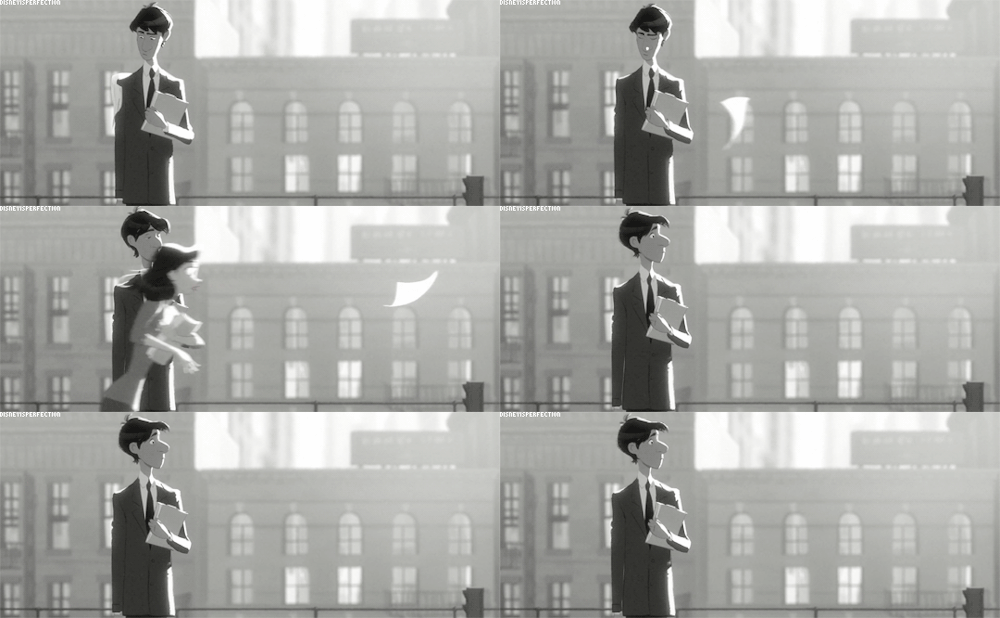
We see George, a twenty-something in a sixty-something’s suit and tie, obviously on his way to work, and not looking at all enthused about it. He stares straight ahead, expression bored, lifeless, right on the edge of depressed. Wind from a passing train pushes him slightly, and he lets it, demeanor unchanging.
2) Set-Up
But then a sheet of paper, caught on the wind, hits his shoulder. The paper flies off again, and a young woman appears onscreen, chasing after the paper, as the surprised George watches.
After catching it offscreen, the girl returns, tucking the paper into the stack she carries, smiling slightly. They both face forward, waiting for the train side-by-side, in silence. She’s glancing sideways at him, he’s smiling and fidgeting nervously, but still resolutely facing forward; they’re both aware of each other, seemingly hoping the other will be braver, but neither able to overcome their shyness and the unspoken rules of everyday life.
3) Theme Stated
As a train charges into the station, a paper from George’s stack is snatched by the wind and lands flat on the woman’s face. When he pulls the paper away, she laughs: her lipstick left a perfect kiss mark on the sheet. When George spots it, he laughs too …
but when he opens his eyes, she’s gone. She’s boarded a different train. The kiss-mark paper flaps in the wind as the train begins to move, taking her away. He watches, crestfallen. She glances back. Looks of regret and disappointment are exchanged, both a little wistful. The paper, the symbol of their fleeting memorable meeting, waves goodbye.
Through this little sequence of images, the question of the whole story is asked: Was there a connection between them? Will they find each other again? And on a wider level: What does it take to find love?
Further Set-Up:
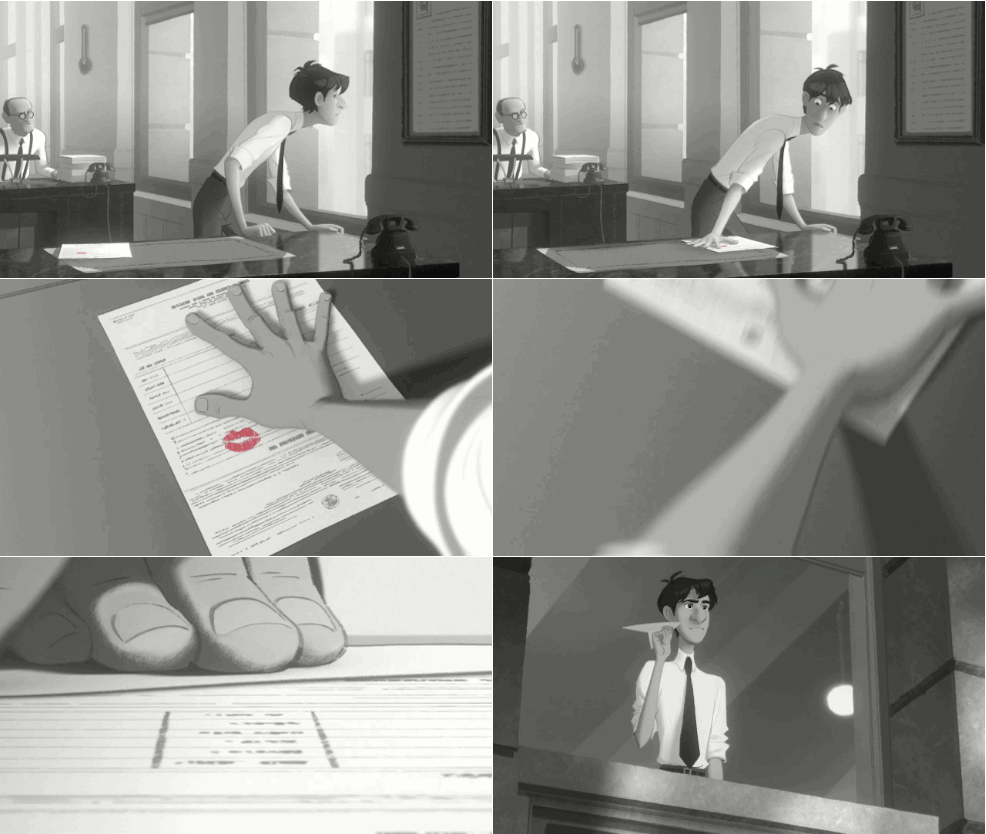
And cut to George behind a desk, in a gray office, dark file cabinets towering behind him, clocks on the wall ticking away his life. Miserable again, he stares at the lipsticked paper. A stack of documents slams onto the desk from on high. The grim-faced boss of the office scowls down at him. George frowns at the stack, then at his boss, who stomps away.
4) Catalyst
Breeze pulls the kissed paper off his desk and out the open window. He catches it just in time, breathing a sigh of relief. And then he sees something. The girl! She’s there! She’s right across the street!
5) Debate
He needs to get her attention! He dithers for a moment, then throws the window wide and enthusiastically waves his arms.
An ominous “ahem” from the boss brings him back inside, and back to his desk. But his attention is still on the girl, and the need to get her attention. He folds a paper airplane, stands before the window, poises the airplane to fly … but he glances at his boss’s office before he throws it. Should he?
6) Break Into Act 2
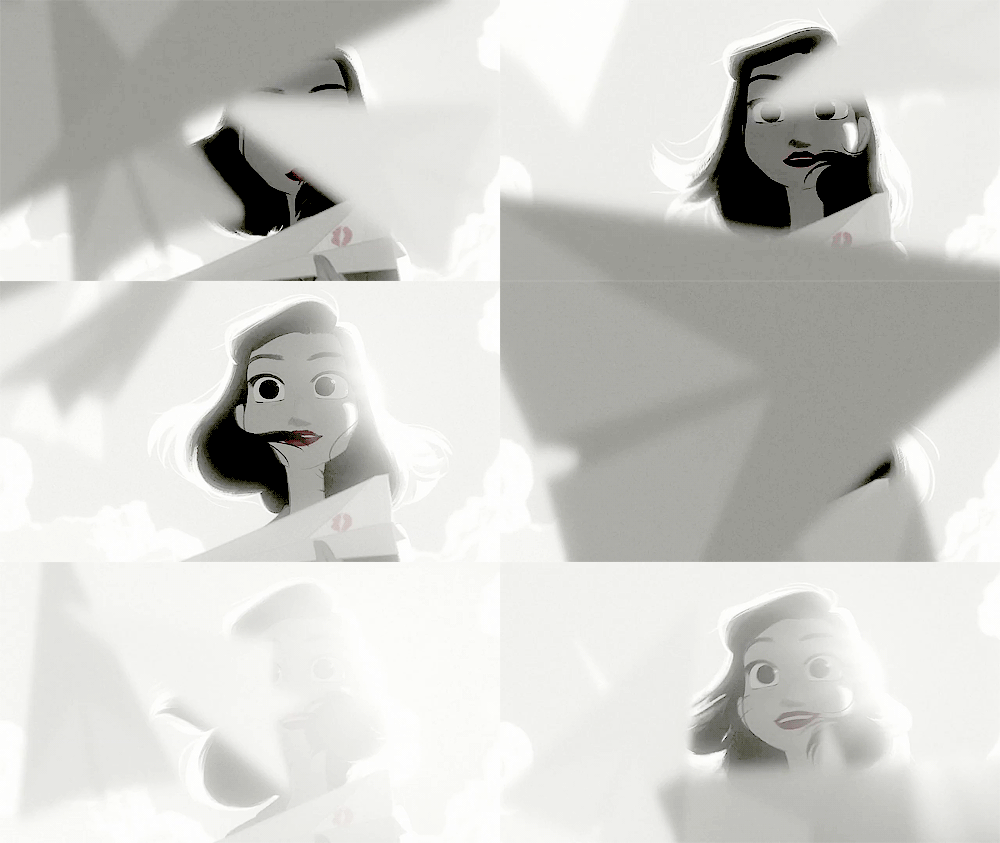
Yes. Yes, he should. He sends the little airplane messenger to bridge the distance between himself and the girl.
7) B Story
What he should have done while waiting for the train, he’s committed to do now. Talk to her. The relationship of the story has started officially.
8) Fun & Games
In this moment, he becomes the “paper man” of the title. He folds and throws paper airplane after paper airplane. The boss shows up, shoves him back and slams his window. George pauses until he’s gone, then just keeps sending airplanes. They sail over the street, but are intercepted or miss their mark every time.
9) Midpoint
He reaches for more paper … and knocks an empty tray off the desk. He’s run out. Except for one paper, the kissed one, the only one he’s held onto. With a determined look, he folds it precisely into an airplane, stands before the window, breathes to steady himself …
And the wind steals the airplane from his hand, sending it spiraling to the street below, George reaching out pointlessly. On top of this defeat, the girl leaves the office.
10) Bad Guys Close In
Immediately, the boss emerges from his lair. The other office workers hurriedly return to their scribbling, hunched to avoid drawing attention. The girl is leaving the building across the street! George turns from the window … and finds the boss looming above him, glowering, delivering another tall pile of meaningless work.
George sinks into his chair, defeated. But something happens as he watches his boss walk away, as he sees the office workers in neat rows; all of them older versions of George, reflections of what he will become … if he doesn’t do something right now.
He runs, sending paper from the perfect stacks flying in his wake.
11) All Is Lost
But when he escapes the building, and attempts to cross the street, cars nearly kill him. And when he finally makes it to the opposite sidewalk, the girl is nowhere in sight. She’s lost again.
And all he manages to find is the little traitorous paper airplane. The paper he’d believed might mean something, might have signified something important and maybe a little magical. Which it obviously never did.
12) Dark Night of the Soul
Angry, he grabs the plane and throws it with all his strength. He’s lost his job, he’s lost the girl, he’s lost all faith in the magic he’d just started to believe might be real. He stomps towards the train station, returning home.
13) Break Into 3
But fate has other plans. The airplane glides over the city, almost supernaturally graceful and purposeful. It dives between buildings, and lands in the middle of the alley where all the paper planes have collected.
It sits immobile. Then it moves. Moves again. And jumps into flight. The airplane flies over the rest, stirring them into motion, into the air. In a place where not even a breath of wind could reach, there is now a whirlwind of George’s airplanes.
Though the forces of mediocrity tried to keep them apart, something greater has recognized George’s efforts and is going to see things through.
14) Finale
A parade of airplanes follows George down the street.
The leader attaches to his leg. He brushes it off, mad. A flurry of them attach to him, then carry him down the street, unfazed by his fighting.
The leader airplane rockets over the city purposefully, finds the girl, then lures her to follow.
She chases after.
Somewhere else in the city, George is being pushed wherever the paper airplanes want him to go. We switch back and forth between George and the girl, as the airplanes push him and beckon her.
Until they’re both on different trains, which stop simultaneously, on opposite sides of the platform. The girl gets out. She fiddles with the airplane, like she’s trying to get it to work again. And just then, a breeze brings hundreds of paper planes skittering all around the platform.
She looks up …
15) Closing Image
And there’s George, covered in paper planes.
He lurches towards Meg, and the airplanes falls away, their work done.
George and Meg face each other, smiling, the barriers of routine and shyness overcome. Exactly what should have happened, exactly what was meant to happen. Putting effort into connection and love prevailed in the end, defeating the allure of life spent in safety and mediocrity. The closing image is the opposite of the opening: he’s not alone, he’s not facing the train leading to his mundane job, he’s not looking miserable and hopeless. He’s facing the girl, his bright and meaningful new future.
***
So! Those are the 15 plot points. This is a fantastic way to begin learning what story structure is, why it works the way it does, and how to precisely pull it off.
For a more in-depth explanation, I highly recommend picking up a copy of Save the Cat. (It holds a special place in my heart; it was the first screenwriting book I ever read, and started obsessive study of storytelling.)
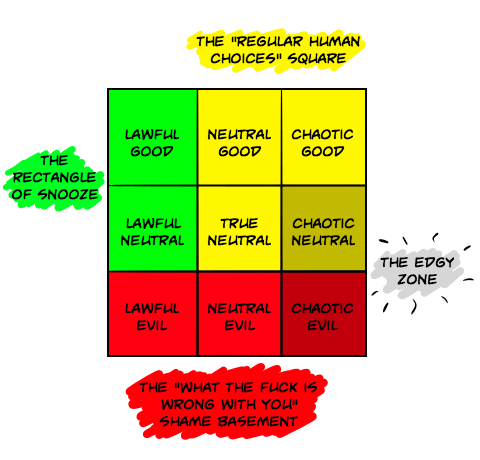
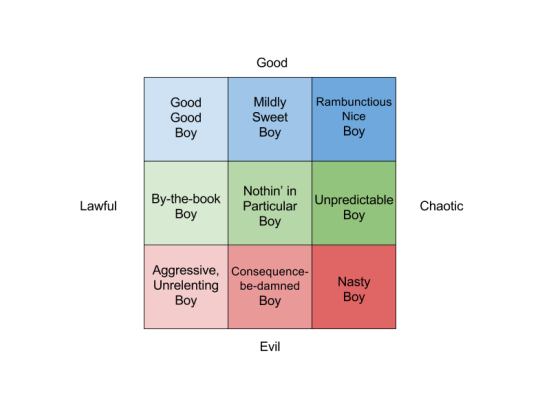
can someone explain the alignment chart for me but in like, the simplest wording possible lmao
lawful good: i want to do the right thing, and following society’s rules is the best way to do that
neutral good: i want to do what’s right, and i’m willing to bend or break the rules as long as no one gets hurt
chaotic good: i’m willing to do whatever it takes as long as it’s to do the right thing
lawful neutral: following the rules of society is the most important thing, and that matters more to me than doing what’s right
true neutral: i just want myself and the people i care about to be happy
chaotic neutral: i want my freedom, and i don’t care what i have to do to keep it
lawful evil: to impede the protagonists (in whatever evil way) is my primary goal, but i follow my own code of morals even when it’s inconvenient
neutral evil: to impede the protagonists (in whatever evil way) is the my primary goal, and while i’ll do what it takes to achieve it, i also won’t go out of my way to do unnecessary damage
chaotic evil: i relish in destruction and want to do as much damage as possible while i try to achieve my primary goal








 wupacing