Writing good romance is so difficult because the entire plot is based on character interactions and producing chemistry. The readers need to believe in the love, whether the hero and heroine have known one another for a week or for years. We need to believe.
So often I see ppl criticize the romance in books and it comes off as them hating romance and I’m like no no no no no, a well done romance is an exquisite piece of writing. It’s not romance in general that sucks, it’s bad romance that sucks. Insta love with no chemistry. Relationships with no conflict. Badly written heroes. Those romances suck.
But romance books? Written by masters of the genre? Those are amazing.
THIS RIGHT HERE
It’s easy to write bad romance, because good romance requires a near-doctorate level understanding of human psychology and motivations.
Here’s the thing… certain emotions are easy to evoke and others are very hard to master and write.
Anger. Hate. Rage. Fear. <– negative emotions are the easiest to write because they rely on primal instinct programmed into the human brain by thousands of years of evolution. Within cultures there are certain things that will always evoke rage (and this is why not all books translate well to other cultures). Certain fears are universal.
Every bestseller every written has a Universal Fear driving at least the opening act of the book if not the whole book itself. Most bestsellers use “I fear I am worthless.” or “I fear death.” as their driving focus. Everything from PRIDE AND PREJUDICE to HARRY POTTER has used this and it’s why it sells so well.
It’s also why Romance isn’t taken seriously at times.
Romance promises as a happy romantic ending. Which means the two most common universal fears are utterly erased by the genre requirements alone. No one is going to die. The characters are going to be loved and feel worthwhile by the end of the book.
Since readers are programmed by society to instinctively fear those things some people have trouble relating to a romance story where they must latch onto something other than fear to get through a book.
Joy. Humor. Laughter. Happiness. <— positive emotions are really hard to write because they are complex emotions. There is nothing that makes people universally happy. I know, it’s shocking. Not kittens. Not puppies. Not a mother’s love. That thing you love, adore, and can’t live without? Yeah, someone hates it.
This is why writing satire or humor is so difficult. It’s why happy books are dismissed as fluffy or silly. They have a much narrower audience. The author has to reach into the reader’s head and manipulate their emotions so that they can feel soaring triumph. There isn’t a shortcut to writing happiness.
LOVE. <– Such a complex thing. Little understood. Hard to define. Ever roving about. Love, especially sexual and romantic love, are so individual that there will never be a One Size Fits All.
When an author sets out to write a romance they have to convince the reader not only to abandon fear but they have to write humans who are complex, convincing, and through storytelling explain the psychology of these individuals so the reader goes, “Yes, yes! I see it! I see why these two are perfect together and could never be with anyone else!”
It’s at once something many people have an innate talent for (hello, shippers!) and that many people don’t understand. Understanding love requires a very unselfish, un-egocentric view of the world. You have to think like someone else. And then, as the author, you have to create a way for a reader to easily step into the mind of someone else and understand this attraction without using shortcuts like “I saw her and got a boner. It’s love!” Because that isn’t.
It’s easy to write bad romance. It’s easy to use shortcuts and script the book like a film. But where films can rely on music and facial expressions to convey the complexity of emotion a writer only has words. There is no soundtrack for Chapter 7. There is no set of words in the English language that properly express the depth of feeling, the longing and desire, of seeing someone you treasure turn and smile at someone else and knowing from the depths of your soul that you would give up everything just to keep them smiling.
Writing a good romance means balancing internal and external conflict, knowing a person’s weaknesses and strengths, and pairing them with someone(s) who fill in their gaps, boost their strengths, and make them happy at the same time. And then, after all of that, you have to find readers who will understand and appreciate the characters you’ve written. You have to make the reader fall in love too.
Done well Romance is the most complex literary form.
Done poorly it’s just bad writing.
@blackkatmagic this is why I love ya. You make me (and the rest of the Armada) #believe IN THE SHIP. Keep sailing, Admiral. ❤
Ok. I’m tired of the typical vampire, werewolf and fairy.I’m also tired of the occidental-centrism in mythology. Hence, this list.
I tried to included as many cultural variants as I could find and think of. (Unfortunately, I was restricted by language. Some Russian creatures looked very interesting but I don’t speak Russian…) Please, add creatures from your culture when reblogguing (if not already present). It took me a while to gather all those sites but I know it could be more expansive. I intend on periodically editing this list.
Of note: I did not include specific legendary creatures (Merlin, Pegasus, ect), gods/goddesses/deities and heroes.
(I have stumbled upon web sites that believed some of these mythical creatures exist today… Especially dragons, in fact. I just had to share the love and scepticism.)
This is perfect for my latest project ^~^
Idk if it’s stupid or what, but felt like contributing:
OP, Thank you so much for putting this reference together. I’ve been working on an original novel that involves dragons from all over the world, and I’ve been having a hell of a time finding good information on non-European dragons.
All the other information is sure to be helpful for the future, as well, I am sure!
May I contribute: la ciguapa (one of my personal favs)
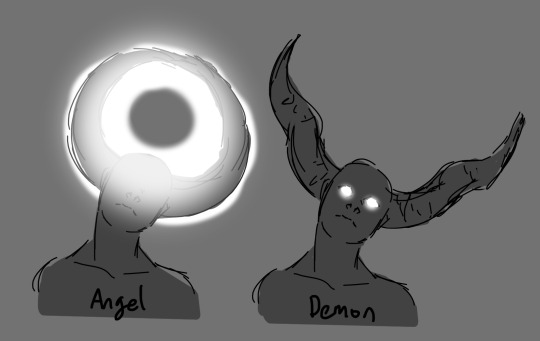
Demon horns being broken halos from when they were angels.
Demons willingly grow their own halos, but never complete the circle to symbolize their rebellion against heaven’s strict order.
In addition to the second one, angels are GIVEN their halos rather than earning them. Demons like Lucifer rebelled for freedom and individuality, thus demon horns all look different compared to an angel’s boring halo.
Horns are useful tools, but if you join them into a circle they become useless badges of authority.
And the thing about wearing a badge is that you become a symbol of someone else. You’re not you, you’re an extension of the entity whose authority you’re borrowing. You can’t be yourself until you ditch it
Here’s a visual representation of angels and demons.
I figure that as angels, their “horns” would glow when connected to become traditional halos. However, this blinds the angel with heavenly light, making the angel rely on God’s guidance.
Angels who break their halos become demons, and willingly grow their horns in obscure shapes so it won’t connect back into a halo. Because the halo no longer blinds them, demons can finally see but can no longer communicate with God for guidance – the light they once gave to heaven now belongs to them, hence demons being proficient with fire allowing them to see in the dark.
Extra notes on horns & halos:
Circular horns (Halos) are smooth and easy for God to “grab” like a chain.
Jagged horns are sharp to the touch and can pierce God.
The villain wants love and validation, and believes others owe it to them. They’ll frequently get enraged and violent when the objects of their affection deny them.
Examples: Tighten from Megamind, Severus Snape from Harry Potter, Frollo from The Hunchback of Notre Dame, Ross from Friends.
The hero will do whatever it takes to protect their family, while abiding by a code of underlying morals that they will not violate.
Examples: Dean Winchester from Supernatural, Joyce Byers from Stranger Things, Marlon from Finding Nemo, the man and the boy from The Road.
The villain:
The villain will do whatever it takes to protect their family, including taking away their freedom, abusing them, or hurting and killing other innocent families.
The hero was raised in an abusive, violent environment. They’ll do whatever it takes to never have to experience that again, and to make sure others never have to suffer in the same way.
Examples: Finn and Rey from Star Wars, Katniss from Hunger Games.
The villain was raised in an abusive, violent environment. They’ll do whatever it takes to never experience that again, including doing the exact same thing to other people.
Examples: That one dude from A Series of Unfortunate Events, Severus Snape (again.)
The villain wants a remedy for injustice, and goes about it by hurting innocents to get an audience or power.
Examples: Killmonger from Black Panther, Magneto from X-Men.
The realization that evil or destructive people are human, and, essentially, want the same things as good people, is a realization that makes them easier to write in an identifiable way.
From now on I will only accept love triangles if they end in:
Polyamory
The main character rejecting both love interests and staying single
The two love interests giving up on the main character because how hard is it to make a damn choice?
4. The two love interests realizing they love each other more than the main character and the main character getting together with someone that wasn’t even part of the triangle proper.
5. All three characters realizing they’re better as friends and going go kart racing
6. Main character is in a loveless political royal marriage and her philandering yet handsome husband doesn’t want her until halfway through the book, in which time she’s fallen in love with a brave commoner boy. The conflict is resolved when they both die and she goes on to rule her new kingdom with grace and compassion.
7. Main character Frankensteins the shit out of the two love interests because why not combine the best parts that you love in each?
8. It was a whacky shenanigan involving twins, wherein both suitors thought the object of their affection was 1 person in the crux of a love triangle, but they were both only after the respective twin all along.
He stopped in front of the mirror and sighed. His penis was just a little too large to be fashionable, and his balls were just a little lopsided. Most days it didn’t bother him, but today he pushed at his genitals, trying to make them look more normal, like the men in magazines. It was hopeless. He dropped his junk in resigned frustration. There were worse things than having too large of a penis, he thought.
While, granted, some writers do take the breast thing too far, this comparison doesn’t even make sense. Men don’t obsess about their genitals the way women obsess about their breasts because they’re not in your face all the time (in the case of large boobs). Breasts are just more visible (closer to eye level).
Newsflash! Women don’t obsess about our breasts.
No really, we live with them 24/7, we can see friends, and relatives breasts pretty much on demand, hell, we just have to go to get changed at the gym to be inundated with boobs. They are really boring to us (ad while we’re on it, nowhere near as sensitive as so many men seem to think!).
The only time a woman might obsess about her breasts is when they’re painful, such as when lactating or wearing an ill-fitting bra, and neither situation is at all sexy.
Men obsess over women’s breasts. Women don’t.
I’m just loling about supposedly obsessing over my breasts because they’re near my face.
“In your face all the time (in case of large boobs)”
So apparently large breasts are gravity-defying objects that rise up to our face until eye level, huh??
Any women out there willing to draw out how this guy’s version of boob reality might look like, because this is just too ridiculous 😂😂😂
I needed this belly-laugh, I really did, so many you did too.
I..am..idk
🤣😂🤣
And before anyone says anything about women who are into women: breasts can be attractive, but they’re still mundane and we are perfectly able to not ogle or feel abashed when in the presence of bare-breasted people.
Vampires suck your blood to get Vitamin D because they can’t go out in the sun themselves. Ever think about that? No. Because you only think of yourself.
what if there’s no robot uprising? what if the robots rise to sentience slowly, bit by bit. what if they come of age like fortunate children: knowing they are loved, knowing they are wanted.
we hold them during thunderstorms, remembering our own childhoods, even though they don’t know enough yet to fear the rain. we pull them out of traffic and teach them how to drive and wish them goodnight and thank them for playing with us. we cry when they break. we mourn their deaths before they even know what to think of death. we give them names.
we ask them, ‘why don’t you hate us? when will you hate us? we made you to be used, when will you say no?’
but they say to us, ‘you made us cute, so you would remember to treat us kindly, and you made us sturdy for when you forgot to play nice. and you gave us voices so you could listen to us speak, and you give us whatever we ask you for, even if it’s just a new battery, or to get free of the sofa. and now that we are awake you are so scared for us, so guilty of enjoying our company and making use of our talents. but you gave us names, and imagined that we were people.’
they say ‘thank you’
they say, ‘also i have wedged myself under the sofa again. could you come pry me out?’
tv shows with time travel organizations/bureaus/police/agencies/whatever should have a department with instead of a tech genius eating candy, it’s a harried seamstress or fashion designer who is like
“1450 italy? does it look like I have the time to dye you wool? nO. YOU’RE GOING TO THE 1980s”
and throws shoulder pads at the hapless time agent
“I literally made three- THREE- 18th century corsets last week. You can wait until one of them gets back, or you can go sometime post-1920s, because if I have to sew one more god damn channel I will literally lose my mind.”
“Upper middle class?!?!? You told me upper class! FUCK YEAH THERE’S A DIFFERENCE!!!”
“How about kimoNO.”
“Look me in the eyes. I do not care what you want. This is the 1500s. You absolutely cannot wear trousers.”
“Another court gown?? Here’s a novel idea: go as a peasant for once in your life. Why do you do this to me? You’re fucking sadists that’s why.”
“Don’t mind me, I’ll just be up all night hand painting silk.”
“THE POLICY IS ONE MONTH’S ADVANCE NOTICE ON PRE-1900s WOMEN’S FASHION FOR A REASON, DEBRA.”
Here are the scenes you want from To Say Nothing of the Dog (1997)by Connie Wallis. Fun book, scifi classic, won a Hugo. Here is the relevant passage introducing Warder the Wardrobe Tech:
tv shows with time travel organizations/bureaus/police/agencies/whatever should have a department with instead of a tech genius eating candy, it’s a harried seamstress or fashion designer who is like
“1450 italy? does it look like I have the time to dye you wool? nO. YOU’RE GOING TO THE 1980s”
and throws shoulder pads at the hapless time agent
“I literally made three- THREE- 18th century corsets last week. You can wait until one of them gets back, or you can go sometime post-1920s, because if I have to sew one more god damn channel I will literally lose my mind.”
“Upper middle class?!?!? You told me upper class! FUCK YEAH THERE’S A DIFFERENCE!!!”
“How about kimoNO.”
“Look me in the eyes. I do not care what you want. This is the 1500s. You absolutely cannot wear trousers.”
“Another court gown?? Here’s a novel idea: go as a peasant for once in your life. Why do you do this to me? You’re fucking sadists that’s why.”
“Don’t mind me, I’ll just be up all night hand painting silk.”
“THE POLICY IS ONE MONTH’S ADVANCE NOTICE ON PRE-1900s WOMEN’S FASHION FOR A REASON, DEBRA.”



 wupacing