I feel like racism is more pronounced in America. The disease is still there, it’s the same disease, but it just manifests in a different way. British culture is way more reserved, so it’s more systematic. – Daniel Kaluuya
This is what I always think when people claim that Americans spend too much time on racism, and that racism isn’t as bad as it is in other countires, and that we just make it more than what it is.
Like, it’s just as bad, but you have all inernlized it to the point of thinking it’s disapeared. You think your country is the best regarding racism, partly because you are someoen who doesn’t/can’t experience it.
It’s always white people who are regarding racism as a sort of American thing, not realizing that you all think racism is non-existent because you perpetrate an idea and system that makes it impossible for it to be as pronounced. and when it’s not as pronounced, it never gets fixed.
When I was a kid, I read the autobiographical novel To Sir, With Love by
the African-British writer
E.R. Braithwaite. It was written in 1959, and he made the exact same observations about US vs UK racism. It was something that always stuck with me, how the same racism can look different in different places. 60 years later, what has changed?
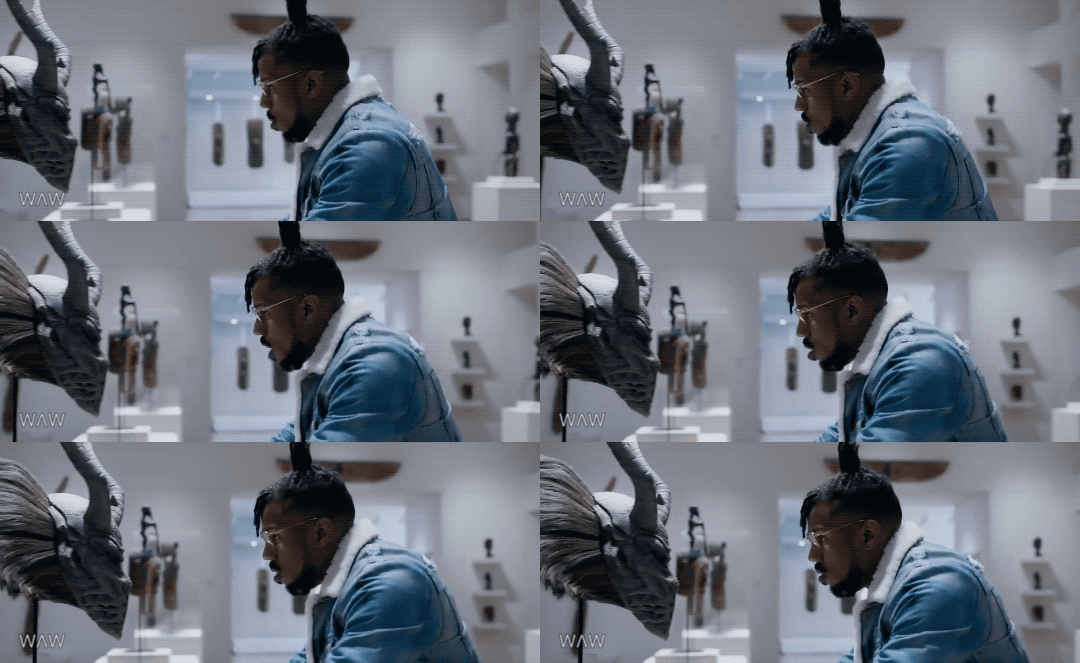
Killmonger: How do you think your ancestors got these? You think they paid a full price for it? Or did they take them like they took everything else?
I work in a museum- an old one- and during this scene I was nudging my brother the whole time. I clapped a little at that line. Museums need to rethink the way we curate things. If we aren’t elevating the heritage of those objects’ creators, if we aren’t telling their story, if we aren’t making those narratives accessible to the descendants and letting them lead, then what is even the point? Decolonize collections. Practice co-curation. Hire scholars of color, and make the collections accessible to visiting scholars. Involve the descendant community and elevate their voices, not the white colonial narrative.
And for goodness’ sakes, don’t run your museum like a jewellery shop. Have context. Honor the objects for their beauty, but remember that no object is as important as the people who created it.
Ummmm,, and like straight up, give things back? Indigenous communities in North America have campaigned for decades to have body parts, ceremonial items and sacred parts of our history returned to their communities.
Ofcourse, Hurd scholars of colour and think critically about your role. But like sometimes, you just have to give things back.
That’s repatriation (what I meant by “decolonize collections”) and it’s actually been federal law in America for almost thirty years. It’s been happening and will continue to happen, but it’s a LOT more complicated than just “give the stuff back.” Obviously you’re totally right- giving the stuff back is absolutely necessary.
But at the same time, giving ALL the old stuff back to Native groups doesn’t really work, either- for us OR for them. What happens to the stuff when it goes back? Do the modern Alaskan Athabascans really want the 1000+ baskets the museum I work at holds? (No, they don’t. We asked them. They definitely do not want those baskets back.) What about Native groups who don’t want remains back- the Navajo, for instance, believe that the remains of the dead are taboo objects, unclean and best left buried. And there are some Native groups who actually WANT their objects in museums. Not every object has a ritual context- sometimes a pot is just a pot. Even some ritual objects aren’t as spiritually important, and we’ve actually had people from different tribes come in and help rewrite language surrounding an object, or give instructions as to how it should be stored. Some groups really want us to display their cultural artifacts, because it reminds people that Native American cultures are alive and real.
One thing that works really well in a lot of cases is co-curation, which is when we commission and work with Native artists, leaders, and scholars to reframe the way we display objects. Like, recently, we asked Chris Pappan, who’s a Kanza artist, to come in and draw on the displays from the ‘30s. The juxtaposition of his art with the colonialist view of Native Americans has had a huge impact in visitor impressions- people go to that gallery now to learn and see what’s ACTUALLY happening today with Native Americans. This I think is how these institutions can use their power for good- elevating creator voices and letting them present their own past and own history. The Field does that a lot- we’ve had exhibitions from Rhonda Holy Bear, Bunky Echo-Hawk, and are continuing to work with Native Americans from many tribes to redesign and reframe the objects on display. We’re not doing this for social justice points- we’re doing this because the Field Museum gets something like 1.5+million visitors a year, and we owe it to the Native tribes we stole from to a.) tell their story b.) how they want it.
If you take all evidence of Native Americans out of the big natural history museums, you’re taking away representation- and education- and a lot of tribes actually don’t want that. What many groups want is the old colonial narratives to go away and be replaced with their own messaging and history. Native Americans are mythologized and what we did to them is sanitized in the US education system. I know that the person who responded is in Canada- and from what I hear, they’re even worse about destroying Native history and sanitizing what the colonists did (and continue to do) to them and their cultures. And this is where I think museums can actually HELP. People only care about things they’re familiar with. If the only image you have of a Native American is a racist football mascot, you’re not going to care about them as a culture- you’re not even going to see them as people. There’s a lot of white people who don’t believe in Native Americans. Like, they legit don’t think that there’s ANY Native groups left, and I know this because I’ve talked to these people at work. It’s baffling, how little Americans know about their own country’s behavior. And it’s totally a global problem- I could go on for days about what the British Museum Needs To Do With Those Fucking Marbles, Give Them Back You Cowards, You Have Enough Money To Ensure Their Care In Greece You’re Just Being Assholes- but I wanted to respond with a Native American context because of the person I’m replying to AND because… well, most Americans don’t know this, and they need to, because knowing about repatriation and why we do it is important.
Repatriation is so very vital, but it’s even more vital to listen to the Native American groups and ask them what they want to happen- as well as treat each tribe individually. We don’t hold onto Tlingit remains because the Navajo don’t want their remains back. Treating all tribes as identical is wrong- not as wrong as withholding their precious cultural traditions, relics, and remains- but if we’re even going to (as a museum industry) attempt to apologize for the atrocities we’ve sanctioned, the first thing we gotta do is ask people what they want.
And the next thing we gotta do is listen.
I’m starting to work in a Museum, and though my museum is about Natural Science something stuck le about all of this. The museum does not only exhibit but also safekeeps collections and in the introductory course we were given three keys to the basis of a museum: preservating, researching and exhibiting.
And one is worthless without the other. Our collections are meaningless if they aren’t available for investigation. It’s totally encouraged for scientists to come and use our collections. Granted, our collection mostly consists of dead animals, plants and fossils. And part of my own museum’s goal is orientated to reclaiming by mostly having our own collections as otherwise some of our best fossils are exhibited in museums in USA.
In our museum, all a scientists has to do is basically send an email to access the collection.
So what strikes me is that you point that one of the things to get better is “make the collections available to visiting scholars”. Is that not the case? Or is it specifically not available to scholars of color?
It REALLY varies from museum to museum! Some museums it’s really easy to get in- but others, it’s SO. MUCH. RED. TAPE. I had mine in mind when I was writing that, because collections access takes absolutely forever.
Anytime something is so precious that a culture wants it back but the museum wants it too, i bet you anything some artist would love the commission to duplicate it.
And sometimes that works out amazing.
The Field used to have this totem pole. There are many such poles in the museum, and others in museums around the world- but not all poles have the same significance- it depends on context. This pole, in particular, was a 26 foot tall pole that had been stolen from an “abandoned” Tlingit village- of course, the village wasn’t abandoned, and the people who lived there never consented to giving up their totem poles, and they rather wanted them back.
Anyways, the Field had one that was taken from the Cape Fox Tlingit back in 1899, and in 2001, we sent it home.
In 2002, the Cape Fox Tlingit gave the museum a log. A big one, a huge cedar log. They didn’t need to, but they did, and what the museum did with it was this:
A father-son team of Tlingit artisans- Nathan and Steven Jackson- were commissioned to design and create a new totem pole for the museum. They worked with the museum to create a totem pole that celebrated Tlingit traditions and the modern Tlingit people- a totem pole that combined ancient designs with modern ideas. It’s a gorgeous piece with an incredibly pertinent meaning- according to the Jacksons, the hybrid design illustrates the “refraction” or bending of traditional Tlingit culture that occurred during a turbulent history of cultural loss and recovery.
Which do you think tells you more about what it means to be Tlingit today?
“Let the rumors be true.” Janelle Monáe is not, she finally admits, the immaculate android, the “alien from outer space/The cybergirl without a face” she’s claimed to be over a decade’s worth of albums, videos, concerts and even interviews – she is, instead, a flawed, messy, flesh-and-blood 32-year-old human being.
And she has another rumor to confirm. “Being a queer black woman in America,” she says, taking a breath as she comes out, “someone who has been in relationships with both men and women – I consider myself to be a free-ass motherfucker.” She initially identified as bisexual, she clarifies, “but then later I read about pansexuality and was like, ‘Oh, these are things that I identify with too.’ I’m open to learning more about who I am.”
Janelle Monae Frees Herself, Rolling Stone April 2018 (x)
“And I think when you have suicide rates going up, when you have the bullying, when you have maybe even the drug usage because people are not feeling comfortable being their unique selves, because of the
societal norms and the pressures of conforming or because they feel like they have to erase parts of them because they’re not socially accepted, I felt like through my truth it could help other people walk in their truth and breathe a little easier.”
Can we appreciate how The Brain’s parents keep a dictionary just to look up words that their son says that they don’t understand, but they want to encourage him in his intelligence and don’t shut him down with ‘In English please’ like most people in cartoons will tell the smart characters?
Even real life parents are more likely to ask for their kid to rephrase their sentence while using simpler terms, and having seen this with my brother, it discourages the kid from even talking to the parent because they start to think a)they don’t understand them b)they are stupid and c)they have no middle ground to meet at.
But The Brains parents are so caring and want Alan to never feel odd or like he can’t talk to them so they keep a dictionary- a very thick one- just to be able to talk to their son without having to make him feel like a bother for using words that aren’t every day regular people words.
And they black
The Brain is a fucking bear. A BEAR. Holy shit tumblr, you never dissapoint me.
@naturelovefreedom HE’S AN AFRICAN AMERICAN CODED ANTHROPOMORPHIC CHARACTER!!!
HAVE YOU IDIOTS NEVER WATCHED ARTHUR??!!
HE CALLS HIMSELF AFRICAN AMERICAN!!!!
Omg!!!!
A link to the Christmas special, time stamped to where The Brain specifies that he celebrates Kwanzaa (41:48): https://youtu.be/ygXALnyCa0c?t=41m48s
“And the raspberry (represents) the African struggle for freedom”
This one is the timestamp for the Kwanzaa celebration itself (51:28)(it’s a brief clip in the episode wrap-up of everyone celebrating at home): https://youtu.be/ygXALnyCa0c?t=51m28s
Thank you! They been blowing me up!
Bruh. Why do they always step so far out of their lane?
they have been really trying it over this post
Anyone who thinks race does not exist in Arthur did not watch Arthur correctly/doesn’t remember enough. All of the characters hint at nationalities, at traditions from their grandparents etc. who lived in other countries, and even religions. Meaning, yes, race exists in Arthur-BUT NO ONE IS FIGHTING OVER RACES IN THE SERIES WHICH IS FUCKING BEAUTIFUL.
Brain has African roots-and African cousins. According to Wiki, those roots come from the Senegalese area of Africa. They even did a song about Africa when said cousin visited.
You could even argue that Francine is black, based on the makeover episode where rich white girl Muffy tries to change her style to make her girly while also criticizing everything about Francine and her poor lifestyle. In that episode, Francine’s Bad Hair Day, you can very clearly tell they are making a hint that Francine has hair that is much different than Muffy’s. Sound familiar? Black hair and white hair are not the same. Hair is hair, but depending on your race, your hair tends to be much different than others.
The Reeds neighbors are Mexican
Binky Barnes family adopted a Chinese baby Mei Lin Barnes.
And you can’t go off their colors alone on the show. You have to know them as a person before you get the hints of what race the characters are meant to represent. In some cases yes, you can very clearly see what race someone is meant to represent but in an animal form-like Emily, DW’s friend, but in some cases, like when Celebrities were on the show, they either had the characters colors look like the person skin or changed it up to fit the series. Examples:
Mr. Rogers was one of the whitest old men around on TV, and we all loved him, but in Arthur he’s a dark tan/light brown
The same goes for Jack Prelutsky
Yo-Yo Ma -because no one on earth is a silvery gray
Alex Trebeck played himself but with a different last name
Then we have some very clear examples of characters fitting color schemes of their real life counterparts races.
Neil Gaiman
Backstreet Boys
Joshua Reedman (Aka Francine’s canon uncle)
Michael Fincke
Michelle Kwan (a little paler in her Arthur appearance but it still works)
Race, nationalities, religion and all of that stuff exist in Arthur no matter how you try to water it down or deny it. The big difference between Arthur and our world is that in Arthur- I state again that Race and Nationality were not put down, they were not even big deals to the characters, but something to learn about and find out that no matter how people may look, what they do, people are people, and you should always accept people no matter their race, nationality, traditions, etc. If you didn’t take that from the show, I don’t know what you did take out of it other than a meme.
Representation is important because it allows people to see characters like themselves as heroes.
It also allows people to see characters unlike themselves as sympathetic and relatable.
Stories teach us how to be human.
This is also why bad representation that demonizes already stigmatized groups is so dangerous; it reinforces the belief that those groups are not human.
A lot of people reblog this with some variation of “oh but tokenism is bad”. Yeah, sure. But if characters are depicted as sympathetic and relatable, they’re not tokens. That’s the point.
Tokenism isn’t “oh there’s too much diversity here”. Tokenism is “this diversity is shallow and features cardboard characters who exist only as representatives of their demographic, not relatable, sympathetic, or interesting beyond X trait”.



 wupacing