After college, Johnson joined the U.S. Air Force, where he worked on the stealth bomber program.[8] Later, he worked at NASA’s Jet Propulsion Lab with the nuclear power source for the Galileo mission to Jupiter.[9
And half AMAZING HIJINKS
Johnson conceived the Super Soaker while doing work with the US Air Force. On October 14, 1983 he applied for a U.S. patent. On May 27, 1986 he received patent number 4,591,071.[13][7] Initially it was called the “Power Drencher” when it appeared in toy shops in 1990, but after some tweaks and remarketing, it got its name.[6] Selling between $10 to $60 depending on the model, the Super Soaker took off, generating $200 million in sales in 1991.[3] Shortly after making the deal for the Super Soaker with the Larami Corporation, Larami became a subsidiary of Hasbro Inc. in February 1995.[14] But being an inventor, Johnson came up with another idea: replacing the water in the Super Soaker with a “toy [Nerf] projectile.” In 1996, Johnson received patent US5553598 A[15] for “Pneumatic launcher for a toy projectile and the like.”
With a healthy chunk of “fuck racist corporations get yours”
Johnson discovered he was underpaid royalties for the Super Soaker and several “Nerf line of toys, specifically the N-Strike and Dart Tag brands.”[16] In November 2013, Johnson was awarded nearly $73 million in royalties from Hasbro Inc. in arbitration. According to Hasbro, the Super Soaker is approaching sales of $1 billion.
STARRING NATHAN STEWART-JARRETT, COMING TO A THEATER NEAR YOU
Guys do centaurs have to eat both horse food and human food?
Centaur, eating out of a burlap sack of hay like it’s potato chips: So do you guys wanna get Chipotle later?
Centaur: *kneeling on the ground, ripping up bits of grass and eating it*
Nearby horse: *neighs*
Centaur: Well it’s easy for you to bend over, isn’t it?
Horse: *snorts*
Centaur: *through a mouthful of grass* Well goody goody for you, but some of us have two spines.
Human: Hey does somebody want the rest of my burger?
Centaur: Oh I’ll have it. I am starving.
Human: Didn’t you just eat like an entire barrel of hay?
Centaur: *snatches the burger* That was for the horse stomach not the human one. Don’t be racist, Carl.
Centaur: *eating a carrot*
Human: So does stuff like that go through both stomachs or…
Centaur: *pauses mid chew* *swallows hard* Well that’s something else to keep me up at night.
Centaur digestion might not be all that much different than what horses already do. Horse digestion is already divided into two, the foregut and hindgut. The foregut is like a more traditional GI tract like a human or dog, with an esophagus, stomach, and small intestine, and works pretty much the same way. Because horses are not ruminants and don’t have the multichambered fermentation stomach a cow does, only the easier-to-digest surface nutrients are digested in the foregut. (This also means that a horse ends up with more direct protein and fat absorption than a cow, because the symbiotic bacteria in a cow’s multichambered stomach usually ferments and consumes a lot of the proteins and fats from incoming food before the cow’s body has a chance to absorb. And proteins and fats are vital to brain development.)
However, a horse’s hindgut is different from most mammals. After otherwise indigestible cellulose passes through the small intestine, it enters a specialized section of the large intestine called a caecum, and that’s where the horse’s symbiotic fermentation bacteria live. Feed stays in the caecum for about 7 hours, where it ferments and the nutrients are eventually absorbed. The caecum is a very odd digestive organ; both its entrance and exit are at the top, presumably to allow a horse to better pass any gasses generated by the fermentation process, but because the exit is at the top, it is very easily blocked by any solids that the caecum failed to digest, and gravity does not help. The bacteria mix in the caecum is very specialized, usually only capable of digesting very specific foods, and it can take several days or weeks of slowly introducing new foods so that the caecum grows the bacteria needed to be able to digest it. That’s where you get most colic in horses, when the caecum is blocked by solids that the bacteria weren’t adapted to digest. Colic is extremely painful and can be quite deadly for a horse. After fermentation in the caecum, food travels on through the large intestine like most other mammals.
So, in regards to centaurs, I doubt the digestive tract would change all that much. Whether a centaur has one stomach or two, they would probably have a caecum in addition, since fermentation has a much higher energy yield than digestion alone, and they’d need that energy to run. But if they do have a caecum, a centaur would have to be extremely careful about what they ate, and they’d probably be very averse to trying new foods. They’d probably try to eat the same thing all the time, with maybe one or two variations to keep it a little interesting, but nothing terribly extreme. A traveling or adventuring centaur would probably keep a supply of food they know they can eat with them at any time, because adapting to a new food is extremely slow. If they were moving to a new region, they’d probably bring a couple hundred pounds of their old food with them so they could mix in the new region’s food a little at a time.
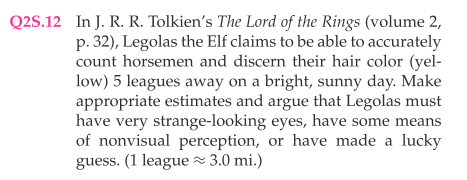
Update: Legolas’ pupils are about 3.5 cm wide each. Now drawing kawaii Legolas on physics assignment.
And they told you science was no fun.
Science!
I’m going to do it. I’m going to hand it in.
Legolas’s pupil size isn’t the problem here, though. 5 leagues is 17.262 miles. The curvature of the Earth means that for a person of average height, the visual horizon is less than three miles away. Even if your vision is telescopic and the atmosphere is perfectly clear, you can’t see around the planet. If they were standing on a hill, it would have to be at LEAST 198 feet above sea level in order to see the horizon at 17.2 miles away, with nothing tall in between. Which, knowing Rohan, isn’t impossible.
But consider: Elven satellite eyeballs.
you mean like
@sidereanuncia it’s back, the post that I can only imagine haunts your nightmares
I shall never find peace.
Also, for what it’s worth, there’s absolutely no reason to believe that the curvature of Middle Earth is the same as that of Earth.
There’s no evidence that Middle Earth curves.
Yeah there is. The Silmarillion states that the world was curved after the fall of Numenor (I believe), preventing access to Valinor. But Elves (among others) can travel the straight path across it.
So middle earth is round, but not for Elves because magic.
So wait, the reason he can see that far is because Elves just have the ability to ignore the curve of the earth? That’s awesome. It also means that no matter how good your optics got, you would always want elf eyes manning the spyglass because they can see arbitrarily far while everybody else is limited by this ‘horizon’ bullshit.
Oh thank God, my poor elf prince has seen too much in this post
Elves are flat-earthers
This post went from amusing to horrifying, to be brought back down to amusing, sprinkled in with some cannon explanation, and then you leave me here in fucking outrage
Jade and striped icebergs. “When seawater at depths of more than 1,200 feet freezes to the underside of massive ice shelves like East Antarctica’s Amery Ice Shelf, it forms ‘marine ice.’ Enormous hunks of ice calve—or break off—from the ice shelf, creating icebergs. When one of these icebergs overturns, its jade underside is revealed. The wondrous color of this ‘marine ice’ results from organic matter dissolved in the seawater at those great depths,” explained Audubon Magazine. “Green icebergs are infrequently seen because their verdant bellies are underwater; it’s only when they flip over, a rare event, that their richly colored regions can be seen before they melt. Striped icebergs, perhaps even more scarce than jade bergs, are thought to form in one of two ways: either meltwater refreezes in crevasses formed atop glaciers before they calve icebergs (creating blue stripes), or seawater freezes inside cracks beneath ice shelves (creating green stripes).”
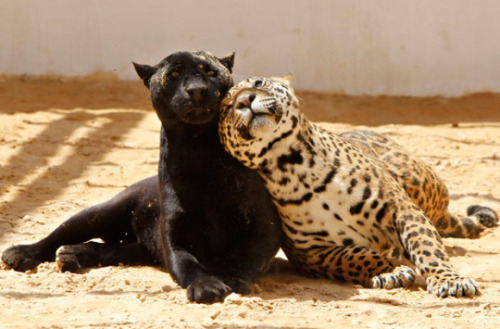
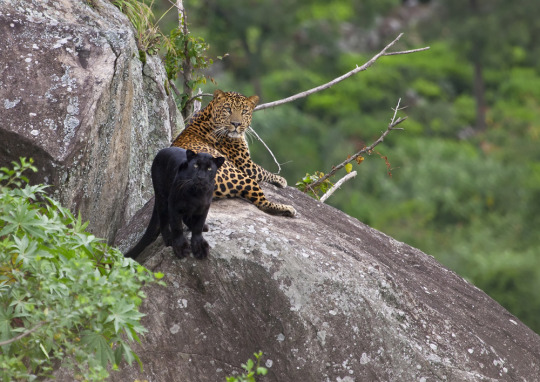
The opposite of albinism called melanism, a recessive trait where the skin and fur are all black.
nature & real talk
Holy shit that’s majestic.
Yes, the powers of Photoshop are indeed majestic
So far the closest thing we have to melanistic lions are the black-mained Asiatic lions
(Panthera leo persica), and it’s not known whether lions are even able to be melanistic!
The only melanistic big cats we know of are jaguars…
…and leopards.
We do, however, know of abundism in other big cats! What’s abundism you may ask? Well, it’s basically when places that normally have a lot of melanin end up producing an abundance of it. So an abundistic tiger looks like this:
And an abundistic cheetah looks like this:
And just for good measure, here’s an abundistic leopard:
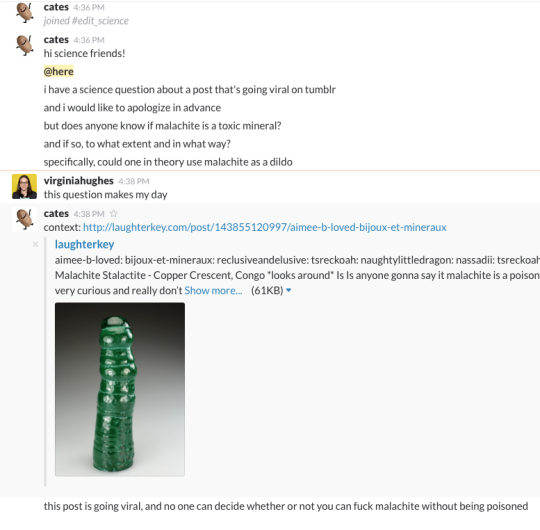
malachite is a poisonous mineral. please do not fuck the malachite stalactite
@lizaleigh do you know any rock people that can confirm/deny because I am very curious and really don’t feel like getting into a conversation with my geophysicist brother that MAY somehow get back to the fact I saw a malachite that looked like a weird dildo.
…sadly, I am not on good enough terms with any of our partner geologists to just attach this to an email with the subject line: “EXPLAIN.”
Although I think @mollisaurus is a mineral person. Thoughts?
oh geeze, i’m kinda rusty on minerals but malachite is just copper carbonate and is really common in both antique and modern jewelry so i think like if you were really gun-ho about it you could go ahead and put it wherever you want?
It’s really only a problem if you’re polishing or cutting it. The particles would be bad to breathe. It’s rather porous too, so I would worry about bacteria growing. Well, being literal anyway… Better to leave the poor thing alone. ._.
I mean it kinda depends on where you stick it because malachite does not like acidic environments very much and the malachite will degrade and also might dye your bits blue-green as the copper dissolves out.
So use a condom when fucking rocks is the takeaway here.
Oh my god guys it’s poisonous
It is super poisonous
There is a reason we do not use it in make up any more
Not even with a condom, do not fuck the rock
Try this one instead.
malachite literally explodes in water does it not?
I… no… I think you’re thinking of pure sodium?
Malachite is however water soluble, which really just means it will poison you quicker
This is both hilarious and cool as fuck because you’re getting all this information on minerals and rocks. You’re also watching people argue over wether or not you can fuck this rock
I go on hiatus for a week and come back to find tumblr molesting my post, but hey, at least we all learned something so yay tumblr, you just keep on being you.
I’m still not sure if I can fuck this rock.
I’m looking into it.
UPDATE:
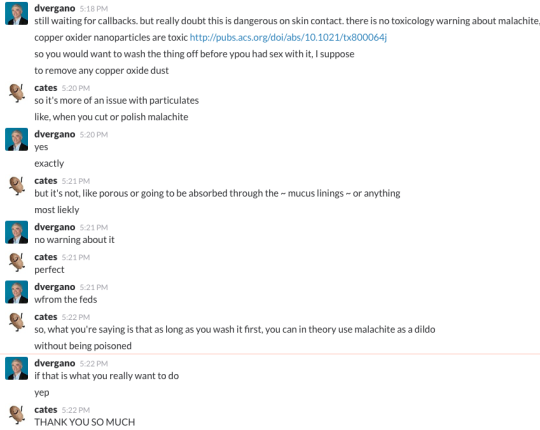
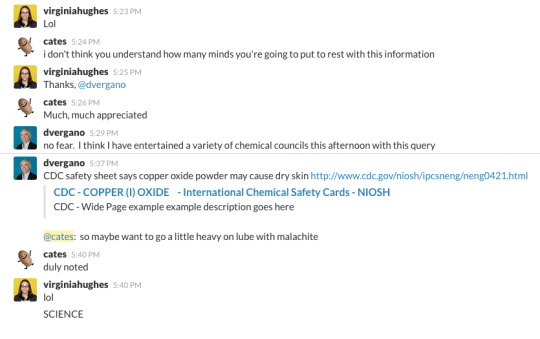
Today in “I’m so sorry, coworkers, it’s for Tumblr,” I brought this post to the attention the science reporters at BuzzFeed. Dan Vergano did a some research and weighed in on the question “Can you use malachite as a dildo or is it toxic?”
The answer is “It’s probably fine, just wash it first and maybe use a bunch of lube.”
Oh man this got so much better than the last time I saw this post
This is my favourite. Science side of tumblr: asking the REAL questions
*biologist crashes through the underbrush*
Ok so here’s the thing though
Malachite is not poisonous to YOU. BUT fucking this stalactite will probably wreck your vaginal flora and leave you with a gruesome infection within a couple days.
Want details? SO GLAD YOU ASKED, ‘CAUSE HERE THEY ARE.
• Malachite is not copper oxide. It’s Cu2CO3(OH)2. Like most carbonates it’s water soluble– that’s how it became a stalactite in the first place! And technically any given chunk of “malachite” isn’t just malachite– it’s a mix of various copper carbonates & oxides. This will become important later.
• When malachite dissolves it makes a bunch of copper (Cu++) ions. Cu++ is GREAT at killing bacteria and fungi– so good at it that sprays with Cu++ get used a lot as a spray in agriculture to stop plant disease. It takes such a large dose to harm larger organisms that copper sprays are used a lot in organic agriculture (like Bordeaux mixture).
So bottom line, yes malachite is technically nontoxic to humans. But it kills bacteria when it dissolves and releases Cu++.
• Malachite dissolves somewhat slowly in water– but vaginal secretions aren’t just any water. A healthy human vagina has a pH of 3.8-4.5 and a salinity of about 0.9%. It’s also warmer than your average underground cave at 37°C (or 98.5°F in American meat units). As luck would have it, acidity, salinity, and warmth all make malachite dissolve faster.
• In other words, the human vagina dissolves malachite.
• I have no deeper explanation for why human females can dissolve rocks with our genitals. It simply is.
• Gonna to take a quick moment to point out that sex toys that dissolve when you use them are maybe not the best investment.
• Anyway the key question now is “how fast does the human vagina dissolve malachite?” Are we talking geological timescale, a Nazis-in-Indiana-Jones situation, or something in between? If the reaction kinetics of dissolution are very slow, then there’s nothing to worry about. An encounter with a stalactite would have to last years for enough Cu++ to leach out to cause problems. If it’s quick then we’re in trouble.
• Unfortunately it looks like nobody really knows. One of the best sources on how malachite dissolves & precipitates in water– an EPA document on how to avoid too much Cu++ in municipal drinking water systems– helpfully says “The kinetic constraints on the formation of these solids in water systems are largely unexplored” (p. 42) because end equilibrium points are all you need to run a city water system safely. In other words, the experiments that would tell us how fast malachite dissolves in various types of water just don’t exist because nobody’s ever needed to know before. So we’d better assume it’s going to happen reasonably quickly, #for safety.
• So in best scientific fashion, we’re just going to bullshit our way ahead using what facts we DO have on hand: endpoint equlibria.
That orange box is how many moles of dissolved Cu++ Scaife got from sticking malachite in some water that had 0.171 moles NaCl/L (body salinity is about 0.154 moles NaCl/L so this is slightly more salty than people) at 30°C. He’s got no acidity in there, and again the salinity and temperature are slightly off from the vaginal standard. But this is probably the closest we’re going to get to data on how malachite behaves in vaginas anytime soon, folks. From this we can take away that if you leave malachite alone in a vagina you’ll get AT LEAST 9.12 x 10^-4 moles/L, or 5.8 ppm, of Cu++ at equilibrium.
• Recall from above that most “malachite” isn’t actually pure malachite, it’s a mix of various copper carbonates & oxides. The EPA document elaborates: “[T]raditional ‘eyeball’ identification of malachite by its blue-green color is extremely
unreliable, because almost all cupric hydroxysulfates, hydroxycarbonates, hydroxychlorides,
and even fresh cupric hydroxide can be some shade of blue-green. … Thus, the uncertainty in the computed copper
concentration in equilibrium with malachite is at least about a factor of 2 … until further experimental data focusing on this problem is generated.”
In other words, “do your math and then double how much Cu++ you think is going to be in the water, just in case.” So that gives us 11.6ppm Cu++, at equilibrium, with malachite in a (til now!) healthy vagina.
• Next step: do we have any idea what happens to bacteria in acid conditions with copper? OH MY GOD WE TOTALLY DO. Gyawali et al 2011 checked this out in the context of “so what if we rinsed tomatoes with a solution of lactic acid and copper, because that would be a safe & organic way to get rid of E. coli?” So now this post has officially ruined stalactites, vaginas, and tomatoes.
^This would happen. These are the counts of 4 E. coli strains exposed to various levels of lactic acid & Cu++ for 8 hours. This table only shows the end counts but it represents the death of 99.7% of bacteria*.
• Losing 99.7% of your vaginal flora is seriously bad news. You’re looking at really good odds of a yeast infection, bacterial vaginosis, and/or other infection issues. And that’s if you’re lucky enough to not be in the 4% of the population or so that’s sensitive to skin contact with copper.
• The good news? Biochemically speaking, you’re probably ok to put it in your butt. It’s not as acidic or salty in there, plus there’s a huuuuuge stockpile of gut microbes right upstream that can quickly repopulate the colon after spelunking is complete. However this stalactite is not flared at the base so it is the wrong shape for putting in your butt. Do not put this stalactite in your butt.
• This all looks like fun and games, but I think it’s really interesting that the internet’s mistake in concluding that this stalactite is fuckable is very similar to the mistake made by the Flint water management system. Hear me out.
• Central to the Flint lead poisoning crisis is that authorities only looked at & tested Flint’s water in its central treatment plant before it went out through the pipes. Not after it went through the pipes. They did not consider what would happen biochemically as it went through the pipes and metals started dissolving.
• Similarly, in concluding that the stalactite is fuckable, the internet only considered the stalactite itself. Not the biochemical processes that would happen to it as it, welp, went through the pipes.
• Media frequently reports that the Flint River’s water is “corrosive,” leading many to believe the river is full of industrial waste. This ain’t the case. You’d need industry to fill a river with industrial waste, and industry left decades ago. That’s why Flint’s so poor. So what IS in the water? Road salt. Plain old stupid road salt. The old Detroit-based source didn’t have salt because it came from Lake Huron which has a large, mostly rural watershed. Meanwhile the Flint River runs through a lot of towns, making it slightly salty as everything melts down in spring. And as we recall from the stalactite experience, a little salt is all it takes to get metals to dissolve.
• Information on this engineering problem was not coming through clearly from the engineering or chemistry sides. It took a biologist, pediatrician Mona Hanna-Attisha, to document the real-time results and provide the data to kick-start a high-level investigation.
• Morals of the story: when dealing with a biological system pls consider asking a biologist, your vagina and/or city could depend on this
• Pls use a condom when fucking any water-soluble material
• Still don’t put the stalactite in your butt -3/10 do not recommend
the fact that we can’t drink sea water even tho its the most common type of water just bc its 3% salt yet we can safely consume multiple forms of literal poison and even benefit from doing so just blows my fucking mind
“Gretchen: On the International Space Station, you have astronauts from the US and from other English speaking countries and you have cosmonauts from Russia. And obviously it’s very important to get your communication right if you’re on a tiny metal box circling the Earth or going somewhere. You don’t want to have a miscommunication there because you could end up floating in space in the wrong way. And so one of the things that they do on the ISS – so first of all every astronaut and cosmonaut needs to be bilingual in English and Russian because those are the languages of space. Lauren: Yep. Wait, the language of space are English and Russian? I’m sorry, I just said ‘yep’ and I didn’t really think about it, so that’s a fact is it? Gretchen: I mean, pretty much, yeah, if you go on astronaut training recruitment forums, which I have gone on to research this episode… Lauren: You’re got to have a backup job, Gretchen. Gretchen: I don’t think I’m going to become an astronaut, but I would like to do astronaut linguistics. And one of the things these forums say, is, you need to know stuff about math and engineering and, like, how to fly planes and so on. But they also say, you either have to arrive knowing English and Russian or they put you through an intensive language training course. But then when they’re up in space, one of the things that they do is have the English native speakers speak Russian and the Russian speakers speak English. Because the idea is, if you speak your native language, maybe you’re speaking too fast or maybe you’re not sure if the other person’s really understanding you. Whereas if you both speak the language you’re not as fluent in, then you arrive at a level where both people can be sure that the other person’s understanding. And by now, there’s kind of this hybrid English-Russian language that’s developed. Not a full-fledged language but kind of a- Lauren: Space Creole! Gretchen: Yeah, a Space Pidgin that the astronauts use to speak with each other! I don’t know if anyone’s written a grammar of it, but I really want to see a grammar of Space Pidgin.”














 wupacing