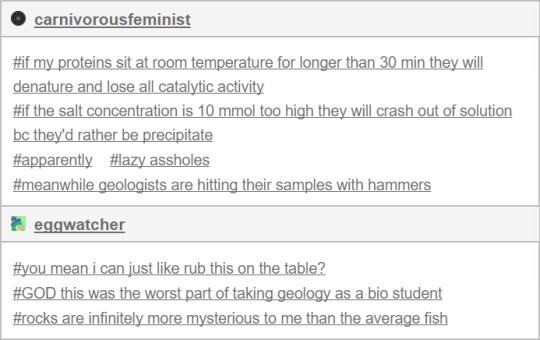
Fun fact: the guys at our college’s geology department prop out the doors with their samples. I totally understand why but as someone whose work with samples is necessarily super delicate and sterile it fucks me up so bad
lol idk if you watch nautilus live at all but watching them process bio & geo samples side by side evokes exactly this Thing (the descriptions are gold too… “here are the 30 steps we use to preserve bio samples, and as for rocks, well, we let them dry, bag them, & put them in the Rock Box)
Good to know there’s enough Biologist Salt™ to go around
Paleontologists occupy a weird and highly uncomfortable slice of this Venn Diagram
in my own experience with geology most precautions with samples are to preserve the life and safety of the geologist, most of the rocks are fine.
i am continually reminded of one of my colleagues, who wanted to collect a sample of gypsum on a field excursion but was too lazy to take off his backpack and get his rock hammer. so he said “eh, it’s soft enough” just fucking punched the rock until a piece fell off like it was fucking minecraft
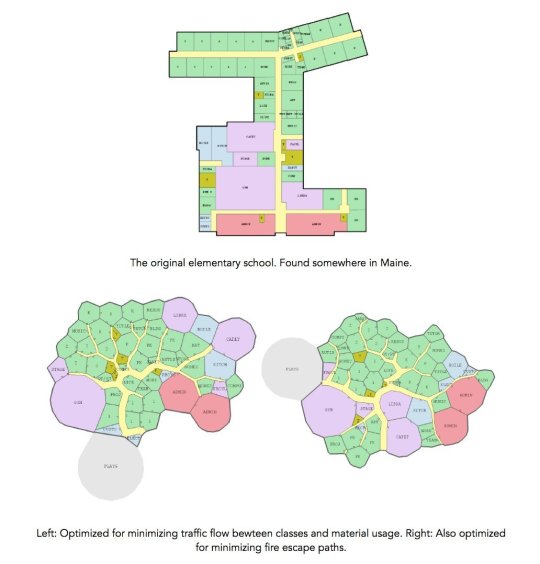
I eagerly await our new AI masters’ world of ultraoptimized, uncannily organic, evolving foorplans. Joel Simon:
Evolving Floor Plans is an experimental research project
exploring speculative, optimized floor plan layouts. The rooms and
expected flow of people are given to a genetic algorithm which attempts
to optimize the layout to minimize walking time, the use of hallways,
etc. The creative goal is to approach floor plan design solely from the
perspective of optimization and without regard for convention,
constructability, etc. The research goal is to see how a combination of
explicit, implicit and emergent methods allow floor plans of high
complexity to evolve. The floorplan is ‘grown’ from its genetic encoding
using indirect methods such as graph contraction and emergent ones such
as growing hallways using an ant-colony inspired algorithm.
Adds Simon: “I have very mixed feelings about this project.”
In the link are also some variants with optimization for windows; now I want to go to that school. I also want to feed this algorithm the floorplans for some other buildings, such as a shopping mall (can you optimize for impulse purchase? for a natural wander rate that inclines the shopper to slow down and take their time? Can you get rid of those trouble-mongering perfume and moisturizer kiosks?) or a multifamily home (could my entire gaming group live at the same address without growing to hate each other? people with different hours of activity, different sensitivities to sound and stimulation, different accessibility needs?).
Remember this the next time you want to complain about GMO’s, we may not have done it in a lab but they still are that.
Bananas looked like lemons wtf
Isn’t this more of a combination of selective breeding and GMOs? Not just GMOs?
Yes. But people talk about how GMO’s are “unnatural”, yet for centuries humanity has been exploiting mutations in animals and plants to produce food for themselves.
GMO’s are simply the process of inducing these mutations reliably.
People hear “Lettuce being modified with scorpion DNA” and think that we’re now eating scorpions. But, in reality, they’re taking a tiny bit of scorpion DNA and splicing it into the plant. Why? So the plant will produce poison that is not harmful to humans but will deter insects, reducing the use of pesticide, which CAN be harmful to humans and the environment.
GMOs are producing rice that can survive flooding, which makes rice more reliable yields and will prevent food shortages in poor nations that rely on said crops for staple food.
GMOs are also creating spider-goat hybrids. Why? So we can splice web production into the goat’s udders. We’ll be able to spin huge quantities of spider silk, enough to reliably create spider silk cables and ropes, which have more tensile strength than steel.
I for one am glad I live in a time where watermelons aren’t giant tomato abominations
The issue with GMOs is that corporations like Monsanto are patenting GMOs and arresting indigenous farmers for cross pollinating with they seeds. But there is nothing dangerous about the science.
^This.
The problem isn’t the science, it’s what capitalism does with that science.
this should be in the largest letters we’ve got, plastered everywhere until it gets through people’s heads:
The problem isn’t the science, it’s what capitalism does with that science.
I just saw a video title on YouTube that said something like “Why is glass transparent?” And that’s an interesting question and I’m sure it’s great that the video exists but my first thought was like “Because glass is terrible, obviously.” Because it’s unwieldy and let’s out warmth and needs to be heated to hundreds of degrees to be shaped and turns into hundreds of tiny daggers if you drop it. Why the hell would we bother with that if it didn’t have some magical quality like being totally transparent despite being solid? Glass is transparent because if it weren’t, we’d use something else.
looking through my “me” tag and this is apparently what I was thinking 3 years ago
If you’re still curious we did not start working glass for its transparency. It was most likely started as a sanitary concern. Glass is easy to clean with soap and water, once it’s cleaned out you can use it again for anything and no germs or flavor from the previous meal or drink will remain.
Other materials at the time, namely clay, would absorb flavors and germs meaning that if you ate beef off a clay plate your next meal with that plate could have beef flavor and microbes common on cow meat on it. That would leak out seemingly at random no less. Heck imagine a sick person coughing into their soup bowl and then months later their germs hiding in the clay would pop out to infect whole new people.
Also the earliest human use of glass we know of is for its sharpness. Pre-historic people would use volcanic glass as sharp knives for food preparation. Also beads. Pretty much any new substance humans get their hands on for most of our history we immediately try to make into beads.
The fact that it could become see through was a side benefit.
this is amazing and I’m really glad I reblogged that old bullshit post because I got to learn this
If giraffes were predators they would look both hilarious and terrifying while sneaking up on their prey
I’m afraid you’ve missed the predatory giraffes by about 66 million years mate.
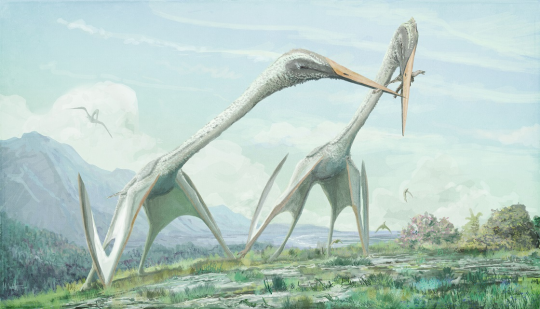
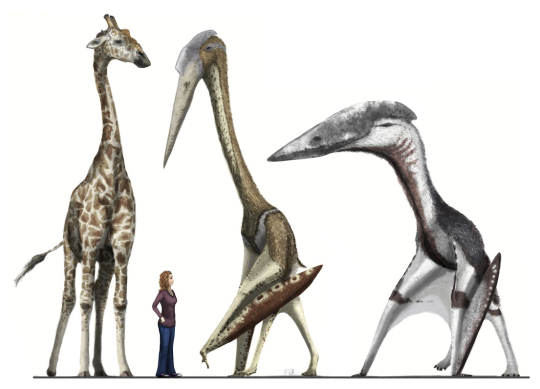
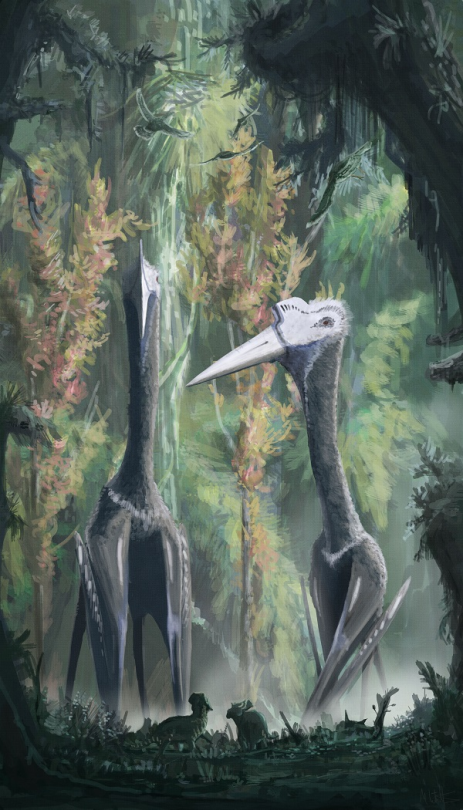
These guys are Azhdarchid pterosaurs, and they were some of the strangest reptiles to ever exist. They were perfectly capable of flight, but their physiology suggests that they may have spent a significant portion of their lives hunting on the ground.
The largest of them could reach over 5 metres tall while standing, and had a 10-metre wingspan. They varied greatly in body type, from the tall, spindly forms of Quetzalcoatlus and Arambourgiania (images 4 and 1-2 respectively) to the heavy brute strength of Hatzegopteryz, a species that may have used its head to bludgeon its prey (images 2 and 3).
There has never been another flying animal before or since to have reached such incredible sizes, nor any predator so intimidatingly tall. Well, not any that we know of yet.
All of these illustrations are by Mark Witton, a palaeontologist and artist who specialises in pterosaurs. This is his blog about palaeontology and the science of reconstructing extinct species. You can find out more about each of these images here, here and here.
(Oh, and by the way … these are NOT dinosaurs)
What the hell these are so intimidating, why aren’t these in any dinosaur movies
Just imagine it …
The protagonists and a few disposable minor characters are walking carefully through a forest at night, covered by a thick fog. They know there are dinosaurs everywhere, but they can’t see more than three metres in front of their own faces.
Eventually they stop near a small cluster of trees to rest. As they sit there, exhausted, one of the trees begins to move. Everyone freezes, terrified. They have no idea what this thing is.
Then a massive beak slams down, longer than a person is tall, and plucks one of the minor characters off his feet and into the air.
The small group erupts into movement, frantically running away from whatever those things are. There’s two of them now, and as the fog begins to clear the group are able to make out more of their shape. They are huge, with long, spindly necks topped with a massive, daggerlike head. The long legs that they once mistook for trees have an almost mechanical movement as the giant creatures stalk towards them. And then comes the next terrible surprise.




 wupacing