Everyone agrees! Your intestines squirming around like eels in your belly is horrifying!
IM SORRY THEY FUCKING WHAT NOW?
The racks even have hooks to keep them from squirming right off and onto the floor apparently. They desperately want to escape our bodies
Intestines are muscles, and function involuntarily. If your muscles did not squirm around, then they wouldn’t be able to move food through them, thus you wouldn’t gain any nutrients from anything you eat, and the food would spoil and make you sick. I agree the squirmy wormies are a bit unsettling, but hey it’s actually really good for you! Your intestines work so hard for it! Please give them a little love.
my god but I get mad when someone flippantly dismisses important scientific progress because you can make it sound dumb by framing it the right way.
For a start, of course a lot of science sounds dumb. Science is all in the slogging through the minutiae, the failures, the tedious process of filling in the blank spaces on the map because it ain’t ’t glamorous, but if someone doesn’t do it, no one gets to know for sure what’s there.
Someone’s gotta spend their career measuring fly genitalia under a microscope. Frankly, I’m grateful to the person who is tackling that tedium, because if they didn’t, I might have to, and I don’t wanna.
But let’s talk about why we should care about this particular science and spend money on it. (And I’ll even answer without even glancing at the article.)
Off the top of my head?
-advances in robotics
-advances in miniature robotics
-advances in flight technology
-advantages in simulating and understanding the mechanics and programming of small intelligences
-ability to grow crops in places uninhabitable by insects (space? cold/hot? places where honeybees are non-native and detrimental to the ecosystem?)
-ability to improve productivity density of crops and feed more people
-less strain on bees, who do poorly when forced to pollinate monocultures of low nutrition plants
-ability to run tightly controlled experiments on pollination, on the effects of bees on plant physiology, on ecosystem dynamics, etc
-fucking robot bees, my friend
-hahaha think how confused those flowers must be
Also worth keeping in mind? People love, love, love framing science in condescending and silly sounding terms as an excuse to cut funding to vital programs. *Especially* if it’s also associated with something (gasp) ‘inappropriate’, like sex or ladyparts. This is why research for a lot of women’s issues, lgbtq+ issues, minorities’ issues, and vulnerable groups in general’s issues tends to lag so far behind the times. This is why some groups are pushing so hard to cut funding for climate change research these days.
Anything that’s acquired governmental funding has been through and intensely competitive, months-to-years long screening by EXPERTS IN THE FIELD who have a very good idea what research is likely to be most beneficial to that field and fill a needed gap.
Trust me. The paperwork haunts my nightmares.
So, we had a joke in my lab: “Nice work, college boy.” It was the phrase for any project that you could spend years and years working on and end up with results that could be summed up on a single, pretty slide with an apparently obvious graph. The phrase was taken from something a grower said at a talk my advisor gave as a graduate student: “So you proved that plants grow better when they’re watered? Nice work, college boy.”
But like, the thing is? There’s always more details than that. And a lot of times it’s important that somebody questions our assumptions.
A labmate of mine doing very similar research demonstrated that our assumptions about the effect of water stress on plant fitness have been wrong for years because *nobody had thought to separate out the different WAYS a plant can be water stressed.* (Continuously, in bursts, etc.). And it turns out these ways have *drastically different effects* with drastically different measures required for response to them to keep from losing lots of money and resources in agriculture.
Nice work, college boy. :p
Point the second: surprise! Anna Haldewang is an industrial design student. She developed this in her product design class. And, as far as I can tell, she has had no particular funding at all for this project, much less billions of dollars.
‘grats, Anna, you FUCKING ROCK.
ps: On a lighter note, summarizing research to make it sound stupid is both easy AND fun. Check out @lolmythesis – I HIGHLY RECOMMEND. :33
I’d also like to chime in that a chunk of my family are apple farmers, and one thing I learned visiting them is that you can’t always let bees pollinate. With certain apple varieties, people have to go out with little paintbrushes to pollinate them by hand, because if they cross-pollinate with the wrong variety the apples won’t come out the same. Beebots could potentially be a huge time-saver at that task, because depending on how the algorithms work, you could just tell them “Don’t go into the Gala field next door” and let them do the job more efficiently than you without having to worry about getting weird mutant apples.
Also holy shit all science is not interchangeable. Nobody got up one morning and said “instead of saving the bees I’m going to build a bee robot.”
The only problem with those robots is a marketing one. Make ‘em anthropomorphic, like pixies, and people would be all over that shit and want them as pets.
I feel morally obligated to remind everyone, when I see discourse like this, that there are vested interests in destroying the public’s faith in
Evidence-based statements
Publicly-funded science
Critical examination of the media
Affection and investment for the natural world
And this is something I’ve been explaining for years.
And next thing you know it’s 2017 and everyone is surprised that the CDC has been told not to use the words “vulnerable” or “evidence-based” when writing their budgets. And the people running the world are able to deny the effects of climate change while the waters rise. This is how you get hurricanes while people tell you there aren’t any hurricanes. And how conspiracy theories are more attractive than the truth.
We got here on purpose because we wanted to be here. Because cynicism seemed cooler than wonder. Because of course the world is broken so why bother?
Because we didn’t want to be like those wide-eyed nerds and their silly robot bees.
I think I may have rebligged the root post before without particularly examining how counter to my values it is. Though, I do truly hope that scientific research can fix the woes of ailing bees before we have to implement any robot army based solutions.
every time i see this im reminded of the “shrimp on a treadmill” thing that people were lambasted for being a “waste of taxpayer money”. DESPITE the fact that it was like a few thousand dollars MAX and done by a student in university (with a grant provided BY THE UNIVERSITY) to study how the negative water quality in the gulf of mexico caused by the bp spill would affect oxygen processing in shrimp.
which is a SIGNIFICANT part of the fishing industry down there and how some folks literally make their living. it also ties into ecology and conservation since you don’t want to overfish shrimp populations that arent going able to bounce back from it. you also dont want to start resorting to fishing methods that will do more harm to to the environment to try to get bigger hauls to hit basic demand if theres nothing there to catch.
my own research was mostly done out of pocket w a few hundred dollars grant despite the fact that it involved potentially an entirely new mode of sensory input as of yet undiscovered by science that had LOADS of potential applications in biology and robotics. but boil it down to “put a scorpion in a maze in the dark to see if it bumps into walls” on paper and people just kinda roll your eyes at you. hell, i even built my own lab apparatuses and paid for the materials with money from my food budget. (bulk dry spaghetti saved my life)
anytime you see a “lol this science was a waste of money” it’s almost always blatant propaganda to encourage the cutting back of research and the justification of budget cuts. dig a little deeper into “dumb studies” and there’s usually some very nifty applications or hypotheses being tested that have real world applications concerning problems that exist RIGHT NOW.
not to say you shouldnt think critically about WHY something is being studied, but the studies you usually have to look out for are the ones privately funded by groups looking to push an agenda (ones from christian “family” groups on homosexuality/lgbt issues, stuff from people with connections to big oil/etc who do studies on global warming, or on the other end of the political spectrum something from pro-marijuana lobbyist about how marijuana will cure -insertailmenthere-). there could still be good raw data in these studies, assuming it hasnt been altered or data sets excluded, but it will be presented in such a way to make their point so you have to keep that in mind (as well as their methodology and things that could have been intentionally or unintentionally skewing the data, but that goes for any study)
“anytime you see a “lol this science was a waste of money” it’s almost always blatant propaganda”
OP turns out to be a Russian propagandist
nice call
Ha! Figures. But seriously, we may need these sooner than later if we want to have fruits like blueberries which aren’t great for honeybees health but which require pollinators.
A scientist in England has made an enlightening discovery about Atlantic puffins — under a UV light, their bills glow like a freshly cracked glow stick.
“It was sort of discovered by accident,” said Jamie Dunning, the ornithologist who first saw the beaks light up.
I can’t tell what is my favorite part of this article, birds see colors humans can’t comprehend, glowing puffin beaks was discover accidentally, or that puffins look really good with aviator glasses.
My favorite is definitely the quote:
So he’s had sunglasses made.
For the puffins.
“This felt like the obvious thing to do,” he said.
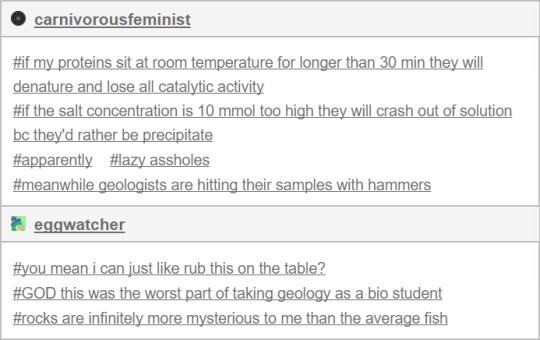
Fun fact: the guys at our college’s geology department prop out the doors with their samples. I totally understand why but as someone whose work with samples is necessarily super delicate and sterile it fucks me up so bad
lol idk if you watch nautilus live at all but watching them process bio & geo samples side by side evokes exactly this Thing (the descriptions are gold too… “here are the 30 steps we use to preserve bio samples, and as for rocks, well, we let them dry, bag them, & put them in the Rock Box)
Good to know there’s enough Biologist Salt™ to go around
Paleontologists occupy a weird and highly uncomfortable slice of this Venn Diagram
in my own experience with geology most precautions with samples are to preserve the life and safety of the geologist, most of the rocks are fine.
i am continually reminded of one of my colleagues, who wanted to collect a sample of gypsum on a field excursion but was too lazy to take off his backpack and get his rock hammer. so he said “eh, it’s soft enough” just fucking punched the rock until a piece fell off like it was fucking minecraft
In a simple experiment, researchers at the University of Chicago sought to find out whether a rat would release a fellow rat from an unpleasantly restrictive cage if it could. The answer was yes.
The free rat, occasionally hearing distress calls from its compatriot, learned to open the cage and did so with greater efficiency over time. It would release the other animal even if there wasn’t the payoff of a reunion with it. Astonishingly, if given access to a small hoard of chocolate chips, the free rat would usually save at least one treat for the captive — which is a lot to expect of a rat.
The researchers came to the unavoidable conclusion that what they were seeing was empathy — and apparently selfless behavior driven by that mental state.


 wupacing