queer-sunshine-femme:

theclockworkaesthete:

zforzelma:

ohdeargodwhy:

A Midsummer Night’s Dream [x]

What with the Mercutio/Romeo kiss from the other day I feel like I should have a tag specifically for “men kissing in Shakespeare plays even though it’s not in the text, but after 400 years of unresolved sexual tension it’s time.”

Asdfghjkl;:

Whaaat this is the most over the top dip-and-kiss I’ve ever seen and I love it

vr-trakowski:

deducecanoe:

whopooh:

daimonie:

motherfuckingshakespeare:

runecestershire:

runecestershire:

persephonesidekick:

harmonicakind:

yknow if romeo had just Cried on juliets corpse for a couple hours instead of drinking poison Right Then they would have been Fine

The moral of the story is: always take time to cry for a few hours before making important decisions.

So I’m more or less being facetious here, but this is actually a thing.

Hamlet is genre savvy. Hamlet knows how Tragedies work, and he’s not going to rush in and get stabby without making absolutely certain he’s got all the facts.

Except once he thinks he has all the facts – once he’s certain that it really is the ghost of his father and Claudius really did kill him, he rushes in and stabs the wrong guy, which starts a domino line of deaths and gets Laertes embroiled in his own revenge tragedy and ultimately results in the deaths of nearly every character other than Horatio.

That’s the irony and the tragedy of the story. Hamlet knows his tropes and actively tries to avoid them, and the tropes get him anyway. It’s inevitable, the tropes are hungry.

I want a sticker that says the tropes are hungry so I can put it on my laptop

i met a scholar once who said that tragedies aren’t about a silly “flaw” or anything, it’s about having a hero who’s just in the wrong goddamn story

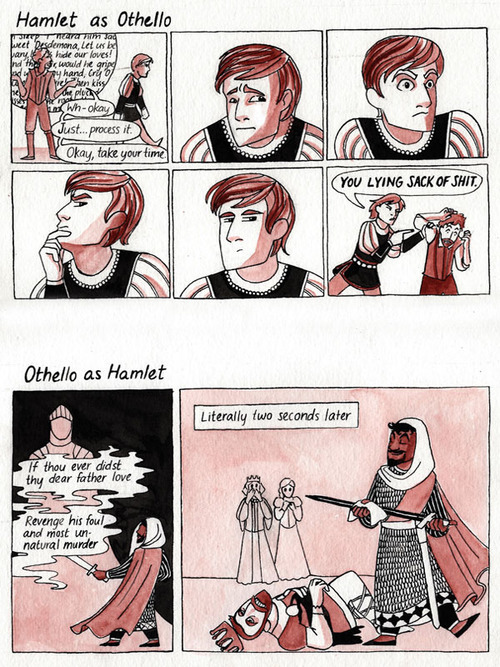
if hamlet swapped places with othello he wouldn’t be duped by any of iago’s shit, he’d sit down & have a good think & actually examine the facts before taking action. meanwhile in denmark, othello would have killed claudius before act 2 could even start. but instead nope, they’re both in situations where their greatest strengths are totally useless and now we’ve got all these bodies to bury.

The tropes are hungry and the hero is in the wrong goddamn story.

I love this post.

Feels

I believe the artist is Katy Doughty.  

Concerning Juliet’s age

thebibliosphere:

catintheoffice:

penfairy:

I find a big stumbling block that comes with teaching Romeo and Juliet is explaining Juliet’s age. Juliet is 13 – more precisely, she’s just on the cusp of turning 14. Though it’s not stated explicitly, Romeo is implied to be a teenager just a few years older than her – perhaps 15 or 16. Most people dismiss Juliet’s age by saying “that was normal back then” or “that’s just how it was.” This is fundamentally untrue, and I will explain why.

In Elizabethan England, girls could legally marry at 12 (boys at 14) but only with their father’s permission. However, it was normal for girls to marry after 18 (more commonly in early to mid twenties) and for boys to marry after 21 (more commonly in mid to late twenties). But at 14, a girl could legally marry without papa’s consent. Of course, in doing so she ran the risk of being disowned and left destitute, which is why it was so critical for a young man to obtain the father’s goodwill and permission first. Therein lies the reason why we are repeatedly told that Juliet is about to turn 14 in under 2 weeks. This was a critical turning point in her life.

In modern terms, this would be the equivalent of the law in many countries which states children can marry at 16 with their parents’ permission, or at 18 to whomever they choose – but we see it as pretty weird if someone marries at 16. They’re still a kid, we think to ourselves – why would their parents agree to this?

This is exactly the attitude we should take when we look at Romeo and Juliet’s clandestine marriage. Today it would be like two 16 year olds marrying in secret. This is NOT normal and would NOT have been received without a raised eyebrow from the audience. Modern audiences AND Elizabethan audiences both look at this and think THEY. ARE. KIDS.

Critically, it is also not normal for fathers to force daughters into marriage at this time. Lord Capulet initially makes a point of telling Juliet’s suitor Paris that “my will to her consent is but a part.” He tells Paris he wants to wait a few years before he lets Juliet marry, and informs him to woo her in the meantime. Obtaining the lady’s consent was of CRITICAL importance. It’s why so many of Shakespeare’s plays have such dazzling, well-matched lovers in them, and why men who try to force daughters to marry against their will seldom prosper. You had to let the lady make her own choice. Why?

Put simply, for her health. It was considered a scientific fact that a woman’s health was largely, if not solely, dependant on her womb. Once she reached menarche in her teenage years, it was important to see her fitted with a compatible sexual partner. (For aristocratic girls, who were healthier and enjoyed better diets, menarche generally occurred in the early teens rather than the later teens, as was more normal at the time). The womb was thought to need heat, pleasure, and conception if the woman was to flourish. Catholics might consider virginity a fit state for women, but the reformed English church thought it was borderline unhealthy – sex and marriage was sometimes even prescribed as a medical treatment. A neglected wife or widow could become sick from lack of (pleasurable) sex. Marrying an unfit sexual partner or an older man threatened to put a girl’s health at risk. An unsatisfied woman, made ill by her womb as a result – was a threat to the family unit and the stability of society as a whole. A satisfying sex life with a good husband meant a womb that had the heat it needed to thrive, and by extension a happy and healthy woman.

In Shakespeare’s plays, sexual compatibility between lovers manifests on the stage in wordplay. In Much Ado About Nothing, sparks fly as Benedick and Beatrice quarrel and banter, in comparison to the silence that pervades the relationship between Hero and Claudio, which sours very quickly. Compare to R+J – Lord Capulet tells Paris to woo Juliet, but the two do not communicate. But when Romeo and Juliet meet, their first speech takes the form of a sonnet. They might be young and foolish, but they are in love. Their speech betrays it.

Juliet, on the cusp of 14, would have been recognised as a girl who had reached a legal and biological turning point. Her sexual awakening was upon her, though she cares very little about marriage until she meets the man she loves. They talk, and he wins her wholehearted, unambiguous and enthusiastic consent – all excellent grounds for a relationship, if only she weren’t so young.

When Tybalt dies and Romeo is banished, Lord Capulet undergoes a monstrous change from doting father to tyrannical patriarch. Juilet’s consent has to take a back seat to the issue of securing the Capulet house. He needs to win back the prince’s favour and stabilise his family after the murder of his nephew. Juliet’s marriage to Paris is the best way to make that happen. Fathers didn’t ordinarily throw their daughters around the room to make them marry. Among the nobility, it was sometimes a sad fact that girls were simply expected to agree with their fathers’ choices. They might be coerced with threats of being disowned. But for the VAST majority of people in England – basically everyone non-aristocratic – the idea of forcing a daughter that young to marry would have been received with disgust. And even among the nobility it was only used as a last resort, when the welfare of the family was at stake. Note that aristocratic boys were often in the same position, and would also be coerced into advantageous marriages for the good of the family.

tl;dr:

Q. Was it normal for girls to marry at 13?

A. Hell no!

Q. Was it legal for girls to marry at 13?

A. Not without dad’s consent – Friar Lawrence performs this dodgy ceremony only because he believes it might bring peace between the houses.

Q. Was it normal for fathers to force girls into marriage?

A. Not at this time in England. In noble families, daughters were expected to conform to their parents wishes, but a girl’s consent was encouraged, and the importance of compatibility was recognised.

Q. How should we explain Juliet’s age in modern terms?

A. A modern Juliet would be a 17 year old girl who’s close to turning 18. We all agree that girls should marry whomever they love, but not at 17, right? We’d say she’s still a kid and needs to wait a bit before rushing into this marriage. We acknowledge that she’d be experiencing her sexual awakening, but marrying at this age is odd – she’s still a child and legally neither her nor Romeo should be marrying without parental permission.

Q. Would Elizabethans have seen Juliet as a child?

A. YES. The force of this tragedy comes from the youth of the lovers. The Montagues and Capulets have created such a hateful, violent and dangerous world for their kids to grow up in that the pangs of teenage passion are enough to destroy the future of their houses. Something as simple as two kids falling in love is enough to lead to tragedy. That is the crux of the story and it should not be glossed over – Shakespeare made Juliet 13 going on 14 for a reason. 

Romeo and Juliet is the Elizabethan equivalent of  ‘won’t someone please think of the children’  it’s a romantic tragedy  not a romance  romantic in that it’s a love story  but not a romance in the sense that it is supposed to be emulated  and is likely a social commentary of something happening at the time  whether it was ongoing religious feuds  which did tear families apart  uprisings across the country  or just general malaise with how the world was going in the 1590s  it’s also worth noting that R+J was based heavily on a poem writen  some 30ish years prior  by Arthur Brooke  known as The Tragical History of Romeus and Juliet  which in turn was based on the work of Matteo Bandello  who supposedly based most of his work on real life events  making his association to Lucrezia Gonzaga  an Italian noblewoman  who was married off at the age of 14  likely to solidify some sort of alliance during turbulent times all the more poignant  Shakespeare was and never has been the reserve of the intellectual and elite  that we are taught his work without historical context  robs us of the true value of his work social commentary  and this social commentary would like to have a few words with your false ideas of ‘historical accuracy’ (via @thebibliosphere)

I saw this in my emails and couldn’t see why I’d been tagged in it (all the while nodding vehemently along) and then I saw my tags and ah. Yep. Still forever mad at how badly Shakespeare is taught in most schools.

thatsthespiritdear:

writterings:

so a traveling shakespeare troupe came to my school today and performed romeo and juliet and it was just so good and

-the actor playing romeo was hella short and the actor playing benvolio was hella tall. at several points he just picked romeo up and moved him around the stage/out of his way.

-when the nurse delivered juliet’s letter they played it up like she was flirting with mercutio but mercutio just looked at her, wrapped his arm around benvolio, and more or less gave her an expression that said “i’m gay”

-when mercutio and benvolio were making fun of romeo for being Heterosexual™ (aka for loving juliet), benvolio picked him up and mercutio gave him a purple nurple

-juliet wore no shoes throughout the entire show except during the wedding when she wore these giant sparkly pink pumps with platform heels

-when mercutio gave the queen mab speech they had benvolio stand behind him and click castanets and go “ooooooooh” every time he dropped a dramatic line

-they had friar lawerance and the nurse say the prologue and the end lines and like…..that changed the impact of the lines and their character significantly. i’ve made a post or two about this before but i personally interpret romeo and juliet as a story about two kids too afraid to come to their parents with a problem because they’re afraid of repercussions. but what about the adults in their life that DID try to help with them with their problems, but still ended up failing them? let’s just say it hit hard and was very telling when the friar and the nurse choked out the last lines of the play while sobbing.

-whenever there was a fight scene, mercutio and benvolio were constantly trying to keep romeo away from the action, as if he was their younger brother who they didn’t want to get hurt in a brawl. during mercutio’s fight with tybalt, benvolio was shielding romeo with his body and physically picked him up and held him back at times. that really changed the dynamic of the three of them and made it even funnier when ben and merc were teasing romeo about his crush on juliet.

-romeo killed paris by hitting him on the head with a flashlight

-the apothecary that sold romeo poison was dressed up as your typical TV drug dealer and he acted like one as well

-while benvolio more or less disappears from the written play after romeo is banished, they kept him around this time and he followed romeo around to make sure he was okay but didn’t say anything. it was implied he didn’t talk because he was still grieving mercutio. (he also wasn’t there when romeo killed himself)

-i was watching it with a bunch of freshmen who hadn’t read the play before but when juliet killed herself nearly half the room started screaming because they were so shocked

honestly this cast was just so good. i’ve also seen them perform julius caesar set in a modern politician’s world and m*cbeth in a post-apocalyptic setting. i absolutely loved this production and i hope i can see more of their work soon

WHAT COMPANY WAS THIS OMG

skyelle0:

thebibliosphere:

penfairy:

zetsubouloli:

penfairy:

Women have more power and agency in Shakespeare’s comedies than in his tragedies, and usually there are more of them with more speaking time, so I’m pretty sure what Shakespeare’s saying is “men ruin everything” because everyone fucking dies when men are in charge but when women are in charge you get married and live happily ever after

I think you’re reading too far into things, kiddo.
Take a break from your women’s studies major and get some fresh air.

Right. Well, I’m a historian, so allow me to elaborate.

One of the most important aspects of the Puritan/Protestant revolution (in the 1590’s in particular) was the foregrounding of marriage as the most appropriate way of life. It often comes as a surprise when people learn this, but Puritans took an absolutely positive view of sexuality within the context of marriage. Clergy were encouraged to lead by example and marry and have children, as opposed to Catholic clergy who prized virginity above all else. Through his comedies, Shakespeare was promoting this new way of life which had never been promoted before. The dogma, thanks to the church, had always been “durr hburr women are evil sex is bad celibacy is your ticket to salvation.” All that changed in Shakespeare’s time, and thanks to him we get a view of the world where marriage, women, and sexuality are in fact the key to salvation. 

The difference between the structure of a comedy and a tragedy is that the former is cyclical, and the latter a downward curve. Comedies weren’t stupid fun about the lighter side of life. The definition of a comedy was not a funny play. They were plays that began in turmoil and ended in reconciliation and renewal. They showed the audience the path to salvation, with the comic ending of a happy marriage leaving the promise of societal regeneration intact. Meanwhile, in the tragedies, there is no such promise of regeneration or salvation. The characters destroy themselves. The world in which they live is not sustainable. It leads to a dead end, with no promise of new life.

And so, in comedies, the women are the movers and shakers. They get things done. They move the machinery of the plot along. In tragedies, though women have an important part to play, they are often morally bankrupt as compared to the women of comedies, or if they are morally sound, they are disenfranchised and ignored, and refused the chance to contribute to the society in which they live. Let’s look at some examples.

In Romeo and Juliet, the play ends in tragedy because no-one listens to Juliet. Her father and Paris both insist they know what’s right for her, and they refuse to listen to her pleas for clemency. Juliet begs them – screams, cries, manipulates, tells them outright I cannot marry, just wait a week before you make me marry Paris, just a week, please and they ignore her, and force her into increasingly desperate straits, until at last the two young lovers kill themselves. The message? This violent, hate-filled patriarchal world is unsustainable. The promise of regeneration is cut down with the deaths of these children. Compare to Othello. This is the most horrifying and intimate tragedy of all, with the climax taking place in a bedroom as a husband smothers his young wife. The tragedy here could easily have been averted if Othello had listened to Desdemona and Emilia instead of Iago. The message? This society, built on racism and misogyny and martial, masculine honour, is unsustainable, and cannot regenerate itself. The very horror of it lies in the murder of two wives. 

How about Hamlet? Ophelia is a disempowered character, but if Hamlet had listened to her, and not mistreated her, and if her father hadn’t controlled every aspect of her life, then perhaps she wouldn’t have committed suicide. The final scene of carnage is prompted by Laertes and Hamlet furiously grappling over her corpse. When Ophelia dies, any chance of reconciliation dies with her. The world collapses in on itself. This society is unsustainable. King Lear – we all know that this is prompted by Cordelia’s silence, her unwillingness to bend the knee and flatter in the face of tyranny. It is Lear’s disproportionate response to this that sets off the tragedy, and we get a play that is about entropy, aging and the destruction of the social order.  

There are exceptions to the rule. I’m sure a lot of you are crying out “but Lady Macbeth!” and it’s a good point. However, in terms of raw power, neither Lady Macbeth nor the witches are as powerful as they appear. The only power they possess is the ability to influence Macbeth; but ultimately it is Macbeth’s own ambition that prompts him to murder Duncan, and it is he who escalates the situation while Lady Macbeth suffers a breakdown. In this case you have women who are allowed to influence the play, but do so for the worse; they fail to be the good moral compasses needed. Goneril, Regan and Gertrude are similarly comparable; they possess a measure of power, but do not use it for good, and again society cannot renew itself.

Now we come to the comedies, where women do have the most control over the plot. The most powerful example is Rosalind in As You Like It. She pulls the strings in every avenue of the plot, and it is thanks to her control that reconciliation is achieved at the end, and all end up happily married. Much Ado About Nothing pivots around a woman’s anger over the abuse of her innocent cousin. If the men were left in charge in this play, no-one would be married at the end, and it would certainly end in tragedy. But Beatrice stands up and rails against men for their cruel conduct towards women and says that famous, spine-tingling line – oh God, that I were a man! I would eat his heart in the marketplace. And Benedick, her suitor, listens to her. He realises that his misogynistic view of the world is wrong and he takes steps to change it. He challenges his male friends for their conduct, parts company with the prince, and by doing this he wins his lady’s hand. The entire happy ending is dependent on the men realising that they must trust, love and respect women. Now it is a society that is worthy of being perpetuated. Regeneration and salvation lies in equality between the sexes and the love husbands and wives cherish for each other. The Merry Wives of Windsor – here we have men learning to trust and respect their wives, Flastaff learning his lesson for trying to seduce married women, and a daughter tricking everyone so she can marry the man she truly loves. A Midsummer Night’s Dream? The turmoil begins because three men are trying to force Hermia to marry someone she does not love, and Helena has been cruelly mistreated. At the end, happiness and harmony comes when the women are allowed to marry the men of their choosing, and it is these marriages that are blessed by the fairies.

What of the romances? In The Tempest, Prospero holds the power, but it is Miranda who is the key to salvation and a happy ending. Without his daughter, it is likely Prospero would have turned into a murderous revenger. The Winter’s Tale sees Leontes destroy himself through his own jealousy. The king becomes a vicious tyrant because he is cruel to his own wife and children, and this breach of faith in suspecting his wife of adultery almost brings ruin to his entire kingdom. Only by obeying the sensible Emilia does Leontes have a chance of achieving redemption, and the pure trust and love that exists between Perdita and Florizel redeems the mistakes of the old generation and leads to a happy ending. Cymbeline? Imogen is wronged, and it is through her love and forgiveness that redemption is achieved at the end. In all of these plays, without the influence of the women there is no happy ending.

The message is clear. Without a woman’s consent and co-operation in living together and bringing up a family, there is turmoil. Equality between the sexes and trust between husbands and wives alone will bring happiness and harmony, not only to the family unit, but to society as a whole. The Taming of the Shrew rears its ugly head as a counter-example, for here a happy ending is dependent on a woman’s absolute subservience and obedience even in the face of abuse. But this is one of Shakespeare’s early plays (and a rip-off of an older comedy called The Taming of a Shrew) and it is interesting to look at how the reception of this play changed as values evolved in this society. 

As early as 1611 The Shrew was adapted by the writer John Fletcher in a play called The Woman’s Prize, or The Tamer Tamed. It is both a sequel and an imitation, and it chronicles Petruchio’s search for a second wife after his disastrous marriage with Katherine (whose taming had been temporary) ended with her death. In Fletcher’s version, the men are outfoxed by the women and Petruchio is ‘tamed’ by his new wife. It ends with a rather uplifting epilogue that claims the play aimed:

To teach both sexes due equality

And as they stand bound, to love mutually.

The Taming of the Shrew and The Tamer Tamed were staged back to back in 1633, and it was recorded that although Shakespeare’s Shrew was “liked”, Fletcher’s Tamer Tamed was “very well liked.” You heard it here folks; as early as 1633 audiences found Shakespeare’s message of total female submission uncomfortable, and they preferred John Fletcher’s interpretation and his message of equality between the sexes.

So yes. The message we can take away from Shakespeare is that a world in which women are powerless and cannot or do not contribute positively to society and family is unsustainable. Men, given the power and left to their own devices, will destroy themselves. But if men and women can work together and live in harmony, then the whole community has a chance at salvation, renewal and happiness.  

In the immortal words of the bard himself: fucking annihilated.

instead of reporting the murder, i would like to help you bury thE BODY CAUSE DAAMN

zimbitswithtimbits:

notlostonanadventure:

durnesque-esque:

ygrittebardots:

dzamieponders:

warriorprincebellamy:

shakespeare’s character descriptions/stage directions/contexts are so vague it makes me so happy. wanna make Laertes hamlet’s ex boyfriend? doesn’t say HE’S NOT. wanna make juliet a trans girl? WHERE IN THE SCIRPT DOES IT SAY SHE ISN’T??? fucking put King Lear in SPACE set that shit on the enterprise THERE ARE NO RULES IN SHAKESPEARE 

The best part is that pretty much all of the fights are “they fight” with no mention of whether it’s with swords or throwing knives or kung-fu or if they just do the slappy-hands thing at each other.

the only rule in shakespeare is that a bear must show up in the winter’s tale. could be a grizzly. polar. panda. hell, antigonus could’ve wandered into a gay club.

This is the EXACT reason why shakespeare endures more than any other writer, btw

it’s what he would have wanted

maha-pambata-is-my-patronus:

dukeofbookingham:

penfairy:

oh! I have to tell you guys a great story one of my professors told me. So he has a friend who is involved in these Shakespeare outreach programs where they try to bring Shakespeare and live theatre to poor and underprivileged groups and teach them about English literature and performing arts and such. On one of their tours they stopped at a young offenders institute for women and they put on a performance of Romeo and Juliet for a group of 16-17 year old girls. It was all going really well and the girls were enjoying and laughing through the first half – because really, the first half is pretty much a comedy – but as the play went on, things started to get quiet. Real quiet. Then it got up to the suicide scene and mutterings broke out and all the girls were nudging each other and looking distressed, and as this teacher observed them, he realised – they didn’t know how the play ended. These girls had never been exposed to the story of Romeo and Juliet before, something which he thought was impossible given how ubiquitous it is in our culture. I mean, the prologue even gives the ending away, but of course it doesn’t specify exactly how the whole “take their life” thing goes down, so these poor girls had no idea what to expect and were sitting there clinging to hope that Romeo would maybe sit down for a damn minute instead of murdering Paris and chugging poison – but BAM he died and they all cried out – and then Juliet WOKE UP and they SCREAMED and by the end of the play they were so upset that a brawl nearly broke out, and that’s the story of how Shakespeare nearly started a riot at a juvenile detention centre

Apparently something similar happened during a production of Much Ado at Rikers Island because a bunch of inmates wanted to beat the shit out of Claudio, which is more than fair tbh

honestly Shakespeare would be so pleased to know his plays were nearly starting brawls centuries into the future

somethingscarlet13:

Things I am never ever going to get over:

• The fact that the scene at the end of Hamlet where Horatio goes to drink the poison to join Hamlet in death is an exact perfect parallel of the scene at the end of Romeo & Juliet where Juliet goes to drink the poison to join Romeo in death, which is not at all a coincidence.

• The fact that the entire play Horatio is calm and level-headed but the moment Hamlet is dying all that goes out the window as he becomes a grief-stricken mess, completely unprepared and unwilling to live without Hamlet.

• The fact that the word “sweet” has historical significance as a deliberate indicator of homosexual love and how that means the inclusion of “sweet prince” at the end of the play is a completely deliberate indication that Hamlet and Horatio were in love.