It’s so significant too that this narrative was collected by Zora Neale Hurston, one of the greatest authors and anthropologists of her time. She was shunned by the “gatekeepers” of both of these professions, largely because of her Blackness, her womanhood, and her uncompromising commitment to honoring and showcasing both in her works. She died penniless and alone in a state-run institution in 1960. All of her works had gone out of publication by then. It took more than a decade before she was rediscovered. A young author by the name of Alice Walker had come across her work and was deeply inspired by it. “In 1973, after an exhaustive search, Walker came across Hurston’s unmarked grave in Ft. Pierce, Fla. She purchased a headstone for Hurston’s tomb and had it inscribed “A Genius of the South.“”
It is through Zora Neale Hurston’s pioneering sacrifice, and the acceptance of that inheritance by Alice Walker that we have found this missing piece of our history. Without the courageous and unfailing work of Black women, we wouldn’t have Cudjo Lewis’s story. We are slowly regaining a narrative that’s been hidden from us, one that continues to be lied about. Trust Black women to lead the way.
I just thought about this today and dug through my pictures to find it: a letter from a black soldier in the Civil War to the person who owns his daughter. “The longer you keep my child from me the longer you will have to burn in Hell and the quicker you will get there.“
photo text (with corrected spelling and broken into sentences, paragraphs):
Letter from a Black Soldier to the Owner of His Daughter
Spotswood Ric, a former slave, writes to Kittey Diggs, 1864:
I received a letter from Cariline telling me that you say I tried to steal, to plunder, my child away from you. Not I want you to understand that Mary is my Child and she is a God given rite of my own.
And you may hold on to her as long as you can. But I want you to remember this one thing, that the longer you keep my Child from me the longer you will have to burn in hell and the quicker you’ll get there.
For we are now making up about one thousand black troops to come up thorough, and want to come through, Glasgow. And when we come woe be to Copperhood rebels and to the Slaveholding rebels. For we don’t expect to leave them there. Root nor branch. But we think however that we (that have children in the hands of you devils), we will try your the day that we enter Glasgow.
I want you to understand Kittey Diggs that where ever you and I meet we are enemies to each other. I offered once to pay you forty dollars for my own Child but I am glad now that you did not accept it. Just hold on now as long as you can and the worse it will be for you.
You never in you life before I came down hear did you give children anything, not anything whatever, not even a dollars worth of expenses. Now you call my children your property. Not so with me.
My children is my own and I expect to get them. And when I get ready to come after Mary I will have both a power and authority to bring her away and to exact vengeances on them that holds my Child.
You will then know how to talk to me. I will assure that. And you will know how to talk right too. I want you now to just hold on; to hear if you want to. If your conscience tells that’s the road, go that road and what it will bring you to Kittey Diggs.
I have no fears about getting Mary out of your hands. This whole Government gives cheer to me and you cannot help yourself.
Source: Ira Berlin, ed. Freedom, A Documentary History of Emancipation, 1861-1867. Cambridge: Cambridge University, 1982, 690.
I wanted to find out what happened (DID HE GET HIS DAUGHTER BACK?) and the answer is that not only was he reunited with his family, but went on to be a successful minister and his daughter was interviewed in the 30s for the Slave Narratives Project.
Listen, in the build-up to the Civil War, one of the most powerful political forces in the United States was a trend toward moderation that advocated for a moderate amount of slavery, and they saw the abolitionists who wanted zero slavery to be “just as bad” as the planters and fire-eaters who wanted slavery everywhere. This is the “house divided” that Lincoln was talking about; a movement that “rejected extremism on both sides” so that we would have medium slavery.
As it is, so it ever was.
Reading what people wrote about slavery back then had a big impact on me. It was all too familiar how it was justified.
And liberals are perpetually trying to justify this stance with, “Oh, that was just the way things were back then, don’tcha know,”
and I’m just staring at them like
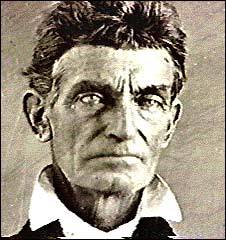
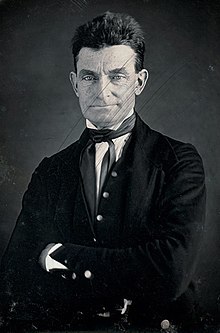
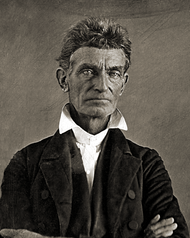
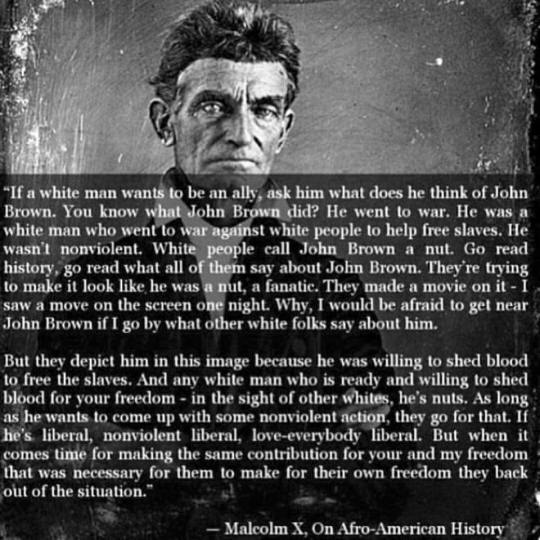
“John Brown having none of your shit” needs to be used more often as a reaction image on this site.
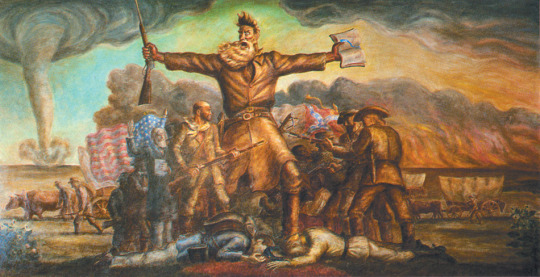
Every single depiction of the man looked like a meme template, even
Worth keeping in mind: when John Kelly said the civil war was started over a “lack of compromise,” he’s trying not to admit, “the South refused to compromise on the idea that slavery should be legal everywhere.”
The abolitionists were not a strong, solid majority. They were the extremists, the people saying “burn it all down” was better than a partial fix. And most white people (y’know, the only people who could vote) were content with “we could have SOME slavery, just… there should be limits.”
The South refused to accept limits. That’s the “lack of compromise” that kicked off the Civil War.
When some asshole Nazi wannabe tells you “look, both sides have some valid opinions; we should have more compromise,” know that what he really means is, “YOU should compromise; I should have the right to be as vicious as I want to anyone I wish.” And the people actually advocating for compromise? Again, they mean, “the bigots have been a big part of our history and we need to keep making them feel welcome. Their targets need to accept the gains they’ve gotten, and shut up about actually getting equality.”
So fuck compromise. Compromise only works when you’re starting from equal positions.
I don’t remember EVER learning about this dude, so I went to Wikipedia and this one sentence really resonated:
Historian James Loewen surveyed American History textbooks and noted that historians considered Brown perfectly sane until about 1890, but he was generally portrayed as insane from about 1890 until 1970.
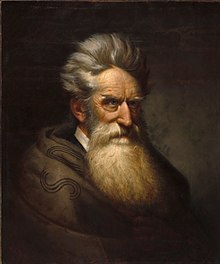
Also I want to know if he ever had a grand, flowing beard like that or if the artist was like “No, he absolutely NEED a Moses beard. NEEDS IT.”
there is no compromise when it comes to equality and freedom
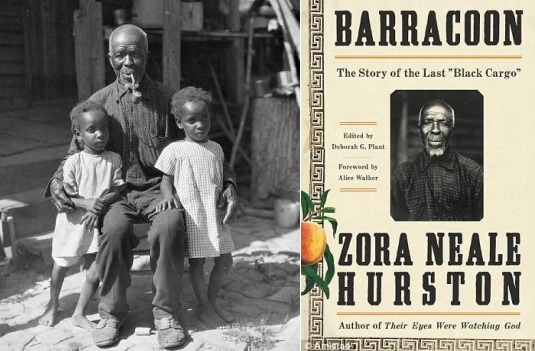
Cudjo Lewis, who was born as Kossola, was nearly 90 years old and living in Plateau, Alabama. He was thought to be the last African man alive who had been kidnapped from his village in West Africa in 1859 and forced into slavery in America aged 19.
Hurston, who was an anthropologist, documented her interviews with Lewis during the late 1920s and wrote a book in his own words about his life titled, ‘Barracoon: The Story of the Last ‘Black Cargo’.
But the manuscript she wrote was turned down by multiple publishers in 1931 who felt as though Lewis’s heavily accented dialect was too difficult to read.
For decades, Hurston’s manuscript of the book was tucked away inside Howard University’s archives until The Zora Neale Hurston Trust found a buyer for the book – more than 50 years after her death in 1960. On Tuesday, May 8, 2018. ‘Barracoon: The Story of the Last ‘Black Cargo’,’ was published by Amistad/HarperCollins.
Of her time spent with Lewis, Hurston wrote in a letter to her friend, fellow Harlem Renaissance author and poet Langston Hughes, that the experience left her deeply moved, according to her biography, ‘Wrapped in Rainbows: The Life of Zora Neale Hurston’ by author Valerie Boyd.
‘Tears welled in his eyes as he described the trip across the ocean in the Clotilda,’ Hurston wrote, as cited in Boyd’s biography.
‘But what moved Hurston most about the old man — whom she always called by his African name, Kossola — was how much he continued to miss his people back in Nigeria. ‘I lonely for my folks,’ he told her.
‘After seventy-five years he still had that tragic sense of loss…That yearning for blood and cultural ties. That sense of mutilation. It gave me something to feel about.’
Across the country, judges increasingly are sending defendants to rehab instead of prison or jail. These diversion courts have become the bedrock of criminal justice reform, aiming to transform lives and ease overcrowded prisons.
But in the rush to spare people from prison, some judges are steering defendants into rehabs that are little more than lucrative work camps for private industry, an investigation by Reveal from The Center for Investigative Reporting has found.
The programs promise freedom from addiction. Instead, they’ve turned thousands of men and women into indentured servants.
The beneficiaries of these programs span the country, from Fortune 500 companies to factories and local businesses. The defendants work at a Coca-Cola bottling plant in Oklahoma, a construction firm in Alabama, a nursing home in North Carolina.
There’s little drug rehabilitation going on at these labor camps. Some of the companies that utilize the slave labor are so dependent on it that they’d go under without it. Some of the industries these men are forced to work in are notoriously dangerous. When they’re injured, the companies file workers compensation claims – and keep the money for themselves, even though the workers are typically not employees but clients.
Warning: no matter how bad you think this story is going to be, it’s worse





 wupacing