Every time I reread the Hunger Games trilogy I become more furious about the movie representation.
These books were about an indigenous woman (with a brain injury in book 3) living in poverty overthrowing a corrupt white government.
She was demisexual, had stomach hair, was not even remotely romantically driven (and canonically didn’t even find romance until after she had finished a revolution.)
And Peeta was disabled and physically abused as a child and they both suffered from mental health problems and the parallel between the Capitol and the ruling rich was so very transparent.
And I’m seeing fun coloured makeup in stores labeled “Capitol colours from the Hunger Games”!
These books were about the revolution of the most oppressed taking over the extravagance and elitism and decadence of the ruling class while citizens starved.
These books were a parallel to our current social dynamics, they were a call to arms. They were a battle cry for the impeding ruin of the rich white ruling class.
And the movies portrayed them as a fantasy, a romance story, a cute little tale. When the real story in the books was one of strength and upheaval and shifting paradigms and revolutions.
And like…… the death of a young Black child sparked the rebellion.
When Katniss thinks about running away in the second book it is the memory of Rue that makes her decide to stay and “cause all kinds of trouble.”
That is an indigenous woman deciding that the death of a Black child is so horrific and unacceptable that she needs to start an entire uprising about it. That is WOC solidarity.
Then again, when Katniss is talking with Peeta about not leaving he literally, canonically and verbally SAYS it’s because of Rue.
The movies did not lend enough weight to the injustice and violence that Black women face; they didn’t waste any time in deciding the rebellion came from their White Katniss’s determination to overthrow the Capitol.
The movies purposely and aggressively erased all of the racial oppression and power and dynamics that were so apparent in the books.
They made Katniss white, they made Gale white, they erased Peeta’s amputation, they seriously diminished the PTSD both of them faced (which was actually one of the more accuract accounts of PTSD I had ever read in the books), they drastically lessened the weight and importance of Rue’s death.
Anyway, fuck the movies. The books are miraculous. Right down to the respect of survival sex workers. Right down to the power imbalances of society being set in the hands of a violent old white man who has surgery to appear younger.
The author said these books was based on her interpretation of kids’ experiences in war torn Vietnam and Iraq. None of these kids were supposed to be white.
military worship in this country is out of fucking control
excuse me?
military worship in this country is out of fucking control
Yea you’re right, we shouldn’t honor the people willing to risk their life to save ours and defend our country … oh
Military worship in this country is out of fucking control
I’m in the military and yes it’s out of fucking control. Most of the people I know in the military feel the same way. You civilians need to calm the fuck down. Most of us joined in our teens or early twenties. For a lot of us it was because we needed a job, and we didn’t see any other options, and this job has good benefits, especially for an uneducated young person in America. We get healthcare and education!! That’s some tempting fucking fruit. But this is a JOB. Some people in the military become heroes, that’s true. Jumping on grenades, defusing bombs, dragging a wounded person from the middle of a firefight. They usually end up dead in the process. Those people deserve respect, in my opinion. They give their lives for their friends, no matter whether or not you agree with the policies that put them there in the first place. But a lot of people in America reflexively claim that everyone in the military is a hero, full stop. This isn’t true and it lets people look the other way when something is actually wrong in the military, because it’s the military, they’re heroes, they can do no wrong.
We’re doing a job, and a lot of us are never really put in harm’s way. I work in a climate controlled lab for 8 hours a day, for instance. Really grueling. Such a hero. This fawning lip service of an infallible military doesn’t do us any good. I know people who have bought into it, who have heard so many people tell them that they’re heroes that they actually believe it, and they are the stupid and dangerous ones. Joining the military does not make you a hero, and calling us heroes might make you feel all warm and fluffy and red white and blue but it doesn’t do anything for the people that end up on the streets with PTSD or come home with life-changing injuries or in a box. We’re human beings, not some concept that you can just mindlessly adulate and then feel better about yourself.
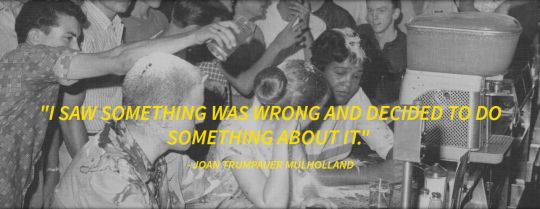
Mugshot of a teenage girl arrested for protesting segregation, Mississippi, 1961.
Her name is Joan Trumpauer Mulholland. Her family disowned her for her activism. After her first arrest, she was tested for mental illness, because Virginia law enforcement couldn’t think of any other reason why a white Virginian girl would want to fight for civil rights.
She also created the Joan Trumpauer Mullholland Foundation. Most recently, she was interviewed on Samatha Bee’s Full Frontal on February 15 for their segment on Black History Month.
Don’t reduce civil rights heroes to “teenage girl”.
Her great-grandparents were slave owners in Georgia, and after the United States Civil War, they became sharecroppers. Trumpauer later recalled an occasion that forever changed her perspective, when visiting her family in Georgia during summer. Joan and her childhood friend Mary, dared each other to walk into “n*gger” town, which was located on the other side of the train tracks. Mulholland stated her eyes were opened by the experience: “No one said anything to me, but the way they shrunk back and became invisible, showed me that they believed that they weren’t as good as me. At the age of 10, Joan Trumpauer began to recognize the economic divide between the races. At that moment she vowed to herself that if she could do anything, to help be a part of the Civil Rights Movement and change the world, she would.
In the spring of 1960, Mulholland participated in her first of many sit-ins. Being a white, southern woman, her civil rights activism was not understood. She was branded as mentally ill and was taken in for testing after her first arrest. Out of fear of shakedowns, Mulholland wore a skirt with a deep, ruffled hem where she would hide paper that she had crumpled until it was soft and then folded neatly. With this paper, Mulholland was able to write a diary about her experiences that still exists today. In this diary, she explains what they were given to eat, and how they sang almost all night long. She even mentioned the segregation in the jail cells and stated, “I think all the girls in here are gems but I feel more in common with the Negro girls & wish I was locked in with them instead of these atheist Yankees.
Soon after Mulholland’s release, Charlayne Hunter-Gault and Hamilton E. Holmes became the first African American students to enroll at the University of Georgia. Mulholland thought, “Now if whites were going to riot when black students were going to white schools, what were they going to do if a white student went to a black school?” She then became the first white student to enroll in Tougaloo College in Jackson, where she met Medgar Evers, Dr. Martin Luther King Jr., Reverend Ed King, and Anne Moody.
She received many letters scolding or threatening her while she was attending Tougaloo. Her parents later tried to reconcile with their daughter, and they tried to bribe her with a trip to Europe. She accepted their offer and went with them during summer vacation. Shortly after they returned, however, she went straight back to Tougaloo College.
She ultimately retired after teaching English as a Second Language for 40 years and started the Joan Trumpauer Mulholland Foundation, dedicated to educating the youth about the Civil Rights Movement and how to become activists in their own communities.
I watched a YouTube video once (by a guy who’s name escapes me) about the importance of making sure the stories of white activists are told. His point was that it’s not about lavishing praise on them just because they were white and “woke”, it’s about letting other white allies see that others have come before them who were willing to sacrifice and do the hard work. This way they can see themselves in someone and realize that destroying inequality isn’t a fringe interest or just an “us vs. them” issue. It has to be ALL OF US.
Wanna do direct action but you can’t run, can’t fight, can’t deal with stress, can’t risk getting arrested? Not near a community to support? You can still do something.
Like write to prisoners.
Prisons try to disappear people, isolate them, crush them. Don’t let that happen.
Write to activists in prison, write to trans people in prison, write to isolated prisoners, write to prisoners who no one else thinks are worth writing to.
Write to prisoners.
Are there any programs or websites that help facilitate this which are based on the UK that you know of? Most of the info I’ve found tends to be US-based or just gov.uk general info about writing to someone you know in prison.
But given that I’m chronically ill or seems like a great way to actually do something and be an active part of change.
Great to hear that you’re interested!
The Anarchist Black Cross is a prisoner support network that has chapters in a lot of countries and cities. In the UK there are:
Do check out some of the ‘do’s and don’t’ on one of these websites before you start, there are some basics like ‘don’t talk about illegal activities’ and ‘don’t stop writing without being honest to the person about the fact that you’re going to stop writing’ that are essential to know, and a lot of less important tips that just make it easier to start writing to someone you don’t know yet. Goodluck!
Shoutout to @freackthejester for pointing out Black and Pink (http://www.blackandpink.org), that can help you find LGBTIAQ+ prisoners in prison in the US, with chapters in:
And whenever there is no explicit prisoner-support organization, ask your local anarchists! Most anarchist groups do some prisoner support as well since supporting those who defy the state is basic anarchist praxis. This long list of Australia anarchist organizations probably includes groups that do some prisoner support: https://anarchy.org.au/directory/
Also contributed by people in the notes of this post so far:
Turns out people really like the extra resources on this post so here we go. Most of these urls were listen by Anarchist Black Cross Gent but I took out some dead urls and make them clickable.
I want to be really clear about something: Planned Parenthood has done more to prevent abortion than the pro-life movement ever has.
Yup, preventing abortion by giving abortions. Makes sense!
No you fucking crusty nutsack giving people the education and the tools to not become pregnant in the first fucking place
One of my Christian friends made a Facebook post about how PP gave her tons of resources when she was trying to get pregnant and people were actually genuinely shocked that they provided such resources; they had fully bought into the idea that PP is just an “abortion factory”. The misinformation that’s been spread about PP is unreal.
gosh it’s almost like Planned Parenthood will help you plan for parenthood
As of July 4th 2018, the Internet as we know it might be dead for good.
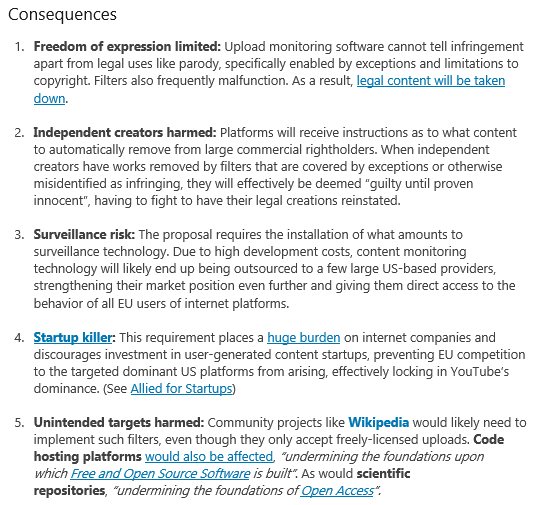
The European Parliament is passing a new Copyright Directive. Article 13 #CensorshipMachine will impose widespread censorship of all the content we share online. Art, fanfiction, parodies, remixes, mashups, memes, etc.. Anything that you do not hold the rights over will be taken down.
Article 13 would force all online platforms to police and prevent the uploading of copyrighted content, or make people seek the correct licenses to post that content. Internet platforms hosting large amounts of user-uploaded content must monitor user behaviour and filter their contributions to identify and prevent copyright infringement.
Such filters will be mandatory for platforms including YouTube, Facebook, Tumblr, Reddit and Instagram, but also much smaller websites.
Last Tuesday (19th June 2018) a group of more than 70 people who have played important roles in building the internet and developing it (Tim Berners-Lee, Vincent Cerf,
Jimmy Wales, Mitchell Baker…) into what it is today addressed an open letter to the members of the European Parliament:
“As creators ourselves, we share the concern that there should be a fair distribution of revenues from the online use of copyright works, that benefits creators, publishers, and platforms alike.
But Article 13 is not the right way to achieve this. By requiring Internet platforms to perform automatic filtering all of the content that their users upload, Article 13 takes an unprecedented step towards the transformation of the Internet from an open platform for sharing and innovation, into a tool for the automated surveillance and control of its users. […] The damage that this may do to the free and open Internet as we know it is hard to predict, but in our opinions could be substantial.”
“If you’re a political enemy of fascism though, either they lose or you die”
Transcript of the gifs:
If you’re a fascist and anti-fascists come for you, you have a choice. You can give it up. You can renounce what you said. You could go on with the rest of your life and stop turning up to fascist rallies. Anti-fascists probably aren’t going to be your best friends, but they’ll move on.
But if you’re a person of color, if you’re trans, or a person with a disability, or gay, or Jewish and fascists come for you, there is nothing you can do to make them happy except stop existing.
That’s the key difference between the far-left and the far-right. Anti-fascists organize themselves against those that are building fascism. If you are doing that, that is something you can nonviolently stop doing. If you’re a political enemy of antifa, you can become a friend. If you’re a political enemy of fascism though, then they lose or you die.
What if Millennials’ aversion to car-buying isn’t a temporary side effect of the recession, but part of a permanent generational shift in tastes and spending habits? It’s a question that applies not only to cars, but to several other traditional categories of big spending—most notably, housing. And its answer has large implications for the future shape of the economy—and for the speed of recovery.
It’s safe to say that a decent number of Tumblr users are a part of the Millennial generation. So, tell us: Do you own a car or house? If not, why?
IT’S BECAUSE THEY HAVE NO DISPOSABLE INCOME YOU THUNDERING IDIOTS. Fucking preference has nothing to do with it. 50% of college graduates have no job! They all have the most student loan debt ever! What are you asking this question for?!
Also: housing is a good bit more expensive now.
My parents got a 15-year mortgage on a new house in the mid-70s. The house was $32,000. Average home price in that area now? $190,000.
So, home prices went up. Food prices went up. Health care prices went WAY UP. Rent prices went up. Higher education went up so damn high that some of us forgo that all together. Energy prices went up. Car prices went up.
Prices of prices went up.
We also pay cell phone bills, internet bills, data plans, text plans, online subscriptions, cable/satellite tv, netflix, DVR subscriptions — bills that didn’t even exist 30-40 years ago. We also use computers and smartphones and microwaves and other consumer electronics that didn’t exist 20-50 years ago.
We need medications and doctors and contact lenses and tampons and maxi pads and other things that cost money just to be alive and keep us healthy.
Most of us can’t afford to:
Get married and have a “Traditional” big wedding
Buy a house
Buy a new car
PLAN to have children
Take two, consecutive weeks of vacation.
Jobs that paid 50k in the late 1990s now pay between 30-35. Interest rates that favor consumers have gone down.
So I say, no. We are not choosing not to buy homes. We’re not choosing to take the bus in cities where there’s no good public transit. WE ARE NOT CHOOSING TO LIVE WHAT SOCIETY DEEMS AS AN UNDESIRABLE LIFESTYLE.
Don’t even get me started on the fact that these two people in the picture are young white hipsters. Young black and brown folks have been forgoing homeownership and buying new cars for decades, this shit isn’t new, pal. You’re just acting like this shit is new because it’s hitting white folks.
anyway, my point is: We are fucking broke.
read the commentary above ^^
“Hey. Hey, guys. I know the economy being fucked up is totally our fault, but what if we tell people the next generation…wants to be poor?”
if someone does the “fine, you’re right, i’m clearly a terrible person, i’m satan, i’m the worst person alive, i should just die” thing in response to criticism of their harmful behavior, they are trying to manipulate ppl and flip the situation around so that they look like a victim
stop tolerating this in 2k17 tbh. like really and truly, if you or your friend thinks this is okay pls call the hotline on the bottom of the screen and learn how to take responsibility for your bad behavior
The bad thing is I do this on a regular basis. Not because I want to manipulate people, but because that’s actually how I feel. I’m bad at receiving concrit. I can’t say that everyone who reacts this way feels the same as I do, but…not every case is like that.
have you considered that, regardless of your intentions, reacting in such an exaggerated way would make it very difficult for anyone to criticize you or tell you that you’re harming people with your behavior? i’m not interested in searching out people’s motives, i don’t really care why someone does or says manipulative things. being unable or unwilling to simply apologize and not make it about themselves is a solid indicator that a person is not interested in being held accountable for their bad behavior, and people, especially the injured parties in question, shouldn’t have to tolerate it.
take responsibility for your bad behavior 2k17 tbh
Okay, life lesson time.
When I was in my late teens and early 20s, I kept getting involved with people who would say, “Oh, I’m a bad person” any time I brought up ANYTHING that was the least bit of a disagreement.
Like, “Please don’t leave my X on the floor” would get, “Oh, I’m a horrible person!”
HERE’S WHY THIS IS A HUGELY PROBLEMATIC BEHAVIOR, and if you think I”m calling you out and you think you’re about to shut down, take a breath, remember that this is about learning, and keep reading.
What is important is what happened after. My boyfriend might say, “Oh, I’m just an awful boyfriend” and instead of him acknowledging the BEHAVIOR and working on fixing it, he’d get me trying to buck him up for the next half hour, telling him he was a good person. The behavior that started it all would not change.
Well, things led to things and I went back home to live for a while, and found that the same exact thing was happening… with my mother.
And then I learned about pattern arguments. Pattern arguments are the ones where you keep having the same nonproductive argument over and over again. They don’t all follow this pattern, but this is a really common one.
The trick?
BREAK THE PATTERN
First you have to know what the pattern is. In this case: 1. Grievance 2. Self deprecation 3. Ego stroking
So, with my mother, we started in on one of these, and she said, “I guess I’m just a terrible mother.”
And instead of reassuring her, instead of derailing the issue and letting it go… I said, “When you say that, it makes me wonder how terrible a daughter I could be that you would think you were a bad mother. We have this conversation this way over and over, and the problem that I have always gets pushed aside in favor of trying to make you feel better. When you’re willing to have a real conversation about this, I’m happy to talk to you, but I’m bored with this argument, so I’ll see you later if you want to really talk.” And I left the room.
Now, my mom is a reasonably self-aware person, and does a lot of hard emotional work, and so she got it, very quickly. 10 minutes later she came out and found me, and we had a real conversation about whatever the hell the issue really was, and we have literally NEVER had that particular pattern argument again in 23 years.
Boyfriend came to visit. I was upset about something, he started in on the “I’m just a shitty boyfriend” thing… and my response?
“Yep. You are.”
His jaw dropped. He blinked.
And I said, “Look, that’s what you do. You say shit like that and it means you don’t have to change your behavior, and I’m tired of the pattern we have where I tell you something isn’t working for me, you tell me you’re terrible, and I spend half an hour making you feel better. I’m tired of it and I”m not doing it anymore. If you’re willing to have an actual conversation about this, and not just the same old argument, I’m game. But this thing we do where you talk yourself down and I butter you up? Is boring. And I’m over it.”
We also did not have that argument again. (The relationship finally ended for real a while after, but it ended in a grown-up way, and not with a ridiculous meaningless fight.)
When you knock yourself down, the gut instinct for the people around you is to pick you up. But that means you’re not pulling your weight in the relationship. You’re making them do the work and you’re not actually hearing them.
So that brings us to another point:
How to deal with criticism
Okay, so if you’re not going to knock yourself down when someone says something negative about you, what DO you do? We don’t actually train people to take criticism well. But it is an art and a skill and NECESSARY to finding emotional stability in the face of a critical world.
I see it as a flow chart, but since the flow chart I made for it ended up in a book that I don’t own the copyright to (not a big deal) I’ll write out the decision tree here instead:
1. Someone offers criticism (constructive or not!)
2. Listen and think about it without immediately trying to defend yourself. You can say, “Okay, I need a moment to take that in and think about it because I want to understand it.” Or something else appropriate to the situation. It is okay to ask for time to think in most circumstances. Most people will appreciate that you are thinking about their words instead of immediately getting defensive or counterattacking. Think about whether what they are saying is valid, might be valid or is not valid.
3A. If it is valid, then you have a choice. You can try to fix the behavior or you can acknowledge that it is a valid criticism but decide you aren’t likely to fix it. Start by acknowledging the validity of the criticism, and then say what you’re going to do to fix it, or say that it’s valid but it isn’t something you’re willing (or possibly able) to change, or say that it’s a valid criticism and you’ll need to think about possible solutions. They may have a suggestion. Taking it or not is also a choice.
3B. If you’re not sure it’s valid, but it might be, tell them, “I really need to give this some more thought.” or “Can you tell me more about this? I’m not sure I understand the issue well.” Or “If you can point me at some reading material or search terms, I’d like to study this before I decide what I’m going to do.”
3C. If you know it is not a valid criticism, STOP a moment, and look at WHY they are making it. This is where Active Listening can be very helpful. “I hear you saying that X is a problem. I don’t see it that way right now but I’d like to understand better why you do.” Or if you think they don’t have enough information, “I hear you saying X, but my understanding of the issue is Y. Here’s what I know about it if you’re ready to listen.” If they’re just looking for a fight, tell them you’re not interested in fighting, and disentangle yourself.
4. If the criticism is something you are going to listen to and take action on, tell them what kind of action you’re going to take. If it’s something you’re hearing and thinking about, tell them that. If it’s not something you’re going to do anything about or it’s just wrong, thank them for their input and move on.
Literally never is it going to be helpful to say, “Oh, I’m just a terrible person.” That’s very much like a nonapology-apology in terms of how unhelpful it is to any conversation. It’s kind of worse because it actually expects emotional labor from someone who is already having to bring up something unpleasant with you.
Think about what they say Decide whether you’re going to do something about it Do the thing, or tell them you’re not going to do the thing. Don’t demand emotional labor from other people when you were the one who messed up.
Apologize if appropriate.
This is all predicated on the notion that you’re talking to someone who actually wants to communicate and isn’t just an asshole on the attack.
Because seriously, the whole “I’m a terrible person” thing?
Boring as fuck. Knock that shit off. Maybe you are. Maybe you aren’t. But take responsibility and have a little self-respect and don’t make others pick your emotional dirty towels off the metaphorical bathroom floor.




 wupacing