Leveraged an inventory of established fictional character and setting elements to generate a disruptive custom-curated narrative entertainment asset.
I worked in HR, handling applications and interviews, and if someone turned in that string of techno babble nonsense, I would have rejected them out of hand.
A resume doesn’t need to sound fancy or overly technical, it needs to tell us why we should hire you.
“Independent novelist/writer” is more than sufficient here. If you want to express the skills that fan fiction taught you, something like, “creative writing, editing, and publication,” will get you a lot further than… Whatever that just was.
A resume should be tailored to the position, if you can afford the time and energy for that. But if not, then just think about what writing got fandom taught you. How to respond to criticism, how to present a professional pubic face, how to correct punished mistakes, creative thinking, project planning, persuasion via emotional leverage, html formatting, office suite fluency.
There are a lot of actual, marketable skills that go into fan fiction.
How to put “I was in a zine” on your resume
Writer:
Published short fiction stories for anthology collection
Able to write short fiction within a designated word count for layout purposes (900-1500 words, 1500-2000, 3000-5000)
Wrote short articles for independent publication
Assisted with editing short stories for publication
Able to reduce or expand written content based on layout needs
Able to check for basic spelling, grammar and syntax
Familiar with Microsoft Office and Google docs
Artist:
Produced full-colour digital illustration for independent magazine
Able to produce digital illustrations optimized for both online and print display
Produced full-colour 2-page spread for art anthology
Published 4-page short comic in anthology collection for charity
Able to transfer traditional art to digital illustration
Illustrated the cover (always brag if you’re on the cover) of an independent art publication
Familiar with professional illustration tools such as Adobe Photoshop, Illustrator, Clip Studio Paint and stylus tablet
Merch artist / graphic designer:
Designed 2″ clear decorative double-sided keychain charm as bonus sale item
Designed 5″ x 6″ sheet of graphic stickers included in art anthology
Able to design bold graphics that are measured for laser cutting production
Designed layouts for 65-page art and writing magazine, focusing on (art placement, text layout, etc)
Able to keep layout design simple and in accordance with the project director’s chosen theme
Created promotional art, icons and banners tailored for social media sites like Twitter, Tumblr, Facebook, etc
Familiar with professional layout and design software such as Adobe Illustrator and InDesign
Running a zine
Produced an independent art and writing collection for sale / for charity
Managed (10, 20, 30) independent artists and writers out of over 500 applicants to create a short-run independent magazine
Worked in online sales and social media promotion selling an independent comics anthology
If it’s really spectacular you can brag about specific numbers
Our book raised over $4,000 for charity in under six months of production
We sold over 750 copies in two weeks of online sales
Produced a digital PDF and printed version of anthology, mailing to recipients all over the world
Communicated with printers and manufacturers of plastic accessories and paper goods, assembling professional packages of our merchandise for mailing.
Built a custom digital storefront and navigated professional market and payment systems including Paypal and Tictail / Bigcartel / Wix etc
Created promotional events to boost sales, including raffles and giveaways over social media
Organized participants through mass emails and use of social media posts on tumblr and twitter
Familiar with organizational software such as Microsoft Excel, Google spreadsheets and Trello
What’s the most ridiculous false rumor that has been spread about you?
I joined my wife’s workplace about 12 months after she joined. When we worked together (same department, same roles), we’d keep mostly away from each other so not to crowd each other. When we’d take breaks, we’d be hanging out together. You know, normal stuff.
Thing is, no one picked up on the fact that we were husband and wife. They knew she was married, and that I was married – but not to each other.
Someone saw us holding hands on the walk back to our car after work, someone else saw us kiss when I dropped her in to work when I had the day off, and rumours started flying around that we were cheating on our significant others.
People took it upon themselves to ‘intervene’ and approached me to tell me she was married and that I should be ashamed of myself. Someone else made a comment to her that she should be more discreet if she was going to continue on her relationship with me.
Truth be told, we both found it pretty fucking funny. Didn’t get a chance to run with it, because we were so taken aback by it when it was brought up to us individually, that we just blurted out the truth on the spot.
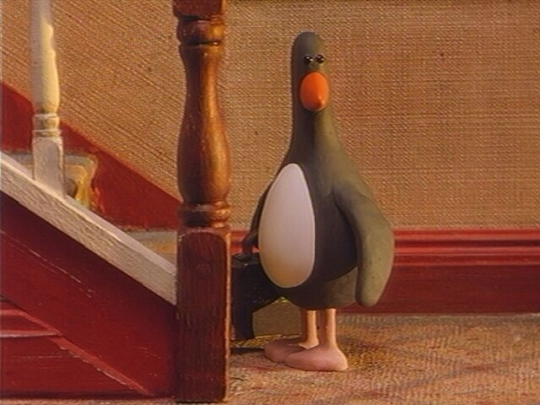
how the FUCK did they make that penguin from wallace and gromit look so evil like it’s literally just a plasticine penguin but it somehow radiates Pure Malice look at it
truly character design at its finest
Part of the reason that Wallace and Gromit is so successful is that every single character is just so expressive. The people’s lips move like half a foot every frame. Gromit has basically only his eyebrows, and he has more personality than two average real people. The Moon Machine was up there with the rest of them, and it didn’t even have a face.
The penguin, on the other hand, never expressed anything at all. It’s designed almost explicitly with purpose of not expressing anything. It’s practically featureless, with only the bare minimum of detail necessary to tell you it’s a penguin.
It has a face, but it never uses it. It has no sclera, meaning it stares straight ahead at all times.
It actively repels most attempts to ascribe any emotion to it – at best, you can feel that it is coldly satisfied, perhaps detachedly frustrated. I’d say it’s like a robot wearing the skin of an animal, but that’s literally the villain of A Close Shave, and he was pretty expressive.
It’s like Aardman found a tiny crack in the likability curve, far away from the uncanny valley but a hell of a lot deeper, and decided to build a penguin there.
– Rapunzel is the witch’s illegitimate daughter, and she is being kept safe from a king who would have her killed on sight.
– The Little Match Girl is a now phantom luring people to their deaths.
– Little Red Riding Hood is a werewolf.
– “So… You’re the Pied Piper, eh? I thought you’d be taller.”
– Princess Snow White and the evil Snow Queen? One and the same.
– “If you value your life, my life, the lives of everyone in this city… you won’t wake the sleeping princess.”
– The land of the Twelve Dancing Princesses is falling apart at the seams, and the rest of reality with it.
– A witch who made some bad decisions in her youth is forced to adopt and raise a child.
– After Jack the Giant Killer ruthlessly murdered their king and threw their world into turmoil and war, the inhabitants of the Sky Kingdom must rebuild their lives.
– “What… what is it?” “A firebird – the last of her kind.”
@leavesdancing You need to draw on your history degree to write the first prompt with Cinderella as a rebel assassin taking down the monarchy for the people.
PSA to all you fantasy writers because I have just had a truly frustrating twenty minutes talking to someone about this: it’s okay to put mobility aids in your novel and have them just be ordinary.
Like. Super okay.
I don’t give a shit if it’s high fantasy, low fantasy or somewhere between the lovechild of Tolkein meets My Immortal. It’s okay to use mobility devices in your narrative. It’s okay to use the word “wheelchair”. You don’t have to remake the fucking wheel. It’s already been done for you.
And no, it doesn’t detract from the “realism” of your fictional universe in which you get to set the standard for realism. Please don’t try to use that as a reason for not using these things.
There is no reason to lock the disabled people in your narrative into towers because “that’s the way it was”, least of all in your novel about dragons and mermaids and other made up creatures. There is no historical realism here. You are in charge. You get to decide what that means.
Also:
“Depiction of Chinese philosopher Confucius in a wheelchair, dating to ca. 1680. The artist may have been thinking of methods of transport common in his own day.”
“The earliest records of wheeled furniture are an inscription found on a stone slate in China and a child’s bed depicted in a frieze on a Greek vase, both dating between the 6th and 5th century BCE.[2][3][4][5]The first records of wheeled seats being used for transporting disabled people date to three centuries later in China; the Chinese used early wheelbarrows to move people as well as heavy objects. A distinction between the two functions was not made for another several hundred years, around 525 CE, when images of wheeled chairs made specifically to carry people begin to occur in Chinese art.[5]”
“In 1655,Stephan Farffler, a 22 year old paraplegic watchmaker, built the world’s first self-propelling chair on a three-wheel chassis using a system of cranks and cogwheels.[6][3] However, the device had an appearance of a hand bike more than a wheelchair since the design included hand cranks mounted at the front wheel.[2]
The invalid carriage or Bath chair brought the technology into more common use from around 1760.[7]
In 1887, wheelchairs (“rolling chairs”) were introduced to Atlantic City so invalid tourists could rent them to enjoy the Boardwalk. Soon, many healthy tourists also rented the decorated “rolling chairs” and servants to push them as a show of decadence and treatment they could never experience at home.[8]
In 1933 Harry C. Jennings, Sr. and his disabled friend Herbert Everest, both mechanical engineers, invented the first lightweight, steel, folding, portable wheelchair.[9] Everest had previously broken his back in a mining accident. Everest and Jennings saw the business potential of the invention and went on to become the first mass-market manufacturers of wheelchairs. Their “X-brace” design is still in common use, albeit with updated materials and other improvements. The X-brace idea came to Harry from the men’s folding “camp chairs / stools”, rotated 90 degrees, that Harry and Herbert used in the outdoors and at the mines.[citation needed]
“But Joy, how do I describe this contraption in a fantasy setting that wont make it seem out of place?”
“It was a chair on wheels, which Prince FancyPants McElferson propelled forwards using his arms to direct the motion of the chair.”
“It was a chair on wheels, which Prince EvenFancierPants McElferson used to get about, pushed along by one of his companions or one of his many attending servants.”
“But it’s a high realm magical fantas—”
“It was a floating chair, the hum of magical energy keeping it off the ground casting a faint glow against the cobblestones as {CHARACTER} guided it round with expert ease, gliding back and forth.”
“But it’s a stempunk nov—”
“Unlike other wheelchairs he’d seen before, this one appeared to be self propelling, powered by the gasket of steam at the back, and directed by the use of a rudder like toggle in the front.”
Give. Disabled. Characters. In. Fantasy. Novels. Mobility. Aids.
If you can spend 60 pages telling me the history of your world in innate detail down to the formation of how magical rocks were formed, you can god damn write three lines in passing about a wheelchair.
Signed, your editor who doesn’t have time for this ableist fantasy realm shit.
If your fantasy setting is having trouble with things like “What other cultures exist in this universe and how do they get on?” or “How do diabled people live?” or “How’s gender work here?” without sounding like Your Conservative Aunt Edna That You Really Wish You Didn’t Have To Be Nice To At Thanksgiving, it’s a good sign that you need to go back, not to the drawing board, but to yourself and your real world, and think real hard about how you’re handling those things in real life.
It’ll do you and your writing a literal world of good.
Okay but like
Do we have to limit ourselves to wheelchairs?
Or could we have like, different kinds of mobility aids? Like we don’t have to remake the fucking wheel, but what if we want to? Like a world with cool magic should have tons of magical ways to help people get around. Same thing with technology. Like sure wheelchairs are cool but so is a guy with like, a fully controllable robot leg suit, or a paraplegic wizard who just flies around sitting on a magic cloud they’ve made solid with their spells.
Absolutely not! I used the example of wheelchairs because the person I was talking to decided to tell me that mobility aids were historically inaccurate and therefore had no place in their historical fantasy novel setting. So I went the entire hell out of my way to drag them behind historically accurate wheelchairs. I actually have another post circulating at the moment that talks about the use of other aids and how magic and other things could work as a mobility aid. I just switched to mobile so I can’t link, but if you scroll my blog you’ll find it.
This is all I’ve been talking about today because it’s all anyone will let me talk about lol.
Do you think it’s ok to say “rolling chair” or “wheeled chair” to sound slightly more old-timey and avoid the tiffany problem
Yep. Another old timey accurate term was “bath chair”. If that helps.
yep another old
timey accurate term was
“bath chair” if that helps
^Haiku^bot^9. I detect haikus with 5-7-5 format. Sometimes I make mistakes.
So I had a good think about this, based off of what I have written lately. As I go further into my novel, do even more research into different types of sign, and start on the arc that is written solely from the POV of my deaf character, I’ve begun to realize some other differences between signed and spoken dialogue.
For one thing, punctuation doesn’t apply in the same way. There is punctuation in sign language, but as I’ve talked about before, it is mostly facial; therefore, you describe it as a part of the dialogue tags. So then, what do about the commas, colons and semi-colons? In this case, the n-dash is your friend! The aforementioned punctuation marks indicate changes in tone, alterations of pace and pauses. Therefore, they can be replaced with an n-dash, like so
“You and I – I don’t think we can continue.”
And fingerspelled words would be written as single letters, hyphenated into a word:
”You and I – going to L-O-N-D-O-N.”
For another, the syntax of your translated signed dialogue is subtly different. One sign can ususally mean several different words and filler words are absent. If someone were to say “really big.” in sign, they might just make the sign for “big” and super over-exaggerate.
So, verbal dialogue version:
“It was really, really big!” Lottie jumped and down in excitement, her eyes shining.
And the signed dialogue version:
“The dog was huge!” Lottie flung out her hands into the word, making it larger than it needed to be, bouncing on her heels.
Keeping in mind that large, big, huge, bountiful (and other connected synonyms) are all the same sign.
I don’t like to write signed language in the syntax that it would be signed in (Name, yours, what instead of “what is your name”). Not only is this confusing for non-signing readers, but it also reads as childish or overly-simplistic for readers who don’t understand sign, which reinforces the harmful stereotype of deaf people being stupid/infantilisation of deaf people. It is impossible to truly do signed language justice in writing, because it’s a language made for hands, bodies and faces.
This all comes together to mean that the sentence structure of dialogue in sign will be different. You would use less contractions (isn’t, you’re, might’ve etc), fewer modifiers and shorter chunks of dialogue with the description of the sign in between.
If it reads differently or feels strange, that’s okay: signed language is different to verbal language and so they won’t sound the same as one another in writing. They’re more like cousins or step-siblings than part of the same direct family group. You’re utilizing different descriptors and tools.
Hopefully, this also answers the repeated issue of differentiation, which has come up time and time again from various people. Best of luck to you all with your writing x
Lately I’ve been seeing people discuss why ‘genderbending’ isn’t transphobic, or why it’s something that’s fine and should be accepted. Most of the people who have been discussing this are cis, which is an issue right off the bat, so I’m going to preface this post by saying that if you are not trans, you do not have the right to determine what is or is not transphobic. Full. Stop. So if you’re cis, and your first instinct is to argue with me on this, I would like for you to consider why you believe that you can recognize transphobia better than someone who is routinely subject to it. That being said, let’s get into this.
To start off, what is ‘genderbending?’ Most fansites will define it as the act of ‘switching’ a character’s gender, but there’s already an issue with this. ‘Genderbending’, or ‘rule 63’ as is called in some circles, it not just about switching a character’s gender, it is about changing that character’s body as well. I have yet to see a ‘genderbent’ version of a male character who lacked breasts and a dfab body. This the first and most obvious reason why ‘genderbending’ is inherently transphobic – it assumes that physical traits and gender are the same thing, and that you cannot be female without also being dfab.This is cissexism, and this is transphobic. The message that ‘genderbending’ says is that you must have breasts and a vagina to be female, and you must have a penis and a flat chest to be male. I should not have to explain why that message is transphobic.
However, the way ‘genderbends’ are carried out also has distinctly transphobic implications in how it switches out the physical traits of characters to make them ‘the opposite gender’ ( the notion of there being ‘opposite genders’ is some fresh bullshit that I’ll cover later in this post ). For example, by giving a male character breasts and curves when ‘genderbending’ him, the message is clear that this character was cis to begin with. ‘Genderbending’ inherently implies that all characters are cisgender by default, and erases any possibility of these characters being trans.This is not as overtly transphobic as the first point, but it is harmful to trans people within fandom spaces, as the assumption that all characters are cis until explicitly stated otherwise pushes us out of media and removes whatever representation we might try to make for ourselves.
The third issue with ‘genderbending’ is that it is always cis male <—> cis female, and nothing else. I have never seen people ‘genderbend’ characters by making them nonbinary or intersex. I have never seen a genderbend of a female character which made her a trans male instead. ‘Genderbending’ implies that there are only two options when it comes to gender: cis male and cis female. There is no such thing as nonbinary people within this ideology. Intersex people are laughable at best. Agender people are little better than a distant myth. ‘Genderbending’ ignores that it is impossible to make a character ‘the opposite gender’, because there is no such thing as an ‘opposite gender’. Gender is a spectrum, not a binary, but you wouldn’t know that from the way fandom spaces treat it.
Of course, there are some reasons for ‘genderbending’ cis male characters into cis females that will always get brought up in discussions on the politics of ‘genderbending.’ The most frequent is that cis girls, who only see themselves as one-dimensional characters in media, want to have characters like them who are just as multifaceted and developed as the male characters that we are given, so they make their male faves female to give themselves the representation they desire. This is a decent reason for ‘genderbending’, but it does not excuse the fact that the way in which ‘genderbending’ is done is inherently transphobic, and it gives fans yet another excuse to ignore female characters in favor of focusing on their male faves.
Another reason for ‘genderbending’ that I’ve heard is ‘it’s for the sake of character exploration – like, what if this character had been born as male/female instead?’ This excuse is cissexist and transphobic from first blush. The idea behind it is that someone ‘born as female’, aka with breasts/vagina will automatically be a cis female, allowing fans to explore what that character’s life would have been like if they were female. Why not explore the possibility of a character being designated female at birth, but still identifying as male? Why do you need a character to be cis for you to find their personality and life interesting to explore? Why do you automatically reject the notion of your fave being trans? If you want to explore what it would have been like for your male fave to have struggled with sexism, consider them being a trans woman, or a closeted dfab trans person.
As a closing statement, I want to make one thing very clear. ‘Genderbending’ does harm trans people. It perpetuates dangerous cissexist notions and the idea of a gender binary being a valid construct, erases nonbinary and intersex people, and others trans people. These are what we call microaggressions – they are not as dangerous as outright harassment and assault, but they enforce and support a system and ideology in which we are other, and we are worthy of hate and violence because we do not fit in.
‘Genderbending’ is a transphobic practice, and if you engage in it, you need to be aware of and acknowledge this.
the most implausible thing about superhero movies is that these guys make their own suits, like seriously those toxic chemicals did NOT give you the ability to sew stretch knits, do you even own a serger
I feel like there’s this little secret place in the middle of some seedy New York business neighborhood, back room, doesn’t even have a sign on the door, but within three days of using their powers in public or starting a pattern of vigilanteism, every budding superhero or supervillain gets discreetly handed a scrap of paper with that address written on it.
Inside there’s this little tea table with three chairs, woodstove, minifridge, work table, sewing machines, bolts and bolts of stretch fabrics and maybe some kevlar, and two middle-aged women with matching wedding rings and sketchbooks.
And they invite you to sit down, and give you tea and cookies, and start making sketches of what you want your costume to look like, and you get measured, and told to come back in a week, and there’s your costume, waiting for you.
The first one is free. They tell you the price of subsequent ones, and it’s based on what you can afford. You have no idea how they found out about your financial situation. You try it on, and it fits perfectly, and you have no idea how they managed that without measuring you a whole lot more thoroughly than they did.
They ask you to pose for a picture with them. For their album, they say. The camera is old, big, the sort film camera artists hunt down at antique stores and pay thousands for, and they come pose on either side of you and one of them clicks the camera remotely by way of one of those squeeze-things on a cable that you’ve seen depicted from olden times. That one (the tall one, you think, though she isn’t really, thin and reminiscent of a Greek marble statue) pulls the glass plate from the camera and scurries off to the basement, while the other one (shorter, round, all smiles, her shiny black hair pulled up into a bun) brings out a photo album to show you their work.
Inside it is … everyone. Superheroes. Supervillains. Household names and people you don’t recognize. She flips through pages at random, telling you little bits about the guy in the purple spangly costume, the lady in red and black, the mysterious cloaked figure whose mask reveals one eye. As she pages back, the costumes start looking really convincingly retro, and her descriptions start having references to the Space Race, the Depression, the Great War.
The other lady comes up, holding your picture. You’re sort of surprised to find it’s in color, and then you realize all the others were, too, even the earliest ones. There you are, and you look like a superhero. You look down at yourself, and feel like a superhero. You stand up straighter, and the costume suddenly fits a tiny bit better, and they both smile proudly.
*
The next time you come in, it’s because the person who’s probably going to be your nemesis has shredded your costume. You bring the agreed-upon price, and you bake cupcakes to share with them. There’s a third woman there, and you don’t recognize her, but the way she moves is familiar somehow, and the air seems to sparkle around her, on the edge of frost or the edge of flame. She’s carrying a wrapped brown paper package in her arms, and she smiles at you and moves to depart. You offer her a cupcake for the road.
The two seamstresses go into transports of delight over the cupcakes. You drink tea, and eat cookies and a piece of a pie someone brought around yesterday. They examine your costume and suggest a layer of kevlar around the shoulders and torso, since you’re facing off with someone who uses claws.
They ask you how the costume has worked, contemplate small design changes, make sketches. They tell you a story about their second wedding that has you falling off the chair in tears, laughing so hard your stomach hurts. They were married in 1906, they say, twice. They took turns being the man. They joke about how two one-ring ceremonies make one two-ring ceremony, and figure that they each had one wedding because it only counted when they were the bride.
They point you at three pictures on the wall. A short round man with an impressive beard grins next to a taller, white-gowned goddess; a thin man in top hat and tails looks adoringly down at a round and beaming bride; two women, in their wedding dresses, clasp each other close and smile dazzlingly at the camera. The other two pictures show the sanctuaries of different churches; this one was clearly taken in this room.
There’s a card next to what’s left of the pie. Elaborate silver curlicues on white, and it originally said “Happy 10th Anniversary,” only someone has taken a Sharpie and shoehorned in an extra 1, so it says “Happy 110th.” The tall one follows your gaze, tells you, morning wedding and evening wedding, same day. She picks up the card and sets it upright; you can see the name signed inside: Magneto.
You notice that scattered on their paperwork desk are many more envelopes and cards, and are glad you decided to bring the cupcakes.
*
When you pick up your costume the next time, it’s wrapped up in paper and string. You don’t need to try it on; there’s no way it won’t be perfect. You drink tea, eat candies like your grandmother used to make when you were small, talk about your nights out superheroing and your nemesis and your calculus homework and how today’s economy compares with the later years of the Depression.
When you leave, you meet a man in the alleyway. He’s big, and he radiates danger, but his eyes shift from you to the package in your arms, and he nods slightly and moves past you. You’re not the slightest bit surprised when he goes into the same door you came out of.
*
The next time you visit, there’s nothing wrong with your costume but you think it might be wise to have a spare. And also, you want to thank them for the kevlar. You bring artisan sodas, the kind you buy in glass bottles, and they give you stir fry, cooked on the wood-burning stove in a wok that looks a century old.
There’s no way they could possibly know that your day job cut your hours, but they give you a discount that suits you perfectly. Halfway through dinner, a cinderblock of a man comes in the door, and the shorter lady brings up an antique-looking bottle of liquor to pour into his tea. You catch a whiff and it makes your eyes water. The tall one sees your face, and grins, and says, Prohibition.
You’re not sure whether the liquor is that old, or whether they’ve got a still down in the basement with their photography darkroom. Either seems completely plausible. The four of you have a rousing conversation about the merits of various beverages over dinner, and then you leave him to do business with the seamstresses.
*
It’s almost a year later, and you’re on your fifth costume, when you see the gangly teenager chase off a trio of would-be purse-snatchers with a grace of movement that can only be called superhuman.
You take pen and paper from one of your multitude of convenient hidden pockets, and scribble down an address. With your own power and the advantage of practice, it’s easy to catch up with her, and the work of an instant to slip the paper into her hand.
*
A week or so later, you’re drinking tea and comparing Supreme Court Justices past and present when she comes into the shop, and her brow furrows a bit, like she remembers you but can’t figure out from where. The ladies welcome her, and you push the tray of cookies towards her and head out the door.
In the alleyway you meet that same giant menacing man you’ve seen once before. He’s got a bouquet of flowers in one hand, the banner saying Happy Anniversary, and a brown paper bag in the other.
You nod to him, and he offers you a cupcake.
This is so awesome.
Actually, this is New York. Why hide?
Marvel had a plotline that there’s an old tailor who does suit design, fabrication, and repair. He sees heroes and villains on alternate days, and no one attacks or fights at his shop for risk of losing his business.
This was a Spider-man story, so of course the upshot of it was that no one had told Spider-man (they assumed he knew, or he just enjoyed making his own costume). Spidey’s sewing skills are also canon, and he’s sometimes expressed frustration/bewilderment that other heroes don’t know how to, mostly when he gets stuck with a sewing job that he assumes literally anyone in a custom costume could be doing.
(there’s a DC fancomic about this except the poor guy has to cater to villains)



 wupacing