This movie has been in various states of development for like a decade, but I think it’s got incredibly good odds of being in the current development climate.
And while we’re here, have a cute picture of Virginia and Paul (he’s the one on the right). The other two pictured are OSS reinforcements who came in along with Paul, but neither stuck around very long – so I relegated their presence in the story to a footnote.
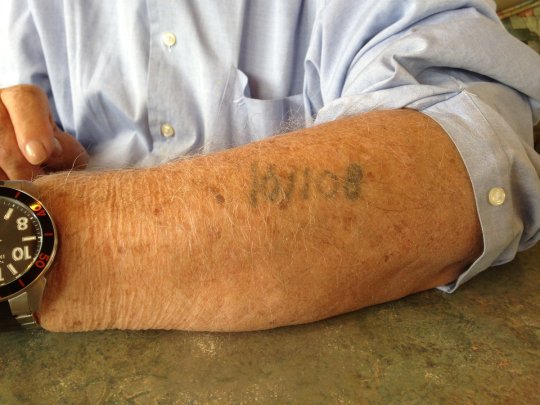
For seven decades, “never forget” has been a rallying cry of the Holocaust remembrance movement.
But a survey released Thursday,
on Holocaust Remembrance Day, found that many adults lack basic
knowledge of what happened — and this lack of knowledge is more
pronounced among millennials, whom the survey defined as people ages 18
to 34.
Thirty-one percent of Americans, and 41 percent of millenials, believe that 2 million or fewer Jews were killed in the Holocaust; the actual number is around six million. 41% of Americans, and 66% of millenials, cannot say what Auschwitz was. And 52% of Americans wrongly think that Hitler came to power through force.
Really look at that last part. The majority of Americans think Hitler came to power through force…because they don’t want to recognize how close our current political climate is to what happened then. They don’t want to believe they’ve elected anyone dangerous.
I think finding out that Hitler was inspired by how throughly Andrew Jackson committed genocide against the Natives would shatter or at least destabilize the ethos of the Founding Fathers & America for a lot of people
She took up acting because the malnutrition she suffered under the nazis permanently damaged her health and prevented her from pursuing her dream to be a ballerina. During the war, she danced to raise money for the resistance – even though she was literally starving, she used what strength she had to make sure more nazis got shot.
She and her mom also denounced their royal heritage because of the Nazis in their family
if youre gonna be a koreaboo at least read up on our history and spread awareness of the tragedies that south korea has faced because of japan. stop glorifying japan’s history if you don’t know it in full.
ive lived my whole life hating my heritage because no one cared about south korea since kpop and kdramas weren’t popular back then. i lived knowing that people were cheering on a nation that committed countless war crimes (cultural genocide, raping hundreds of thousands of women, torturing/beheading/massacring innocent civilians) against my country and other asian nations. i lived in that shadow knowing no one cared about my culture and its history.
since korean culture is becoming so popular nowadays please at least know how badly south korea has been treated by japan and how this shit still affects south koreans today.
Unit 731, a human experimentation death camp, primarily filled with Chinese and Korean citizens, absolved of all wrongdoing in exchange for the data they collected over 40 years of practice
And could we throw in the fact that if you were for a sensible equality you should be demanding not bombing anybody and not demand that just different people should have been killed?
Okay kids, gather round because you seem to be under the impression that this website owes you an education AND that your education on this subject is sufficient. Neither of those is true, but I’m gonna help you out anyway!
First, let’s discuss the “reasons for dropping the bomb” that are commonly given, but also happen to be totally wrong:
Japan wasn’t willing to surrender
Actually, Japan was totally down to surrender! America was very good at cracking Japanese codes, and had intercepted several diplomatic messages sent to other countries where Japan expressed the terms of their conditions, with the only major term being that the emperor remain in power (Which would have been necessary to ensure a peaceful transition to foreign government for the Japanese people). Harry Truman ignored these messages and prolonged the war until the completion of the atomic bomb so that it could be used. More on that later.
In his 1965 study, Atomic Diplomacy: Hiroshima and Potsdam (pp. 107, 108), historian Gar Alperovitz writes:
Although Japanese peace feelers had been sent out as early as September 1944 (and [China’s] Chiang Kai-shek had been approached regarding surrender possibilities in December 1944), the real effort to end the war began in the spring of 1945. This effort stressed the role of the Soviet Union …
In mid-April [1945] the [US] Joint Intelligence Committee reported that Japanese leaders were looking for a way to modify the surrender terms to end the war. The State Department was convinced the Emperor was actively seeking a way to stop the fighting.
It would have saved more lives than it took
Nah. Japan was actually on it’s last legs, and wouldn’t have been able to fight much longer at all, thanks to effective embargoes, blockades, and traditional bombing. They had all but run out of fuel, ammunition, and other war supplies.
Admiral William Leahy – the highest ranking member of the U.S. military from 1942 until retiring in 1949, who was the first de facto Chairman of the Joint Chiefs of Staff, and who was at the center of all major American military decisions in World War II – wrote (pg. 441):
It is my opinion that the use of this barbarous weapon at Hiroshima and Nagasaki was of no material assistance in our war against Japan. The Japanese were already defeated and ready to surrender because of the effective sea blockade and the successful bombing with conventional weapons.
Destroying two major military targets helped us out
LOL Nagasaki and Hiroshima weren’t selected because they were military targets (Because they weren’t military targets at all!). They were selected because they were large cities where the bombs would have the most devastating affect.
President Truman steadfastly defended his use of the atomic bomb, claiming that it “saved millions of lives” by bringing the war to a quick end. Justifying his decision, he went so far as to declare: “The world will note that the first atomic bomb was dropped on Hiroshima, a military base. That was because we wished in this first attack to avoid, insofar as possible, the killing of civilians.”
This was a preposterous statement. In fact, almost all of the victims were civilians, and the United States Strategic Bombing Survey (issued in 1946) stated in its official report: “Hiroshima and Nagasaki were chosen as targets because of their concentration of activities and population.”
Contemporary documents show that Marshall felt “these weapons might first be used against straight military objectives such as a large naval installation and then if no complete result was derived from the effect of that, he thought we ought to designate a number of large manufacturing areas from which the people would be warned to leave–telling the Japanese that we intend to destroy such centers….”
As the document concerning Marshall’s views suggests, the question of whether the use of the atomic bomb was justified turns … on whether the bombs had to be used against a largely civilian target rather than a strictly military target—which, in fact, was the explicit choice since although there were Japanese troops in the cities, neither Hiroshima nor Nagasaki was deemed militarily vital by U.S. planners. (This is one of the reasons neither had been heavily bombed up to this point in the war.) Moreover, targeting [at Hiroshima and Nagasaki] was aimed explicitly on non-military facilities surrounded by workers’ homes.
Now, let’s discuss the the actual reasons for dropping the bomb:
By August 1945, relations between the Soviet Union and the United States had deteriorated badly. The Potsdam Conference between U.S. President Harry S. Truman, Russian leader Joseph Stalin, and Winston Churchill (before being replaced by Clement Attlee) ended just four days before the bombing of Hiroshima. The meeting was marked by recriminations and suspicion between the Americans and Soviets. Russian armies were occupying most of Eastern Europe. Truman and many of his advisers hoped that the U.S. atomic monopoly might offer diplomatic leverage with the Soviets. In this fashion, the dropping of the atomic bomb on Japan can be seen as the first shot of the Cold War.
The US decision to drop atomic bombs on Hiroshima and Nagasaki in 1945 was meant to kick-start the Cold War rather than end the Second World War, according to two nuclear historians who say they have new evidence backing the controversial theory.
Causing a fission reaction in several kilograms of uranium and plutonium and killing over 200,000 people 60 years ago wasdone more to impress the Soviet Union than to cow Japan, they say. And the US President who took the decision, Harry Truman, was culpable, they add.
New studies of the US, Japanese and Soviet diplomatic archives suggest that Truman’s main motive was to limit Soviet expansion in Asia, Kuznick claims. Japan surrendered because the Soviet Union began an invasion a few days after the Hiroshima bombing, not because of the atomic bombs themselves, he says.
According to an account by Walter Brown, assistant to then-US secretary of state James Byrnes, Truman agreed at a meeting three days before the bomb was dropped on Hiroshima that Japan was “looking for peace”. Truman was told by his army generals, Douglas Macarthur and Dwight Eisenhower, and his naval chief of staff, William Leahy, that there was no military need to use the bomb.
“Impressing Russia was more important than ending the war in Japan,” says Selden.
So let’s recap:
Harry Truman purposely killed hundreds of thousands of Japanese civilians to make a political statement.
The US detonated the world’s first weapon of mass destruction simply to send a message to the Soviet Union and stop Red expansion into Asia.
I’m not saying the fact that one group of people (Who happened to be Asian) was viewed as disposable just to put on a show for another group of people (Who happened to also be white) is an act of racism.
I’m also not saying that we should examine the fact that no German or Italian families living in the US were put into containment camps out of fear of spies, but pretty much all Asian-Americans were (Because Asia is a country, obviously).
I AM saying that maybe you should consider that your history lessons in school were taught from books written by old white men, and they might read a little differently if they weren’t.
Oh, and I’ll leave on this little note from President Truman’s youth. Again, I’m not saying he’s racist or anything, but…
In Hiroshima: Why America Dropped the Bomb, Japanese American historian Ronald Takaki writes about the man who made the final decision to destroy two Japanese cities, President Harry Truman. This was the same man who, when he was younger, wrote the following in a letter to his future wife, Bess:
I think one man is as good as another, so long as he’s honest and decent and not a nigger or a Chinaman. My uncle Will says that the Lord made a white man of dust, a n*gger from mud, then threw up what was left and it came down a Chinaman. He does hate Chinese and Japs. So do I. It is race prejudice I guess. But I am strongly of the opinion that negroes ought to be in Africa, yellow men in Asia, and white men in Europe and America.
Hey look, sources where you can go and educate yourself about all of this, and fact check me while you’re at it!



 wupacing