archatlas:

Striking Three-Dimensional Interventions by Mr. June Layer Geometric Paintings Onto Architectural Elements

Since 1985 David Louf, aka Mr. June, has been creating striking urban interventions, recently producing murals that layer three-dimensional effects onto architectural elements. Whether he is painting a graffiti piece, working in his multi-disciplinary graphic design studio, or creating a large mural project, Louf continuously aims to blend his love for typography, fascination with abstraction, and free spirit of graffiti culture. These results are regularly applied to the most unusual and unexpected urban structures.

hamelin-born:

ninemoons42:

musicbuttonsandcake:

literary-potato:

oessa:

Sagrada Família, Spain  41.40364,2.174478  [link]

Sagrada Familia is one of my favorite things ever. Not only is it a basilica that looks like the offspring of Rivendell and a Dr. Seuss book, it’s still not finished. That’s how incredibly detailed and complex it is. They’ve been working on it since 1882, and it’s not projected to be finished until 2026.

I love the pillars. They’re so geometrically cool.

someday I will get there

This is real? Holy bleep. I thought it was stills from a video game!

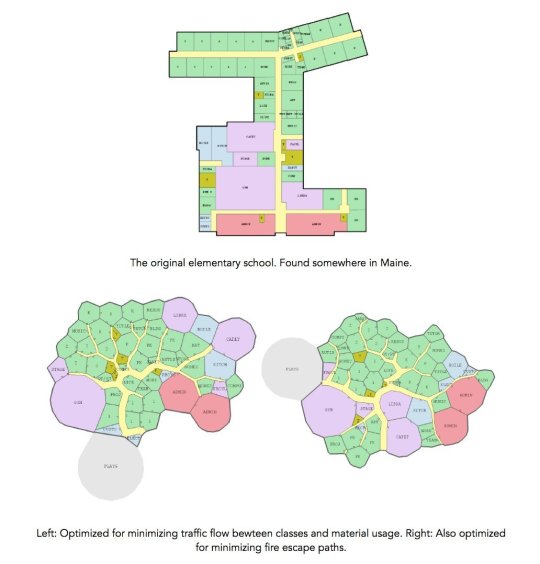
What happens when you let computers optimize foorplans (I love this SO MUCH)

otherpeoplescreativity:

mostlysignssomeportents:

I eagerly await our new AI masters’ world of ultraoptimized, uncannily organic, evolving foorplans. Joel Simon:

Evolving Floor Plans is an experimental research project
exploring speculative, optimized floor plan layouts. The rooms and
expected flow of people are given to a genetic algorithm which attempts
to optimize the layout to minimize walking time, the use of hallways,
etc. The creative goal is to approach floor plan design solely from the
perspective of optimization and without regard for convention,
constructability, etc. The research goal is to see how a combination of
explicit, implicit and emergent methods allow floor plans of high
complexity to evolve. The floorplan is ‘grown’ from its genetic encoding
using indirect methods such as graph contraction and emergent ones such
as growing hallways using an ant-colony inspired algorithm.

Adds Simon: “I have very mixed feelings about this project.”

https://boingboing.net/2018/07/30/what-happens-when-you-let-comp.html

In the link are also some variants with optimization for windows; now I want to go to that school. I also want to feed this algorithm the floorplans for some other buildings, such as a shopping mall (can you optimize for impulse purchase? for a natural wander rate that inclines the shopper to slow down and take their time? Can you get rid of those trouble-mongering perfume and moisturizer kiosks?) or a multifamily home (could my entire gaming group live at the same address without growing to hate each other? people with different hours of activity, different sensitivities to sound and stimulation, different accessibility needs?).  

But most importantly: Science!

fieldbears:

fullmetalquest:

robotsandfrippary:

99laundry:

gogomrbrown:

I learned in a Latin Studies class (with a chill white dude professor) that when the Europeans first saw Aztec cities they were stunned by the grid. The Aztecs had city planning and that there was no rational lay out to European cities at the time. No organization.

When the Spanish first arrived in Tenochtitlan (now downtown mexico city) they thought they were dreaming. They had arrived from incredibly unsanitary medieval Europe to a city five times the size of that century’s london with a working sewage system, artificial “floating gardens” (chinampas), a grid system, and aqueducts providing fresh water. Which wasn’t even for drinking! Water from the aqueducts was used for washing and bathing- they preferred using nearby mountain springs for drinking. Hygiene was a huge part if their culture, most people bathed twice a day while the king bathed at least four times a day.
Located on an island in the middle of a lake, they used advanced causeways to allow access to the mainland that could be cut off to let canoes through or to defend the city. The Spanish saw their buildings and towers and thought they were rising out of the water. The city was one of the most advanced societies at the time.

Anyone who thinks that Native Americans were the savages instead of the filthy, disease ridden colonizers who appeared on their land is a damn fool.

They’ve also recently discovered a lost Native American city in Kansas called Etzanoa It rivals the size of Cahokia, which was very large as well.

Makes me happy to see people learn about the culture of my country 😀

Also, please remember that the idea of a nomadic or semi-nomadic culture being “less intelligent”, “less civilized” (and please unpack that word) was invented by people who wanted to make a graph where they were on the top.

Societies that functioned without 1) staying exclusively in one location or 2) having to make complicated, difficult-to-construct tools to go about their daily lives… were not somehow less valid than others.

meeko-mar:

lisa-rayner:

(via Tintu-Mon added 11 new photos)

“Respect to Nature.”

Humans adapting themselves to nature rather than forcing other species to adapt to us. This is what we must do in the Anthropocene. Trees are the most important three dimensional structures of many ecosystems, and they are the central design features of most permaculture gardens. They provide many products and services to other species, from housing to food (acorns, insects, pollen), shade and shelter from the wind. We ought to respect their importance.

THIS IS WHAT LIFE SHOULD BE  AM SO FUCKING ABOUT THIS

brunhiddensmusings:

pochowek:

pondwitch:

tyloriousrex:

chrissongzzz:

So how do they make that?

This just raises more questions for me 🤦🏾‍♂️

what the FUCK

this is whats called a ‘coffer dam’, you basically build some walls, drop them in the water, tie them together, and then pump out the water from your new hole in the water so you can build while staying dry

its oddly not that hard- the flippin ROMANS were able to do it with logs and mud

occasionally particularly devious people would use this to hide treasure or tombs underneath the river so its not only impossible to find but impossible to get to without an engineer division