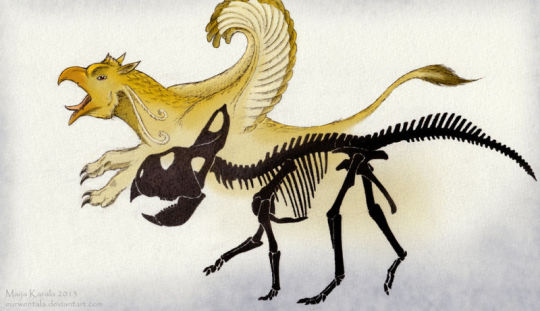
Maybe medieval people happened upon a T-Rex fossil and came to a relatively logical conclusion that dragons existed.
I’ve read a couple books on this actually, thats exactly what happened. Also cyclops are from looking at bones from a certain type of baby elephant. The giant note hole and tiny eyes made it look like a single eye.
Yep, can confirm! And what’s even funnier to me is that back in the dark ages, Greek people used to find a lot of prehistoric bear skeletons – and those look exactly like human skeletons, except they’re like eight feet tall or something – so they naturally assumed those were the heroes of legend, and made armour and clothes for them and reburied them with the most splendid and sacred religious ceremonies they could think of? Fast forward five centuries, Athens’ all modern and rational, philosophers and scientists aren’t taking any shit from anyone – but the problem is, people will randomly find graves containing giant-ass warriors, so that’s something that can’t be explained away and yeah, demigods were a thing and yeah, they used to be eight feet tall and sorry I don’t make the rules.
Ancient people had no idea what the bones of ancient creatures would look like or a concept of extinction. So strange bones that looked unlike modern animals were imagined based on their similarity to modern animals. A beaked dinosaur was imagined to have the head of an eagle, it’s clawed feet looked like a lion. So many mythological creatures are an assortment of different animal features, head like an X, body like a y. This may be from finding fossils which didn’t resemble any one modern animal but sort of resembled different features from various sorts of animals.
I never thought of this before!
… but who says we know how dinosaurs looked like? they might’ve all just been giant chicken.
Would like to again remind everybody that, as a history grad student specializing in US history, the Left really is literally bigger in the United States right now than it has been in 100 years and people need to stop underestimating how big of a deal that is. DSA has over 50,000 members now and it is growing at a rapid pace. Self-declared socialists are going to the US House of Representatives. Anarchists occupied ICE facilities all over the country. There is a massive prison strike going on.
This is big. There is absolutely no reason to be defeatist.
it’s hilarious to me when people call historical fashions that men hated oppressive
like in BuzzFeed’s Women Wear Hoop Skirts For A Day While Being Exaggeratedly Bad At Doing Everything In Them video, one woman comments that she’s being “oppressed by the patriarchy.” if you’ve read anything Victorian man ever said about hoop skirts, you know that’s pretty much the exact opposite of the truth
thing is, hoop skirts evolved as liberating garment for women. before them, to achieve roughly conical skirt fullness, they had to wear many layers of petticoats (some stiffened with horsehair braid or other kinds of cord). the cage crinoline made their outfits instantly lighter and easier to move in
it also enabled skirts to get waaaaay bigger. and, as you see in the late 1860s, 1870s, and mid-late 1880s, to take on even less natural shapes. we jokingly call bustles fake butts, but trust me- nobody saw them that way. it was just skirts doing weird, exciting Skirt Things that women had tons of fun with
men, obviously, loathed the whole affair
(1864)
(1850s. gods, if only crinolines were huge enough to keep men from getting too close)
(no date given, but also, this is 100% impossible)
(also undated, but the ruffles make me think 1850s)
it was also something that women of all social classes- maids and society ladies, enslaved women and free women of color -all wore at one point or another. interesting bit of unexpected equalization there
and when bustles came in, guess what? men hated those, too
(1880s)
(probably also 1880s? the ladies are being compared to beetles and snails. in case that was unclear)
(1870s, I think? the bustle itself looks early 1870s but the tight fit of the actual gown looks later)
hoops and bustles weren’t tools of the patriarchy. they were items 1 and 2 on the 19th century’s “Fashion Trends Women Love That Men Hate” lists, with bonus built-in personal space enforcement
Gonna add something as someone who’s worn a lot of period stuff for theatre:
The reason you suck at doing things in a hoop skirt is because you’re not used to doing things in a hoop skirt.
The first time I got in a Colonial-aristocracy dress I felt like I couldn’t breathe. The construction didn’t actually allow me to raise my arms all the way over my head (yes, that’s period-accurate). We had one dresser to every two women, because the only things we could put on ourselves were our tights, shifts, and first crinoline. Someone else had to lace our corsets, slip on our extra crinolines, hold our arms to balance us while a second person actually put the dresses on us like we were dolls, and do up our shoes–which we could not put on ourselves because we needed to be able to balance when the dress went on. My entire costume was almost 40 pounds (I should mention here that many of the dresses were made entirely of upholstery fabric), and I actually did not have the biggest dress in the show.
We wore our costumes for two weeks of rehearsal, which is quite a lot in university theatre. The first night we were all in dress, most of the ladies went propless because we were holding up our skirts to try and get a feel for both balance and where our feet were in comparison to where it looked like they should be. I actually fell off the stage.
By opening night? We were square-dancing in the damn things. We had one scene where our leading man needed to whistle, but he didn’t know how and I was the only one in the cast loud enough to be heard whistling from under the stage, so I was also commando-crawling underneath him at full speed trying to match his stage position–while still in the dress. And petticoats. And corset. Someone took my shoes off for that scene so I could use my toes to propel myself and I laid on a sheet so I wouldn’t get the dress dirty, but that was it–I was going full Solid Snake in a space about 18″ high, wearing a dress that covered me from collarbones to floor and weighed as much as a five-year-old child. And it worked beautifully.
These women knew how to wear these clothes. It’s a lot less “restrictive” when it’s old hat.
I have worn hoop skirts a lot, especially in summer. I still wear hoop skirts if I’m going to be at an event where I will probably be under stage lights. (For example, Vampire Ball.)
I can ride public transportation while wearing them. I can take a taxi while wearing them. I can go on rides at Disneyland while wearing them. Because I’ve practiced wearing them and twisting the rigid-but-flexible skirt bones so I can sit on them and not buffet other people with my skirts.
Hoop skirts are awesome.
Hoop skirts are a fucking godsend in summer. Nothing’s touching your legs. It’s like wearing a big box underneath whic you’re naked, temperature wise.
Did this with a bustle rather than a hoop skirt, but was quite comfortable running around in said bustle, shirt, full corset, gloves, and overskirt in 117 degrees for a con. It was far more comfortable than the more modern dress i wore the next day.
Writer Note: this is fascinating research information not restricted to just the Victorian era under discussion. Though it’s stating the obvious, the obvious often needs to be stated: when seemingly-awkward garments like crinolines and hoop-skirts (or ruffs, or houppelandes, or etc.) were everyday wear, the wearers knew how to move in them because of practice.
For instance, how not to clear a table with a gesture while wearing sleeves like these…
Fashionable footwear has been weird for centuries.
Think of chopines, pattens, poulaines,
non-fetishy-y high heels, or platform boots worn with bell-bottom jeans so long and wide
that without the platforms
they trailed along the ground. The 1970s is called “the decade that style forgot” for good reason.
Elton John’s stage platforms aren’t as exaggerated as you think…
And then there are the doeskin breeches claimed in some fiction as fitting so tightly the
inside had to be soaped to get them on, going commando was compulsory, and the wearer couldn’t sit
down.
You’d certainly believe it from portraits like this one, “Hunter in a Landscape with his Dogs”, said to be General Thomas-Alexandre Dumas, father of Alexandre Dumas the novelist, with legs apparently clad in just a thick coat of paint. (X-skin breeches would seem more suitable for hunting, but these may represent cotton “inexpressibles” which really did fit like that.)
Like the supposed problems with crinolines etc., not true. Research and reconstruction has shown that doe / buck / sheepskin
breeches have natural stretch and recovery; a common comparison is to
old, well-worn jeans. Of course the artist also wanted to show that his subject “had a good leg” (look up “artificial calves” and be amused) and wasn’t letting realism get in the way of doing so.
This is a bit more like it.
Nowadays “deportment” seems to have an aura of outdated snobbishness – upper-class debutantes learning to curtsey, or walk with books balanced on their heads – but ”porte” in French means “carry”
and the old meaning of deportment was “how to carry yourself”; how to move properly, without inconveniencing yourself or others.
Various historical-costume books point out that “moving properly” in some periods – memory suggests the court of Louis XIV at Versailles was one – meant a sequence of artificial, prescribed gestures, partly enforced by the clothing and partly by court protocol. IIRC one description was of “movements as precisely delineated as the steps of a formal dance”, and getting them wrong resulted in social mockery.
Elizabethan men were taught, as part of their deportment, how to move while wearing the long rapiers of the period; that hand-on-hilt stance in portraits isn’t drama, it’s control.
Once familiar with the length of the sword, they know exactly what shifting the hilt one way or another will do to the rest of it – and the people, furniture and crockery behind them – without needing to look. IIRC the technique is still taught to actors today.
Crinolines, bustles, bloomers, breeches, inexpressibles and all the rest were clothing; after reading about peculiar but oh-so-stylish ways of standing and moving like the “Grecian bend” and “Alexandra limp”, the Kink’s satirical 1960s hit “Dedicated Follower of Fashion” isn’t just a song any more…
“Authors can’t use it in fantasy fiction, eh? We’ll see about that…”
–Terry Pratchett, probably
Try to implement anything but a conservative’s sixth grade education level of medieval or Victorian times and you will butt into this. all. the. time.
There was a literaly fad in the 1890′s for nipple rings for all genders(and NO, it was NOT under the mistaken belief that it would help breastfeeding–there’s LOTS of doctors’ writing at the time telling people to STOP and that they thought it would ruin the breast’s ability to breastfeed well, etc). It was straight up because the Victorians were freaks, okay Imagine trying to make a Victorian character with nipple rings. IMAGINE THE ACCUSATIONS OF GROSS HISTORICAL INACCURACY
people just really, REALLY have entrenched ideas of what people in the past were like
tell them the vikings were clean, had a complex democratic legal system, respected women, had freeform rap battles, and had child support payments? theyd call you a liar
tell them that chopsticks became popular in china during the bronze age because street food vendors were all the rage and they wanted to have disposable eating utensils? theyll say youre making that up
tell them native americans had a trade network stretching from canada to peru and built sacred mounds bigger then the pyramids of giza? you are some SJW twisting facts
ancient egypt had circular saws, debt cards, and eye surgery? are you high?
our misconception of medieval peasants being illiterate and living in poverty in one room mud huts being their own creation as part of a century long tax aversion scam? you stole that from the game of thrones reject bin
iron age india had stone telescopes, air conditioning, and the number 0 along with all ‘arabic’ numbers including algebra and calculus? i understand some of those words.
romans had accurate maps detailing vacation travel times along with a star rating for hotels along the way, fast food restaurants, swiss army knives, black soldiers in brittany, traded with china, and that soldiers wrote thank-you notes when their parents sent them underwear in the mail? but they thought the earth was flat!
ancient bronze age mesopotamia had pedantic complaints sent to merchants about crappy goods, comedic performances, and transgender/nobinary representation? what are you smoking?
Truth is stranger than fiction, and history is weirder than you think.
this post gets better every time it comes across my dash. To provide some more: those Romans also had vending machines, automated puppet plays, doors that opened to the sound of horns when you lit a fire in front of them, and working steam engines. All invented by one dude, Hero of Alexandria.
Julius Caesar’s two most famous assassins, Brutus and Cassius, were the son and son-in-law, respectively, of a Roman noblewoman named Servilia. And Servilia and Caesar were fucking. Not just a one off thing, either. They were having an affair for literally decades. Everyone knew it. Why did everyone know? Well, one time Caesar and Cato, who was Servilia’s brother, were having a debate (catfight) in the Senate and a servant came in and passed Caesar a note. Cato jumps up, all indignant, and announces that Caesar is committing treason right in the middle of the Senate. See that treasonous note he just got handed? (Like I said, it was a catfight.) And Caesar is like, well Cato, here’s the treasonous note, how about we read it aloud to the Senate, huh? It was a love letter from Servilia. And that’s the story of how Caesar made Cato stand there and listen to the sexts Cato’s sister sent Caesar get read aloud in front of the whole Senate.
I’ve always been privately convinced (on no evidence whatsoever) that Brutus and Cassius killed Caesar because they were so fucking embarrassed that he was fucking their mother/mother-in-law.
Ej you can’t just drop all the goss and then say there’s more without sharing
Oh boy. I guess I can’t back out now, can I? Ok, let’s do this.
So Brutus’s great-grandfather was named Quintus Servilius Caepio and he was a completely shit person generally and got two entire armies massacred because he was an elitist shithead and wouldn’t work with someone he thought was low-class but anyway. He was on campaign and he captured this huge hoard of gold at this town called Tolosa and sent it back to the Roman treasury. But then the caravan carrying the gold was hijacked by bandits and it all disappeared. Surprise! Caepio hired the bandits himself and stole all the gold. People were (understandably) pissed.
I was actually wrong in the tags, it wasn’t Brutus’s grandfather, it was his great-uncle. Anyway, so Roman citizens were allowed to vote, but the other Italians, who made up like half of the Roman armies, weren’t technically citizens and couldn’t vote. Which annoyed them. So Brutus’s great-uncle, Marcus Livius Drusus, basically got all the Italians to swear an oath that they would do whatever he said if he could get them citizenship. And he almost managed it. Only historical example I can think of of someone trying to take over a country by expanding democracy. Drusus got assassinated pretty fucking fast.
And then there’s Cato, which, don’t get me fucking started. The dude tore out his own intestines with his bare hands because he hate Caesar so much. I am not fucking joking.
So Caesar fucked everything. Everything. This wasn’t a secret or anything. The dude (probably) fucked the King of Bithynia when he was like 20 and the king was like 80. He made a habit of seducing the wives of his political enemies just to be an asshole. When he held a triumphal march through Rome, his soldiers chanted “Home we bring the bald whore-monger, Romans lock you wives away.” Caesar was basically the embodiment of Big Dick Energy and he made sure everyone knew it.
So Clodia was like the tabloid sensation of her day. She had lots of affairs, maybe killed her husband, and then she got involved with this guy Caelius. Eventually they broke up, so Clodia got Caelius prosecuted for attempted murder. You know, like you do. I don’t have time to get into all the juicy details, but let’s just say it involved accusations of incest, gleeful slut-shaming, and Cicero’s wife being bizarrely jealous.
As for Antony and Curio, they were friends and Cicero at one point (after Curio was dead, if I remember correctly) accused Antony of having had an affair with Curio when they were young men. It’s not clear if this is true, because on the one hand, it’s totally believable (if Caesar was the embodiment of Big Dick Energy, Antony was the embodiment of just Big Dick. Like, he had a really big dick and he liked to show it off to everyone) but on the other hand, Cicero hated Antony and was talking all kinds of shit about him at the time, so who the fuck knows.
Anyway, please buy my Roman tabloid, because the next issue will discuss that time Clodius dressed up in drag to sneak into Caesar’s house and Caesar’s mother organized all the Roman noblewomen to hunt him down.
This weekend I was schmoozing at an event when some guy asked me what kind of history I study. I said “I’m currently researching the role of gender in Jewish emigration out of the Third Reich,” and he replied “oh you just threw gender in there for fun, huh?” and shot me what he clearly thought to be a charming smile.
The reality is that most of our understandings of history revolve around what men were doing. But by paying attention to the other half of humanity our understanding of history can be radically altered.
For example, with Jewish emigration out of the Third Reich it is just kind of assumed that it was a decision made by a man, and the rest of his family just followed him out of danger. But that is completely inaccurate. Women, constrained to the private social sphere to varying extents, were the first to notice the rise in social anti-Semitism in the beginning of Hitler’s rule. They were the ones to notice their friends pulling away and their social networks coming apart. They were the first to sense the danger.
German Jewish men tended to work in industries which were historically heavily Jewish, thus keeping them from directly experiencing this “social death.” These women would warn their husbands and urge them to begin the emigration process, and often their husbands would overlook or undervalue their concerns (“you’re just being hysterical” etc). After the Nuremberg Laws were passed, and after even more so after Kristallnacht, it fell to women to free their husbands from concentration camps, to run businesses, and to wade through the emigration process.
The fact that the Nazis initially focused their efforts on Jewish men meant that it fell to Jewish women to take charge of the family and plan their escape. In one case, a woman had her husband freed from a camp (to do so, she had to present emigration papers which were not easy to procure), and casually informed him that she had arranged their transport to Shanghai. Her husband—so traumatized from the camp—made no argument. Just by looking at what women were doing, our understanding of this era of Jewish history is changed.
I have read an article arguing that the Renaissance only existed for men, and that women did not undergo this cultural change. The writings of female loyalists in the American Revolutionary period add much needed nuance to our understanding of this period. The character of Jewish liberalism in the first half of the twentieth century is a direct result of the education and socialization of Jewish women. I can give you more examples, but I think you get the point.
So, you wanna understand history? Then you gotta remember the ladies (and not just the privileged ones).
Holy fuck. I was raised Jewish— with female Rabbis, even!— and I did not hear about any of this. Gender studies are important.
“so you just threw gender in there for fun” ffs i hope you poured his drink down his pants
I actually studied this in one of my classes last semester. It was beyond fascinating.
There was one woman who begged her husband for months to leave Germany. When he refused to listen to her, she refused to get into bed with him at night, instead kneeling down in front of him and begging him to listen to her, or if he wouldn’t listen to her, to at least tell her who he would listen to. He gave her the name of a close, trusted male friend. She went and found that friend, convinced him of the need to get the hell out of Europe, and then brought him home. Thankfully, her husband finally saw sense and moved their family to Palestine.
Another woman had a bit more control over her own situation (she was a lawyer). She had read Mein Kampf when it was first published and saw the writing on the wall. She asked her husband to leave Europe, but he didn’t want to leave his (very good) job and told her that he had faith in his countrymen not to allow an evil man to have his way. She sent their children to a boarding school in England, but stayed in Germany by her husband’s side. Once it was clear that if they stayed in Germany they were going to die, he fled to France but was quickly captured and killed. His wife, however, joined the French Resistance and was active for over a year before being captured and sent to Auschwitz.
(This is probably my favorite of these stories) The third story is about a young woman who saved her fiance and his father after Kristallnacht. She was at home when the soldiers came, but her fiance was working late in his shop. Worried for him, she snuck out (in the middle of all the chaos) to make sure he was alright. She found him cowering (quite understandably) in the back of his shop and then dragged him out, hoping to escape the violence. Unfortunately, they were stopped and he, along with hundreds of other men, was taken to a concentration camp. She was eventually told that she would have to go to the camp in person to free him, and so she did. Unfortunately, the only way she could get there was on a bus that was filled with SS men; she spent the entire trip smiling and flirting with them so that they would never suspect that she wasn’t supposed to be there. When she got to the camp, she convinced whoever was in charge to release her fiance. She then took him to another camp and managed to get her father-in-law to be released. Her father-in-law was a rabbi, so she grabbed a couple or witnesses and made him perform their marriage ceremony right then and there so that it would be easier for her to get her now-husband out of the country, which she did withing a few months. This woman was so bad ass that not only was her story passed around resistance circles, even the SS men told it to each other and honoured her courage.
The moral of these stories is that men tend to trust their governments to take care of them because they always have; women know that our governments will screw us over because they always have.
Another interesting tidbit is that there is sufficient evidence to suggest that Kristallnacht is a term that historians came up with after the fact, and was not what the event was actually called at the time. It’s likely that the event was actually called was (I’m sorry that I can’t remember the German word for it but it translates to) night of the feathers, because that, instead of broken glass, is the image that stuck in people’s minds because the soldiers also went into people’s homes and destroyed their bedding, throwing the feathers from pillows and blankets into the air. What does it say that in our history we have taken away the focus of the event from the more domestic, traditionally feminine, realms, and placed it in the business, traditionally masculine, realms?
Badass women and interesting commentary. Though I would argue that “Night of Broken Glass" includes both the personal and the private spheres. It was called Kristallnacht by the Nazis, which led to Jewish survivors referring to it as the November Pogrom until the term “Kristallnacht" was reclaimed, as such.
None of this runs directly counter to your fascinating commentary, though.
READ THIS.
“Men tend to trust their governments to take care of them because they always have; women know that our governments will screw us over because they always have.“
Jonathan, like Phryne Fisher, clearly hasn’t taken anything seriously since 1918.
And, I would suspect, for similar reasons.
^^^This. Jonathan being in World War I makes total sense. It’s
almost impossible for him not to have been. Given his age and background, he probably
volunteered in 1914.
Of course he’s going to not take anything seriously. Of
course he can shoot. The drinking, the skittishness, the recklessness, the
sense of ‘keeping your head down’, the scepticism about traditional heroism….
The one with more actual experience of death, carnage and
fighting is Jonathan. Not Rick. Not Ardeth Bey. Jonathan.
When Rick says ‘I’ve had worse (situation/odds)’ and Jonathan replies “ Me too”. That’s probably true.
Drop The Mummy
into the real world context and that’s a character who’s going to have seen a
lot of his school friends die, along with the myths and tales of heroism they
were raised on. Sort of makes the line where Evie’s scolding him for drinking/messing
about a lot darker…
Evie: Have you no respect for the dead? Jonathan: Of course I do, but sometimes I’d rather like
to join them.
I HAVE SO MANY FEELINGS RIGHT NOW
*record scratch*
Wait a minute. Why is it being assumed that Rick and Ardeth wouldn’t have fought in WWI, as well? Johnathan isn’t that much older than any of them–in fact, there is a good chance that he, Rick, and Ardeth are all of an age. Just because Johnathan’s hair is thinning doesn’t mean he’s a decade older.
It was a LOT easier to lie about your age back in the day. So much easier.
Johnathan is the soldier who fought in WWI and became disillusionsed with pretty much everything except wanting to live (most of the time) and live well–and where is the shame in that? He would have seen some of the darkest shit humanity has to offer, and he kept going. And the thing is, though, archaeological digs at that time were DANGEROUS. Not from curses (usually) but from assholes who would turn up with guns to try and steal anything you discovered. Johnathan never really STOPPED having to deal with dangerous pricks, it was just less dangerous than death raining down from the sky in bomb, bullet, and mustard gas form all the time.
Rick grew up in Egypt as an orphan. What paperwork? He joined the French Foreign Legion, which fought in World War I in some seriously critical battles on the Western Front in Europe. Rick is the soldier who quickly grew disillusioned with everything, but he didn’t know how to stop being a soldier. Johnathan had a career and schooling to fall back on. Rick had guns, the talent of not dying easily, and not much else. When the army finally left him behind because he was literally the only survivor of his last FFL battle, he literally didn’t know what to do. At all. “Looking for a good time” was code for “Please someone give me a fucking purpose.”
Ardeth grew up in the desert. He probably never enlisted…but if you think his people didn’t fight against invading forces during WWI, think again: that region of North Africa was swarming with soldiers on both sides, and they alll tried to claim everything they stumbled over even while in the midst of fighting each other. Ardeth spent his entire life fighting to protect what belonged to him, what belonged to his people, and trying to keep assholes from stealing things that didn’t belong to anyone (for good reason). By the time the war was over, Ardeth was disillisioned in everyone except his own people, and seriously fucking done with stupid idiots who stole in the name of archaeology. He is completely (justifiably) resigned to the worst when Rick the Magic Survivalist returns to Hamunaptra.
This has been another episode of “Actual History adding context and depth to character behavior”
I love when “The Mummy” fandom comes out to play. But it’s even better when the history side of tumblr is also in “The Mummy” fandom.
Every time this post comes around I am compelled to watch The Mummy again.
Hm. Looks like there are a lot of people who study this stuff for a living who disagree with your assessment that it’s “bad English.” I guess you better get reading … . asshole.
What’s so useful about the study of different ways people refuse to speak proper English? You did not answer that question.
Hm! Well, first, let’s define “proper English.”
Do you mean Queen’s English? American English? Canadian English? What about Indian English, or Kenyan English? Maybe Zimbabwean English? Maybe you meant Jamaican English, or Sierra Leonean English. Are those “proper English”?
Well, let’s assume you mean American English, since this kind of asshole question usually only comes from Americans, in my experience. Do you mean Southern American English, with “y’all” and “all y’all” and people who are “fixing to” do things? What about New Englander American English, where the thing I call a “side yard” is a dooryard? How about American English as spoken along the Arizona/Texas/Mexico border, which tends to have features not present in more northern states? Oh! Or what about New York City American English? Only place I’ve ever been where a grinder is a kind of food rather than a kind of food-maker and a train is underground.
Ah! Or perhaps you mean Texan American English, where “might-could” is a valid construction that means neither “might” nor “could.” Or Californian American English! Yes, that must be what you mean!
I didn’t answer the question, asshole, because it is not a valid question, and because you clearly asked it just to be (falsely) pedantic and superior. Rewording it as “refuse to speak proper English” instead of “better at bad English” doesn’t make it valid, it just shows that you know more than one way to be an asshole.
AAVE is an American English dialect. No different from any of the other dialects I just mentioned, except that it tends to be based along race lines rather than geographic ones. It is a correct American English dialect, it is a recognized American English dialect, and you don’t have to like it but you don’t get to shit on it just because you want to be racist … asshole.
Proper English is exactly like a proper cup of tea. Despite the fact that there are as many ways to make tea as there are people who drink tea, every single person believes that their way is the only right way and will go to the grave defending it.
Some of them, however, just have to be arseholes about it and try to ruin tea for everyone. Don’t be the arsehole. Just drink your tea and let other people have theirs how they like even if they are PHILISTINES who put almond milk or something in there like HEATHENS. It’s their tea, not yours.



 wupacing