The Chinese #MeToo movement has met its share of resistance over the past few months. Attempts to follow the western wave of #MeToo, #TimesUp and #BalanceTonPorc, among others, with hashtags like #WoYeShi /#我也是 and #MeToo在中国 have struggled to gain traction, in no small part due to censorship inevitably imposed on such sensitive topics in the PRC.
But Chinese netizens, as usual, have found a way around it through euphemism and wordplay. Similar to the use of “river crab” (河蟹/héxiè) as a play on “harmonious” (和谐/héxié), a term commonly used in Chinese propaganda which was eventually censored due to its being endlessly mocked online, or “grass mud horse” (草泥马/cǎonímǎ) as a euphemism for “fuck your mother” (肏你妈/càonǐmā), netizens often use innocuous homonyms to get around automatic blocks. In the case of #MeToo, many are now taking to the hashtag #米兔 I.e. mǐtù, meaning “rice bunny”, as a homonym for the English original. Others are even using the relevant emoji 🍚🐰or the English #ricebunny
i don’t want to achieve equality by sinking to men’s level, i want them to get on ours! why should i have to unlearn the conversational art of waiting my turn, unlearn sexual self-restraint, unlearn trust in others’ good intentions, unlearn the impulse to cater to others’ needs, just to have a chance at success among savages? why can’t the men learn some fucking manners so we can all conduct our affairs in a civilized manner? i shouldn’t have to stop saying sorry, you say sorry!
holy shit literal children should not be taught abt sex and preteens that do experience sexual attraction have no privilege over their peers who might experience it later or not at all
ok but leaving the discourse behind, sex education is actually really important though??? i mean, my elementary school taught that so sex wouldn’t be a stigmatized thing for in the future
literal children are already taught about sex, i don’t understand. in my elementary school, in 4th grade we were taught about “”“male and female”“” development and “urges” we would feel. in 5th grade, we saw actual pictures of naked adult bodies, and in 6th grade we were taught about “types” of sex and protection and pregnancy.
my parents gave me a book targeted at 7-12 year olds that also taught about sex and the body and sex organs and shit like that, like. this post is objectively bad. education from a young age is good and important for the destigmatization of sex in society. i don’t understand, is there a point you hadn’t made clear that i’m misunderstanding, maybe?
let’s not show nudes to ten year olds what fucking school did you go to
learning abt puberty =/= learning about how to fuck and 110 versions of asexuality
I… wha… where the hell were you raised that you think there’s something wrong with kids knowing what a naked body looks like? What century is this?
Sex education isn’t just learning about puberty; it’s learning about sex, relationships and consent, and it’s goddamn important even for children.
I started having sexual fantasies when I was 4 years old; I just didn’t know what they were at the time, or why they made me feel strangely good. My Mum gave me my first book on sex and sexual health when I was 8, but by that time I’d already heard years’ worth of playground rumours about “sex” ranging from the improbable to the downright terrifying, and had at least one inappropriate physical encounter with another child. It’s much better for kids to be taught healthy and safe attitudes to their own sexual development – physiological and mental – than for them run off fifth-hand misconceptions they pick up from equally clueless kids.
I’m not saying we should be teaching five-year-olds about reverse cowgirl. I’m saying it’s never too early to teach kids messages like, “If she’s not having fun you have to stop.” I’m saying most kids have some awareness that sex and sexuality exist, even if they don’t fully understand what those things are. I’m saying some kids have feelings about getting physical with other people from a very early age. I was particularly precocious, but the average age people start experiencing sexual attraction is 10 years old.
And I’m saying that all of these things are why it’s crucially important to give kids the tools and information they need to contextualise and process their understanding of sex and sexuality, both in terms of their own possible sexual identities (all possible sexual identities), and of course in terms of consent and bodily autonomy.
Apart from anything else, we’ve seen proof that this makes kids safer in terms of identifying and reporting sexual abuse. The puritan myth that kids live in some magical fairyland isolated from any conception of sex or sexuality literally causes harm to children. You’re not protecting them from dangerous information, you’re depriving them of information and support they need to safely contextualise their experiences and feelings.
Teaching kids about sex is not the same thing as encouraging kids to have sex. That is literally the exact same bullshit argument that religious fundamentalists use to try to justify abstinence-only sex ed.
Studies show that teaching kids about sex actually delays their sexual debut as well as reduces the risk of STDs and unwanted pregnancy. The more you teach kids about sex, the less they actually have it.
Children live in a sexualised world. All 10-year-olds have already been exposed to sex in advertisements, on TV, and on the internet. If they don’t know what sex is, only that it’s this secret, shameful, dangerous thing they’re supposed to want and which will make them cool and successful people if they have it, they’ll explore their own sexuality in ignorant, harmful ways. This is why the USA have the highest rates of teen pregnancy in the developed world:
The only way to keep children safe is to empower them with the knowledge to make informed decisions about their own sexuality. No one was ever protected from something by keeping them ignorant of it! And no information is actually harmful if presented in age-appropriate ways – which, by the way, also doesn’t mean what antis and Americans think it means.
My school showed us a video of what was essentially softcore porn at age
10. I mean full on nudity, an erect penis, how to roll on a condom, a
man and a woman having gentle sex, and then how to remove the condom and
tie it off. It completely undid the ~mystery~ of sex and made us go
‘huh, that’s it? nah, not really interested actually.’
You can watch the sex ed video here on the Danish National TV’s web archive; it’s in Danish, but you can jump to 10:10 for the sex scene, although honestly I think you’d find the whole video fascinating even if you can’t understand what they’re saying.
One of the most powerful moments I experienced as an ancient history student was when I was teaching cuneiform to visitors at a fair. A father and his two little children came up to the table where I was working. I recognised them from an interfaith ceremony I’d attended several months before: the father had said a prayer for his homeland, Syria, and for his hometown, Aleppo.
All three of them were soft-spoken, kind and curious. I taught the little girl how to press wedges into the clay, and I taught the little boy that his name meant “sun” and that there was an ancient Mesopotamian God with the same name. I told them they were about the same age as scribes were when they started their training. As they worked, their father said to them gently: “See, this is how your ancestors used to write.”
And I thought of how the Ancient City of Aleppo is almost entirely destroyed now, and how the Citadel was shelled and used as a military base, and how Palmyran temples were blown up and such a wealth of culture and history has been lost forever. And there I was with these children, two small pieces of the future of a broken country, and I was teaching them cuneiform. They were smiling and chatting to each other about Mesopotamia and “can you imagine, our great-great-great-grandparents used to write like this four thousand years ago!” For them and their father, it was more than a fun weekend activity. It was a way of connecting, despite everything and thousands of kilometres away from home, with their own history.
This moment showed me, in a concrete way, why ancient studies matter. They may not seem important now, not to many people at least. But history represents so much of our cultural identity: it teaches us where we come from, explains who we are, and guides us as we go forward. Lose it, and we lose a part of ourselves. As historians, our role is to preserve this knowledge as best we can and pass it on to future generations who will need it. I helped pass it on to two little Syrian children that day. They learnt that their country isn’t just blood and bombs, it’s also scribes and powerful kings and Sun-Gods and stories about immortality and tablets that make your hands sticky. And that matters.
hey since I just told a friend this and they found it helpful: if you’re having hallucinations and are having trouble distinguishing what’s real and what’s not, use your phone’s camera and take a picture of the thing you might be hallucinating. cameras don’t hallucinate.
hey maybe reblog this for other neurodivergent people to see please?
sometimes ur own hallucinations may show up on camera or on a recording if its an auditory hallucination, so if ur unsure and have someone you trust, you can try sending the picture or recording to them and asking them what they see/hear too!!
I’ve only ever had like three or four instances of visual hallucinations but a friend who has them regularly
says that the way she checks is that she takes off her glasses, and if the image is still in perfect focus, that’s a hallucination
that might not work for everyone, but it might be helpful for some!
When I thought I was hearing a roommate/family member in the next room and thought they were talking to me, and couldn’t tell if they were actually in there or not and if they were actually saying those things (and usually the things they were saying were pretty bizarre and mean), if I put on headphones and blasted music and could still hear them clearly then I could tell it wasn’t them and I was hallucinating (so bascially similar to the eyeglasses post above, but on the auditory side of things). Headphones and music are great for fact-checking or for helping to block the quieter things out.
Not entirely willingly, mind. I was young, religious, and I made
the naïve mistake in thinking that all Christians were like the ones I had
encountered at my home church: warm, tolerant, kind. I fell in love, and we did
what young, hormonal Christian teenagers did: rushed into a marriage.
I realized my mistake almost immediately, but it took far
too long to get out.
Personally, I endured abuse at the hands of my new husband—mental,
physical, sexual, economic, emotional. You name it, he did it. Brutal is an
understatement. He systematically broke me down until I was a shell of a human
being. I’m still dealing with the emotional fallout and physical side effects,
and I probably will be for another decade at least.
That’s personally, but let’s talk his family. Because he was
an extreme case, yes, but he was raised with the idea that women existed to
keep their mouths shut and their legs open. I spit out two children faster than
I could whip my head, because birth control wasn’t part of god’s grand plan for
my life. I was fulfilling my purpose as a mother, and wasn’t that great? My
husband didn’t want the first baby. He wanted me for himself, see? Abortion was
unthinkable, but he fully expected to carry a baby—my baby—to term, then give
it away.
Keeping him was my first rebellion. Keeping the next one was
my second.
In the time I belonged to that family, I watched my
mother-in-law endure the same, though less extreme mistreatment. I watched every
young female family member be groped by the family patriarch. “That’s just how
it is.” I was shamed for making a fuss about it. I watched an older cousin try to sexually assault my teenage
sister-in-law and she was the one who
felt ashamed. We women made family dinners while the men sat on their asses. My
husband and I lived with his parents for a short time. She and I would go to
work each morning—an hour each way—with our husbands sitting in their robes in
the living room, playing video games. When we returned hours later, weary,
exhausted, they hadn’t moved. The standard greeting? “What’s for dinner.”
That’s his family, and yes, some families are sexist, but let’s
talk about church. That’s where all of this is validated, encouraged, taught. Imagine
my shock, when I went to my new husbands’ family church and encountered muted
xenophobia and racism, a heavy dose of homophobia, and some damned overt sexism
(see above.)
Equal roles, but different. Sound familiar? This is still
being taught to little girls today.
In church, I listened with quiet disgust as pastors preached
about how awful my sister—one of the gays—was. I piped up and asked how that
sexual sin was any different than the two young church kids who’d just been
caught “in a bad way”, soon to expect their first baby. Sexual sin is sexual
sin, isn’t it? I sure did get an earful for that one. We did church boycotts:
Disney, Target. Every Sunday School class: Job, cookies, and lets pray God
saves the moos-lims before they all come over and blow us up. We revered
people with white savior complexes who went to be jesus’s hands and feet and
save the poor, helpless Africans.
Hate and ignorance, wrapped up in the holy Scripture.
Hallelujah.
Meanwhile, I endured this abuse. This abuse, and every door
slammed in my face as my husband hit me, tortured me. “Stay true to your vows,”
the pastor would say. “You have communication issues,” our sister-in-law
would tell us. My mother-in-law: “Linds, you just have to accept it. Love is a
choice.”
“But what about the part where it says that husbands are to
love their wives like Christ loves the church?” I asked.
My brother in law, joking: “This is why women aren’t
supposed to speak in church.”
This America is alive and kicking, kids. It’s never gone away; it’s just been lurking,
behind closed doors. “Pass the casual racism and meat loaf, would you? And get
me a glass of water while you’re up. Ketchup, too.” What I’m scared about,
truly, is that I know this. And these ideas are now validated. Now mainstream. Almost
50% of our population believes this is
a good idea.
“It’s our time to take America back.”
What in the hell, if they’ve been saying these things behind
closed doors, and if they believe them In The Name Of God—what in the hell are
they going to say in the open, now? What in the hell are they going to do?
The 50s are revered as the aspirational yester-year, days
gone by. Progress, as we call it, is godlessness to them. We, the godless libs,
took Jesus out of schools. We’ve gone wrong ever since.
This is the America people want back, and that’s my first
fear.
The second is this:
I got out. And I’m terrified that this, my success story,
won’t happen anymore.
I’m the rare statistic. I un-brainwashed and educated myself.
I got counseling (against every Christian advice) to treat severe post-partum
depression. In the process of becoming a healthier person, I realized
what a goddamn mess I was.
It took three tries and a pastor-pseudo-therapist legitimately
telling me, “You know if he hits you again, Linds, I’m going to have to tell
you to leave.”
All regretful, like it was bad news.
“Why should I stick around and wait for it to happen again?”
I asked.
He didn’t have an answer. I left the next week.
It took a few boldfaced lies (it’s temporary, it’s just a separation), and a few miracles, and a
large support system of family and friends who all but plucked me out of that
hell.
For leaving? My price was excommunication. From his family,
our friends, our church. I am the heathen who Divorced my Husband and broke our
home. In that entire city, only three people talk to me now.
(No loss, but it took a long time to recognize that.)
I never, ever would have made it on my own. I had two small children,
a new job that barely paid a living wage, and I was, as I’ve said, a shell of a
human being. I left him and went straight to the human services office. Without
subsidized childcare, healthcare, and food supplements, we would have starved
or been homeless. It never would have been possible.
These are the services that will probably be cut first.
How will anyone in my situation ever be able to leave? They
won’t. Not to mention federal funding for shelters, crisis counseling for
families, healthcare for abused women, and legal services for domestic violence
victims. Throw in a court system that doesn’t value women, and a cultural mentality
that believes what happens behind closed doors should stay behind closed doors… What hope do abused, trapped women have? None in hell.
If this is what makes America great again, I want out. I’ve
been there, done that, and I’m never, ever doing it again.
You’ll take it back over my cold, lifeless body.
This is the dark, dirty secret of Amerika: Women are not free.
Signal boost the hell out of this!
^ The services that Republicans most want to cut aid to are the ones that do the most to help women break free of the brainwashing, control and abuse of disgusting, hateful male fascists
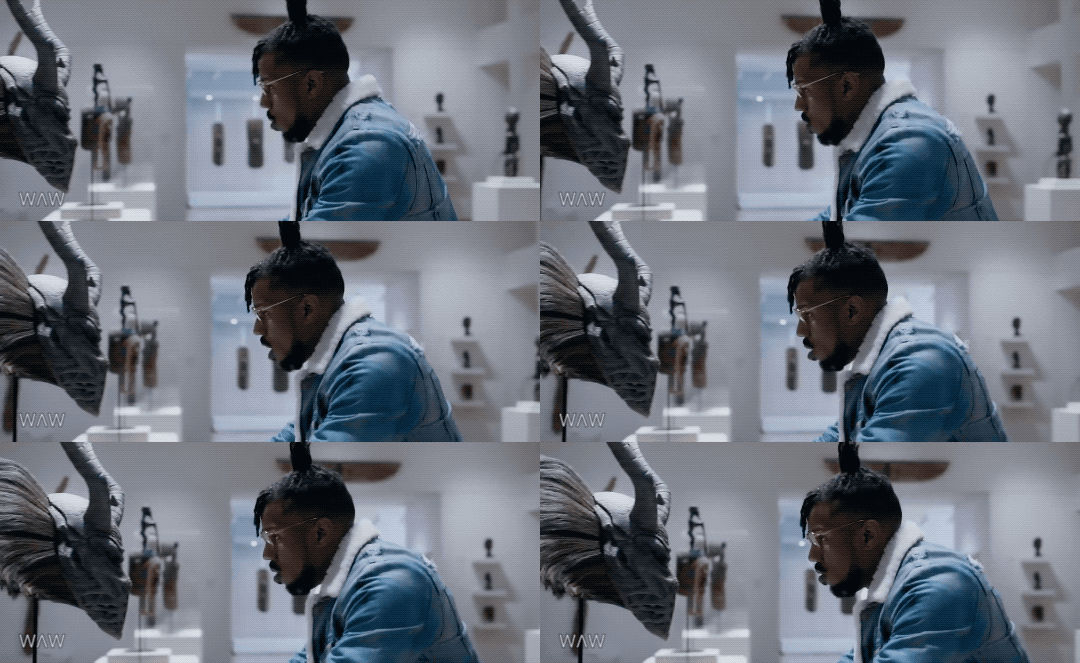
Killmonger: How do you think your ancestors got these? You think they paid a full price for it? Or did they take them like they took everything else?
I work in a museum- an old one- and during this scene I was nudging my brother the whole time. I clapped a little at that line. Museums need to rethink the way we curate things. If we aren’t elevating the heritage of those objects’ creators, if we aren’t telling their story, if we aren’t making those narratives accessible to the descendants and letting them lead, then what is even the point? Decolonize collections. Practice co-curation. Hire scholars of color, and make the collections accessible to visiting scholars. Involve the descendant community and elevate their voices, not the white colonial narrative.
And for goodness’ sakes, don’t run your museum like a jewellery shop. Have context. Honor the objects for their beauty, but remember that no object is as important as the people who created it.
Ummmm,, and like straight up, give things back? Indigenous communities in North America have campaigned for decades to have body parts, ceremonial items and sacred parts of our history returned to their communities.
Ofcourse, Hurd scholars of colour and think critically about your role. But like sometimes, you just have to give things back.
That’s repatriation (what I meant by “decolonize collections”) and it’s actually been federal law in America for almost thirty years. It’s been happening and will continue to happen, but it’s a LOT more complicated than just “give the stuff back.” Obviously you’re totally right- giving the stuff back is absolutely necessary.
But at the same time, giving ALL the old stuff back to Native groups doesn’t really work, either- for us OR for them. What happens to the stuff when it goes back? Do the modern Alaskan Athabascans really want the 1000+ baskets the museum I work at holds? (No, they don’t. We asked them. They definitely do not want those baskets back.) What about Native groups who don’t want remains back- the Navajo, for instance, believe that the remains of the dead are taboo objects, unclean and best left buried. And there are some Native groups who actually WANT their objects in museums. Not every object has a ritual context- sometimes a pot is just a pot. Even some ritual objects aren’t as spiritually important, and we’ve actually had people from different tribes come in and help rewrite language surrounding an object, or give instructions as to how it should be stored. Some groups really want us to display their cultural artifacts, because it reminds people that Native American cultures are alive and real.
One thing that works really well in a lot of cases is co-curation, which is when we commission and work with Native artists, leaders, and scholars to reframe the way we display objects. Like, recently, we asked Chris Pappan, who’s a Kanza artist, to come in and draw on the displays from the ‘30s. The juxtaposition of his art with the colonialist view of Native Americans has had a huge impact in visitor impressions- people go to that gallery now to learn and see what’s ACTUALLY happening today with Native Americans. This I think is how these institutions can use their power for good- elevating creator voices and letting them present their own past and own history. The Field does that a lot- we’ve had exhibitions from Rhonda Holy Bear, Bunky Echo-Hawk, and are continuing to work with Native Americans from many tribes to redesign and reframe the objects on display. We’re not doing this for social justice points- we’re doing this because the Field Museum gets something like 1.5+million visitors a year, and we owe it to the Native tribes we stole from to a.) tell their story b.) how they want it.
If you take all evidence of Native Americans out of the big natural history museums, you’re taking away representation- and education- and a lot of tribes actually don’t want that. What many groups want is the old colonial narratives to go away and be replaced with their own messaging and history. Native Americans are mythologized and what we did to them is sanitized in the US education system. I know that the person who responded is in Canada- and from what I hear, they’re even worse about destroying Native history and sanitizing what the colonists did (and continue to do) to them and their cultures. And this is where I think museums can actually HELP. People only care about things they’re familiar with. If the only image you have of a Native American is a racist football mascot, you’re not going to care about them as a culture- you’re not even going to see them as people. There’s a lot of white people who don’t believe in Native Americans. Like, they legit don’t think that there’s ANY Native groups left, and I know this because I’ve talked to these people at work. It’s baffling, how little Americans know about their own country’s behavior. And it’s totally a global problem- I could go on for days about what the British Museum Needs To Do With Those Fucking Marbles, Give Them Back You Cowards, You Have Enough Money To Ensure Their Care In Greece You’re Just Being Assholes- but I wanted to respond with a Native American context because of the person I’m replying to AND because… well, most Americans don’t know this, and they need to, because knowing about repatriation and why we do it is important.
Repatriation is so very vital, but it’s even more vital to listen to the Native American groups and ask them what they want to happen- as well as treat each tribe individually. We don’t hold onto Tlingit remains because the Navajo don’t want their remains back. Treating all tribes as identical is wrong- not as wrong as withholding their precious cultural traditions, relics, and remains- but if we’re even going to (as a museum industry) attempt to apologize for the atrocities we’ve sanctioned, the first thing we gotta do is ask people what they want.
And the next thing we gotta do is listen.
I’m starting to work in a Museum, and though my museum is about Natural Science something stuck le about all of this. The museum does not only exhibit but also safekeeps collections and in the introductory course we were given three keys to the basis of a museum: preservating, researching and exhibiting.
And one is worthless without the other. Our collections are meaningless if they aren’t available for investigation. It’s totally encouraged for scientists to come and use our collections. Granted, our collection mostly consists of dead animals, plants and fossils. And part of my own museum’s goal is orientated to reclaiming by mostly having our own collections as otherwise some of our best fossils are exhibited in museums in USA.
In our museum, all a scientists has to do is basically send an email to access the collection.
So what strikes me is that you point that one of the things to get better is “make the collections available to visiting scholars”. Is that not the case? Or is it specifically not available to scholars of color?
It REALLY varies from museum to museum! Some museums it’s really easy to get in- but others, it’s SO. MUCH. RED. TAPE. I had mine in mind when I was writing that, because collections access takes absolutely forever.
Anytime something is so precious that a culture wants it back but the museum wants it too, i bet you anything some artist would love the commission to duplicate it.
And sometimes that works out amazing.
The Field used to have this totem pole. There are many such poles in the museum, and others in museums around the world- but not all poles have the same significance- it depends on context. This pole, in particular, was a 26 foot tall pole that had been stolen from an “abandoned” Tlingit village- of course, the village wasn’t abandoned, and the people who lived there never consented to giving up their totem poles, and they rather wanted them back.
Anyways, the Field had one that was taken from the Cape Fox Tlingit back in 1899, and in 2001, we sent it home.
In 2002, the Cape Fox Tlingit gave the museum a log. A big one, a huge cedar log. They didn’t need to, but they did, and what the museum did with it was this:
A father-son team of Tlingit artisans- Nathan and Steven Jackson- were commissioned to design and create a new totem pole for the museum. They worked with the museum to create a totem pole that celebrated Tlingit traditions and the modern Tlingit people- a totem pole that combined ancient designs with modern ideas. It’s a gorgeous piece with an incredibly pertinent meaning- according to the Jacksons, the hybrid design illustrates the “refraction” or bending of traditional Tlingit culture that occurred during a turbulent history of cultural loss and recovery.
Which do you think tells you more about what it means to be Tlingit today?


 wupacing